 contact.paisamarket@gmail.com
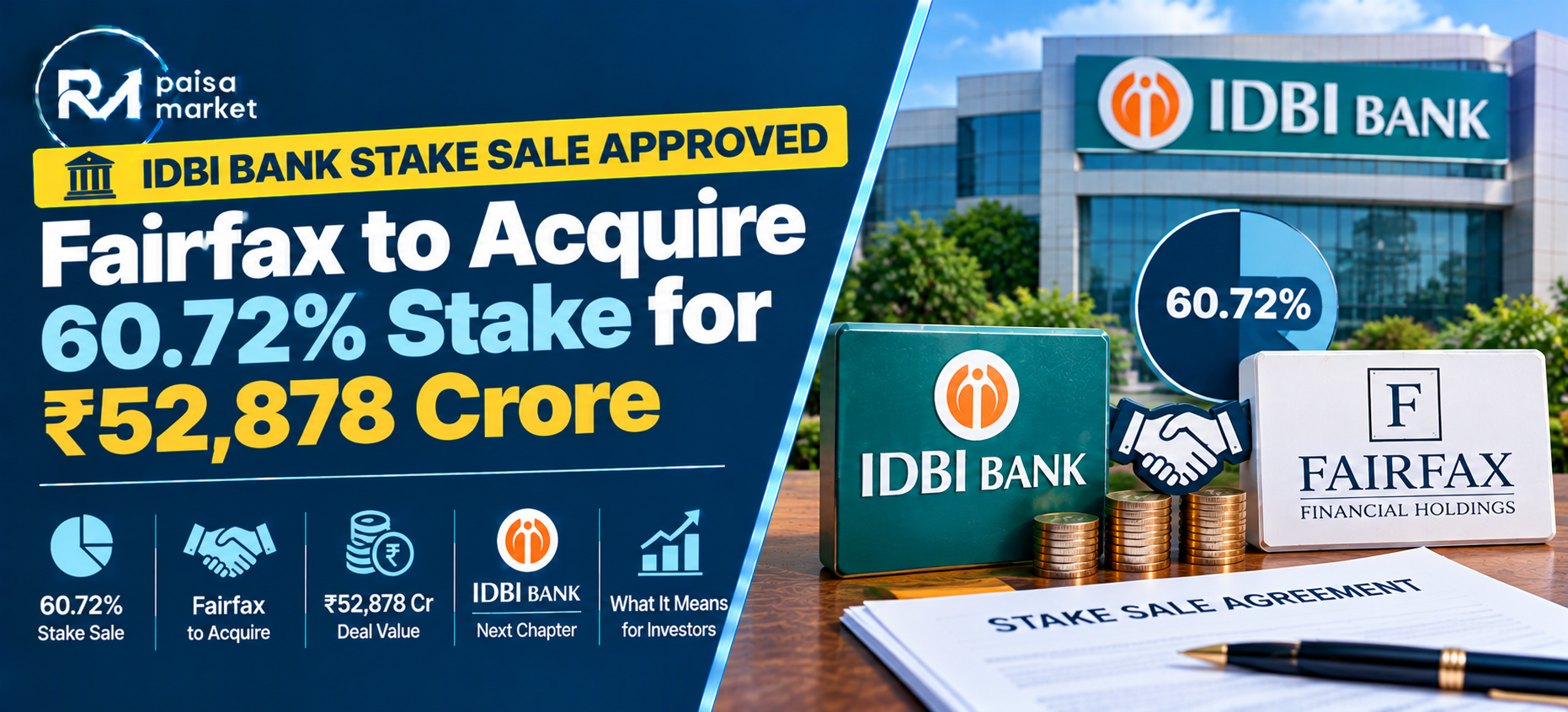
The Cabinet Committee on Economic Affairs has approved the long-pending strategic restructuring of IDBI Bank. Fairfax Financial Holdings, through its entity 10955230 Canada Inc., will acquire a combined 60.72% stake from the Government of India and LIC for ₹52,878 crore. This marks the largest foreign direct investment in India’s financial sector to date and transfers management control while leaving residual public ownership.
The move follows years of balance-sheet cleanup and positions the bank for private capital, technology upgrades and sharper competition in lending and deposits. For depositors, borrowers and minority shareholders, the immediate picture remains one of continuity under full RBI supervision.
What Exactly Has the Cabinet Approved in the IDBI Bank Deal?
Key Terms of the Fairfax Acquisition: Stake Size, Price & Valuation
Fairfax-backed 10955230 Canada Inc. will buy 60.72% of IDBI Bank’s equity at ₹81 per share. The total consideration is ₹52,878 crore. The winning bid stood above the government’s benchmark price of ₹75.99 per share and the fair-value estimates of two independent valuation agencies, which is why the offer was accepted as reasonable.
Who Is Selling – Government of India and LIC Breakdown
The Government of India will sell its 30.48% stake. LIC will sell its 30.24% holding. Together these stakes make up the 60.72% being transferred.
Residual Shareholding After the Deal (Govt 15%, LIC 19%)
After completion the government will retain 15% and LIC will hold 19%, giving the two entities a combined residual stake of 34%. Both will withdraw their nominee directors from the board and become public shareholders. The Cabinet has also empowered the Alternative Mechanism (headed by the Finance Minister) to sell the government’s residual 15% through the open market under the standard operating procedure. LIC will manage its residual holding in line with its own procedures and regulatory requirements, including bringing its stake down to 15% within two years to comply with RBI norms for non-promoter institutional holdings.
Why the Government Calls It “Strategic Restructuring” Instead of Full Privatisation
Because the government and LIC will continue to hold meaningful residual stakes, the transaction is described as strategic restructuring rather than complete privatisation. The intent is to transfer management control and bring in private capital and expertise while retaining a public-sector presence in the bank’s ownership structure.
Deal Timeline & How We Reached This Milestone
From 2021 Cabinet Nod to 2026 CCEA Approval – Full Journey
In-principle approval for strategic disinvestment came in May 2021 after IDBI Bank exited the RBI’s Prompt Corrective Action framework in March 2021. Expressions of interest were invited in October 2022. Five parties expressed interest; four were declared fit and proper. Two submitted financial bids. An earlier bidding round in FY 2025-26 fell short of the then-reserve price and was not approved. Fresh best-offer bids were invited in 2026, leading to the CCEA clearance on 14 October 2026.
Bidding Process, ₹81 Per Share Offer & Valuation Benchmark
The process was a two-stage competitive bidding exercise overseen by the Inter-Ministerial Group, the Core Group of Secretaries on Disinvestment and the Alternative Mechanism. Fairfax’s ₹81-per-share bid cleared the ₹75.99 benchmark and independent fair-value assessments.
Expected Closing Timeline and Remaining Approvals (RBI Fit & Proper, Open Offer)
The share-purchase agreement is expected to be signed and executed before the end of 2026, with the overall transaction targeted for completion within the current fiscal year. The successful bidder must submit credentials to the RBI for a fresh Fit-and-Proper assessment and provide a compliance roadmap. An open offer to minority shareholders will follow under SEBI regulations. Competition Commission of India and other statutory clearances are also required.
Who Is Fairfax Financial Holdings and Why It Matters
Prem Watsa’s Fairfax Track Record in India (Including CSB Bank)
Fairfax, led by Prem Watsa, already holds approximately 40% in CSB Bank (formerly Catholic Syrian Bank), which it acquired control of in 2018 and has since stabilised. The group has a long-standing presence in Indian financial services and is viewed as a patient, long-term investor.
Conditions on Fairfax: Promoter Lock-in, CSB Bank Merger/Exit Rule & Name Retention
Fairfax faces a lock-in on the acquired stake (reports indicate three to five years depending on the precise SPA terms). Under RBI rules that prohibit a single promoter from controlling two banks indefinitely, Fairfax must either merge CSB Bank with IDBI Bank or exit its CSB holding within two years of closing. The IDBI Bank brand name and logo are required to be retained for at least three years from the signing of the share-purchase agreement. Over the longer term Fairfax will be expected to dilute its promoter holding to 26% within the 15-year RBI framework.
Open Offer Obligation for Minority Shareholders
Fairfax will make an open offer to public shareholders at the same ₹81-per-share price (or the applicable SEBI-determined price). Minority shareholders can choose to tender or remain invested.
What the IDBI Bank Stake Sale Means for the Banking Sector
Largest FDI in India’s Financial Sector – Significance for the Industry
Once completed, the deal will be the biggest foreign direct investment ever recorded in India’s banking and financial sector. It signals confidence in the regulatory framework and the attractiveness of cleaned-up public-sector banking assets to global capital.
Boost to Private Capital, Technology & Management Practices
Private ownership is expected to bring fresh capital, modern technology platforms, stronger risk-management systems and more agile decision-making—areas where many public-sector banks have historically lagged.
Implications for Credit Growth, MSME Lending & Competition Among Banks
With stronger capital and private-sector incentives, IDBI Bank is likely to expand credit, particularly to MSMEs and retail borrowers. Increased competition should pressure other lenders on pricing, product innovation and customer service.
Signal for Future Public Sector Bank Disinvestments & Reforms
Successful execution of this transaction will strengthen the case for further strategic sales or residual stake dilutions in other public-sector banks, supporting the broader banking-sector reform agenda.
Impact on IDBI Bank Depositors – Safety, Continuity & Insurance
Deposit Insurance (DICGC) Coverage Remains Unchanged
Deposits continue to be insured by the Deposit Insurance and Credit Guarantee Corporation up to ₹5 lakh per depositor per bank (principal plus interest) in the same right and capacity. Ownership change does not alter this coverage.
Existing Deposit Accounts, Interest Rates & Terms of Service
All existing deposit accounts, contractual interest rates and terms of service remain in force. There is no automatic change to account numbers, IFSC codes or standing instructions.
Will Branch Network, Digital Banking or Customer Service Change?
Any future changes to branch network, digital offerings or service standards will be commercial decisions taken by the new management under RBI oversight. No immediate structural disruption is mandated by the stake sale itself.
What Depositors Should Watch After Ownership Transfer
Depositors should monitor communications from the bank on any product changes, revised interest-rate schedules for new deposits, and continuity of digital channels. The bank remains a scheduled commercial bank under continuous RBI supervision.
What Changes for Borrowers and Existing Loan Customers
Continuity of Loan Agreements and Floating Rate Terms
All existing loan agreements, including floating-rate reset clauses linked to external benchmarks or MCLR, continue unchanged. The ownership transfer does not rewrite signed contracts.
Potential Impact on Interest Rates, Processing Charges & New Product Offers
New management may refine pricing, processing fees and product suites over time. Existing borrowers will not face retrospective changes, but future sanction terms could reflect private-sector risk and return frameworks.
Credit Availability Under New Private Ownership
With stronger capital and private incentives, credit growth—especially in retail, MSME and priority-sector segments—is expected to improve, subject to RBI prudential norms and the bank’s internal risk appetite.
Implications for IDBI Bank Employees and Shareholders
Job Security and Management Transfer Assurances
No large-scale involuntary separation is indicated by the transaction structure. Management control will pass to the strategic buyer, and day-to-day operations will continue under the existing regulatory umbrella.
Minority Shareholders: Open Offer Price & Future Value
Public shareholders can participate in the open offer at ₹81 (or the SEBI-determined price). Those who retain shares will participate in any future value creation under private ownership, subject to market conditions and the bank’s performance.
Board Changes – Exit of Government & LIC Nominees
Government and LIC nominees will exit the board. The new board will be reconstituted in line with the strategic buyer’s nominees and independent directors, subject to RBI approval.
Financial Health of IDBI Bank Before the Deal
Turnaround Story – NPA Reduction, Capital Adequacy & Profitability
IDBI Bank’s recovery has been substantial. Gross NPAs fell from 31.78% in September 2018 to 2.32% in March 2026; net NPAs dropped from 17.30% to 0.15%. Capital adequacy ratio improved from 6.22% to 26.65% over the same period. The bank reported a record net profit of ₹9,513 crore in FY 2025-26. Total business crossed ₹6.27 lakh crore by end-September 2026, up about 18% year-on-year. Provision coverage has remained above 99% for an extended period.
Why the Bank Attracted Strong Bids After Years of Stress
Cleaned-up asset quality, robust capital buffers, healthy profitability and a diversified retail-heavy portfolio made the franchise attractive once the government decided to transfer management control.
Broader Economic & Policy Significance
Contribution to Government Disinvestment Target
The government’s share of the proceeds will meaningfully advance the disinvestment and asset-monetisation target for the current fiscal year.
Role in Attracting Foreign Investment into Indian Banking
The transaction demonstrates that large, regulated banking assets can successfully attract patient foreign strategic capital under India’s current FDI and ownership frameworks.
How This Fits into India’s Banking Sector Reform Agenda
It continues the shift from repeated capital support by the sovereign toward private ownership, better governance and market-driven growth—core elements of the post-2014 banking reform programme.
Key Risks, Regulatory Conditions & What Happens Next
RBI Approvals, Fit & Proper Assessment and Compliance Roadmap
The buyer must complete the RBI Fit-and-Proper process and submit a detailed compliance roadmap covering promoter shareholding dilution, CSB Bank resolution and other regulatory conditions.
Possible Challenges in Integration and Execution
Integration of systems (especially if CSB Bank is merged), cultural alignment, technology platform differences and any residual stressed assets will need careful management. Execution risk remains until closing.
Timeline for Share Purchase Agreement and Final Closing
Share-purchase agreement targeted before end-2026; full closing within the current fiscal year, subject to regulatory clearances and open-offer completion.
Frequently Asked Questions on IDBI Bank Fairfax Deal
Is My Money Safe in IDBI Bank After the Stake Sale?
Yes. The bank remains under full RBI supervision. Deposit insurance up to ₹5 lakh per depositor under DICGC continues unchanged.
Will IDBI Bank Remain a Scheduled Commercial Bank Under RBI Supervision?
Yes. Ownership change does not alter its status as a scheduled commercial bank or the intensity of RBI regulatory and prudential oversight.
What Happens to the Bank’s Name, Brand and Customer Relationships?
The IDBI Bank name and brand are to be retained for at least three years. Existing customer relationships, account numbers and contractual terms continue.
Can the Government Sell Its Remaining 15% Stake Later?
Yes. The Alternative Mechanism has been empowered to sell the residual government stake through the open market under the standard operating procedure.
How Does This Compare with Previous Bank Privatisations in India?
This is the largest banking FDI and the most significant transfer of management control in a major commercial bank in recent decades. Earlier examples (such as the privatisation of smaller or specialised entities) were of a different scale and structure. Residual public ownership distinguishes it from a complete exit.
Bottom Line – What Depositors, Investors and the Banking Sector Should Expect
For depositors and existing customers the immediate picture is continuity: insurance cover, contractual terms and RBI oversight remain intact. For the banking sector the deal injects private capital, technology and competitive pressure while signalling that cleaned-up public-sector banks can attract global strategic investors. Investors gain an open-offer exit option and potential upside from improved performance under private ownership. The successful closing of this transaction will be closely watched as a template for further banking-sector reforms and residual stake sales.
 Aakash Yadav