 contact.paisamarket@gmail.com
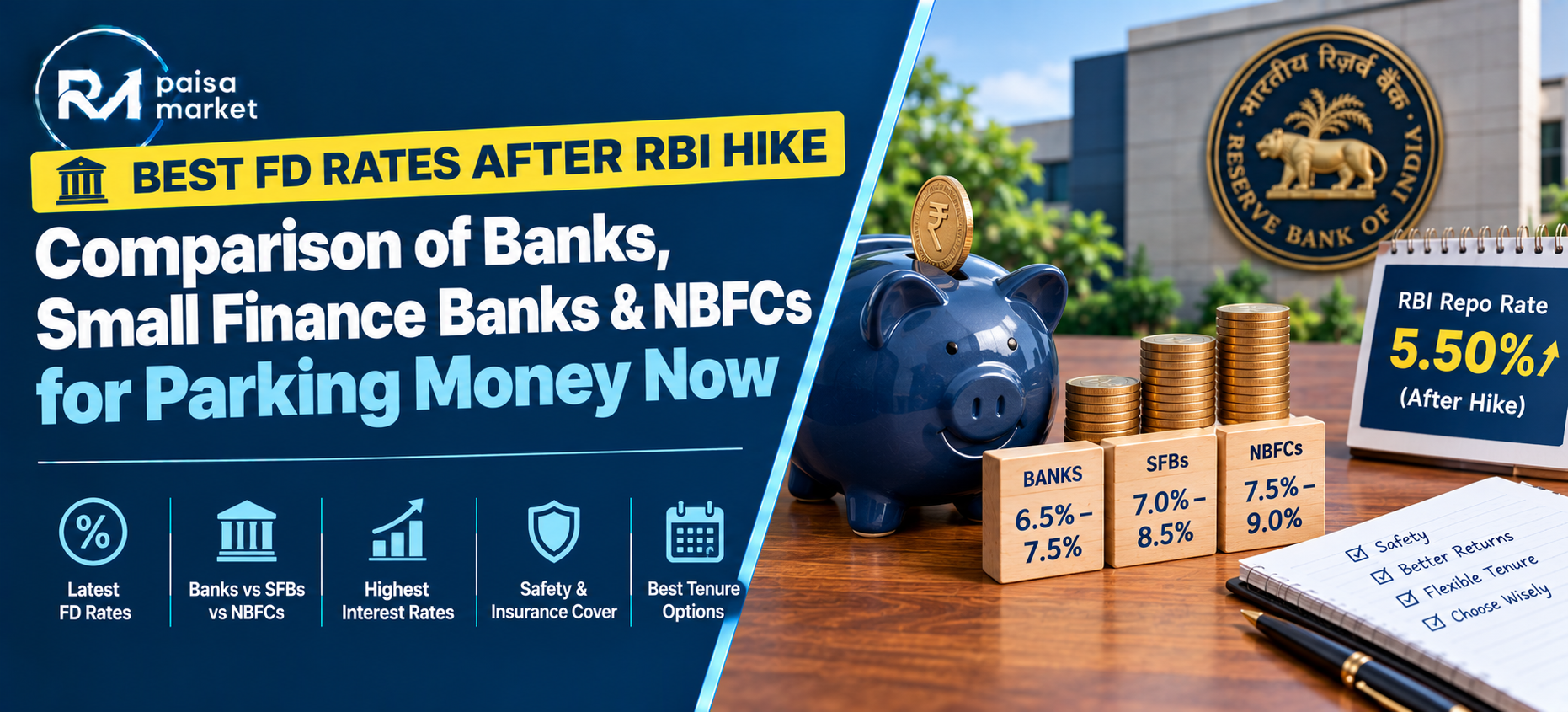
The RBI’s 25-basis-point repo rate hike to 5.50% has started influencing deposit rates. While large banks are still adjusting, small finance banks and some NBFCs already offer noticeably higher returns. Here’s a clear comparison of the best options available right now and where different types of investors should park their money.
Table of Contents
Best FD Rates Available Right Now After RBI Rate Hike
Interest rates vary widely depending on whether you choose a large bank, a small finance bank or an NBFC. The highest rates continue to come from smaller lenders, while big banks offer more modest returns but higher perceived safety.
Highest Rates from Small Finance Banks
Small finance banks are currently leading the rate chart. Several of them offer peak rates in the 8.00–8.25% range for regular depositors on select tenures, with senior citizens able to earn up to around 8.50% in some cases, as shown in recent comparisons of top FD rates from small finance banks after the RBI hike.
Highest Rates from NBFCs and Housing Finance Companies
Among NBFCs, Shriram Finance has revised rates upward effective 11 October 2026, with the highest rate now at 7.85% (8.35% for senior citizens) on 36–60 month deposits. Other NBFCs generally offer lower peaks than the top small finance banks.
Current Rates from Major Banks
Large public and private banks such as SBI, HDFC Bank, ICICI Bank, PNB and Bank of Baroda typically offer peak rates in the mid-6% range for regular depositors (roughly 6.25–6.70%). Senior citizens usually get an extra 0.50%. These rates are lower but come with the comfort of strong brand recognition and full DICGC cover.
Banks vs NBFCs vs Small Finance Banks – Quick Comparison
Choosing where to put money is not only about the interest rate. Safety, insurance cover and ease of access also matter.
Safety Level of Each Category
Large banks are generally viewed as the safest. Small finance banks are regulated by the RBI and have improved significantly over the years, but they are smaller institutions. NBFCs carry higher credit risk because they are not banks and do not have the same deposit insurance.
Interest Rate Difference
The gap is meaningful. Top small finance banks can offer 1.5–2 percentage points more than large banks on comparable tenures. NBFCs sit in between or slightly below the best SFB rates, depending on the issuer.
Deposit Insurance Coverage
Bank and small finance bank deposits are insured by DICGC up to ₹5 lakh per depositor per bank (including principal and interest). NBFC deposits do not have this insurance cover. This is one of the most important differences for conservative investors.
Top FD Rates from Banks After RBI Hike
Large banks have not yet fully passed on the repo rate hike to deposit rates, so their current offers remain moderate.
Best Rates from Public Sector Banks
Public sector banks generally offer peak rates around 6.45–6.70% for regular customers, with senior citizens getting about 0.50% extra. Special schemes or specific tenures sometimes push the rate slightly higher.
Best Rates from Private Banks
Private banks such as HDFC Bank, ICICI Bank and Axis Bank are in a similar range (around 6.25–6.70% peak). A few mid-sized private banks offer somewhat higher rates on selected tenures.
Best Rates from Small Finance Banks
This is where the highest rates are found. Several SFBs offer 8% or more on specific tenures. Senior citizens can earn up to 8.25–8.50% in some cases. These rates make SFBs the most competitive option for pure return seekers who are comfortable with the institutional profile.
Top FD Rates from NBFCs Right Now
NBFCs remain an option for investors willing to step outside the banking system for higher yields. Among NBFCs, Shriram Finance has revised rates upward effective 11 October 2026, with the highest rate now at 7.85% (8.35% for senior citizens) on 36–60 month deposits. Full details of the revision and whether it makes sense to lock money now are covered in our analysis of Shriram Finance’s FD rate hike to 7.85% from 11 October.
Shriram Finance, Bajaj Finance and Others
Shriram Finance’s revised rates (effective 11 October) take the highest offer to 7.85% for 36–60 months. Senior citizens can get 8.35%. Bajaj Finance and most other NBFCs currently offer lower peak rates than the top SFBs.
Extra Benefits for Senior Citizens
Most NBFCs and banks give senior citizens an additional 0.25–0.50%. In Shriram Finance’s case the extra is a full 0.50%, which makes the effective rate quite attractive for older investors.
Where Should You Park Money After the RBI Hike?
There is no single best answer — it depends on how much risk and liquidity you are comfortable with. For the most conservative portion of your portfolio, also compare government-backed options that continue to offer stable returns. Our update on the small savings interest rates for October–December 2026 including PPF, SCSS, Sukanya and NSC provides the complete picture.
Best Option for Maximum Safety
Stick to large public or private sector banks. You get DICGC insurance up to ₹5 lakh and the comfort of dealing with well-known institutions, even if the interest rate is lower.
Best Option for Higher Returns
Small finance banks currently offer the best combination of relatively high rates and deposit insurance. For investors who can accept slightly higher institutional risk, top SFBs are the strongest pure-return choice right now.
Balanced Approach for Most Investors
Many people split their money — keep a core amount in large bank FDs for safety and put a portion in higher-yielding SFB or select NBFC FDs to boost overall returns. This reduces concentration risk while still capturing better rates.
How Much Extra Can You Earn by Choosing Higher Rate FDs
The difference adds up meaningfully over time.
Example Comparison on ₹5 Lakh Investment
On a ₹5 lakh deposit for five years, the gap between a 6.50% large-bank rate and an 8.00–8.25% SFB rate can translate into several tens of thousands of rupees extra in interest (exact amount depends on compounding frequency). The longer the tenure, the bigger the absolute difference.
Impact of Tenure on Total Returns
Shorter tenures reduce the benefit of the higher rate but improve liquidity. Longer tenures lock in the higher yield but reduce flexibility if rates rise further or if you need the money early.
Important Safety Points Before Choosing NBFC or SFB FD
Higher returns always come with trade-offs.
Credit Rating You Must Check
For NBFCs, look for strong ratings (preferably AAA or equivalent from major agencies). Shriram Finance, for example, carries AAA ratings from multiple agencies. Avoid lower-rated issuers unless you fully understand the risk.
DICGC Insurance Limit of ₹5 Lakh
Remember that the ₹5 lakh insurance cover applies per depositor per bank (including all accounts). If you have more than ₹5 lakh, spread it across different banks to stay fully covered. NBFC deposits have no such cover.
Risk vs Return Trade-off
SFBs are regulated banks and carry DICGC cover, so they sit between large banks and NBFCs on the risk spectrum. NBFCs offer no insurance and rely entirely on the company’s financial strength.
Smart Strategy to Park Money After Rate Hike
A thoughtful approach usually works better than chasing the single highest rate.
Split Between Bank FD and Higher-Yield Options
Keep emergency and near-term money in large bank FDs or liquid funds. Deploy money you can lock for 1–5 years into higher-yielding SFB or carefully chosen NBFC FDs.
FD Laddering Idea for Better Liquidity and Returns
Divide your corpus into 3–4 FDs with staggered maturities (for example 1 year, 2 years, 3 years and 5 years). This way some money keeps becoming available regularly while part of the portfolio stays locked at higher longer-term rates.
Who Should Choose Bank FD and Who Can Go for NBFC/SFB
Match the product to your profile.
Ideal Choice for Conservative Investors
Large bank FDs remain the default for those who prioritise safety and simplicity above everything else.
Ideal Choice for Those Seeking Higher Returns
Investors with a moderate risk appetite and a clear time horizon can allocate a portion to top-rated small finance banks. Those comfortable with NBFC credit risk can consider AAA-rated names like Shriram Finance for the extra yield.
Senior Citizen Considerations
Senior citizens get additional interest across most institutions. The combination of higher base rates at SFBs plus the senior-citizen premium can be particularly attractive, provided the deposit stays within the insurance limit or is spread appropriately.
Practical Checklist Before Booking Any FD Now
A few quick checks will help you decide confidently.
Compare Latest Rates Across Categories
Look at large banks, small finance banks and one or two NBFCs for the exact tenure you need. Rates change, so verify on the official website or app before booking.
Check Premature Withdrawal Rules
Understand the penalty or revised interest rate if you need to break the FD early. This is especially important for longer tenures.
Verify Credit Rating and Insurance Cover
For SFBs confirm DICGC cover. For NBFCs check the latest credit ratings from CRISIL, ICRA, CARE or India Ratings.
Decide Tenure Based on Your Goal
Match the tenure to when you are likely to need the money. Avoid locking funds for five years if there is a realistic chance you will need them sooner.
Frequently Asked Questions
Which gives higher FD rates – banks or NBFCs?
Small finance banks currently offer the highest rates overall. Select NBFCs come next, while large banks offer the lowest but safest rates.
Are Small Finance Bank FDs safe after RBI hike?
SFBs are RBI-regulated banks and their deposits are covered by DICGC insurance up to ₹5 lakh per depositor per bank. They carry higher institutional risk than large banks but are generally considered reasonably safe for insured amounts.
Should I break existing bank FD for higher rates?
Only if the net gain after paying the premature withdrawal penalty is clearly positive and the new tenure fits your needs. Calculate the break-even carefully.
What is the safest high-return FD option right now?
Top-rated small finance banks offering 8%+ with DICGC cover currently give the best combination of higher returns and insurance protection.
How much extra do senior citizens get?
Most banks and NBFCs offer an additional 0.25–0.50% to senior citizens. In many cases the extra is a full 0.50%.
Final Recommendation – Best Place to Park Money After RBI Hike
After the RBI’s rate hike, small finance banks currently offer the most attractive combination of higher interest rates and deposit insurance. Large bank FDs remain the safest core holding, while select AAA-rated NBFCs such as Shriram Finance can be considered for a portion of the portfolio if you are comfortable with the absence of insurance cover.
A practical approach for most investors is to keep emergency and short-term money in large banks, use small finance banks for higher-yielding medium-term deposits (within the ₹5 lakh insurance limit per bank), and only then consider NBFCs for any additional allocation. Always match the tenure to your cash-flow needs, check premature withdrawal terms, and verify the latest rates before booking.

 Aakash Yadav