
 Aakash Yadav
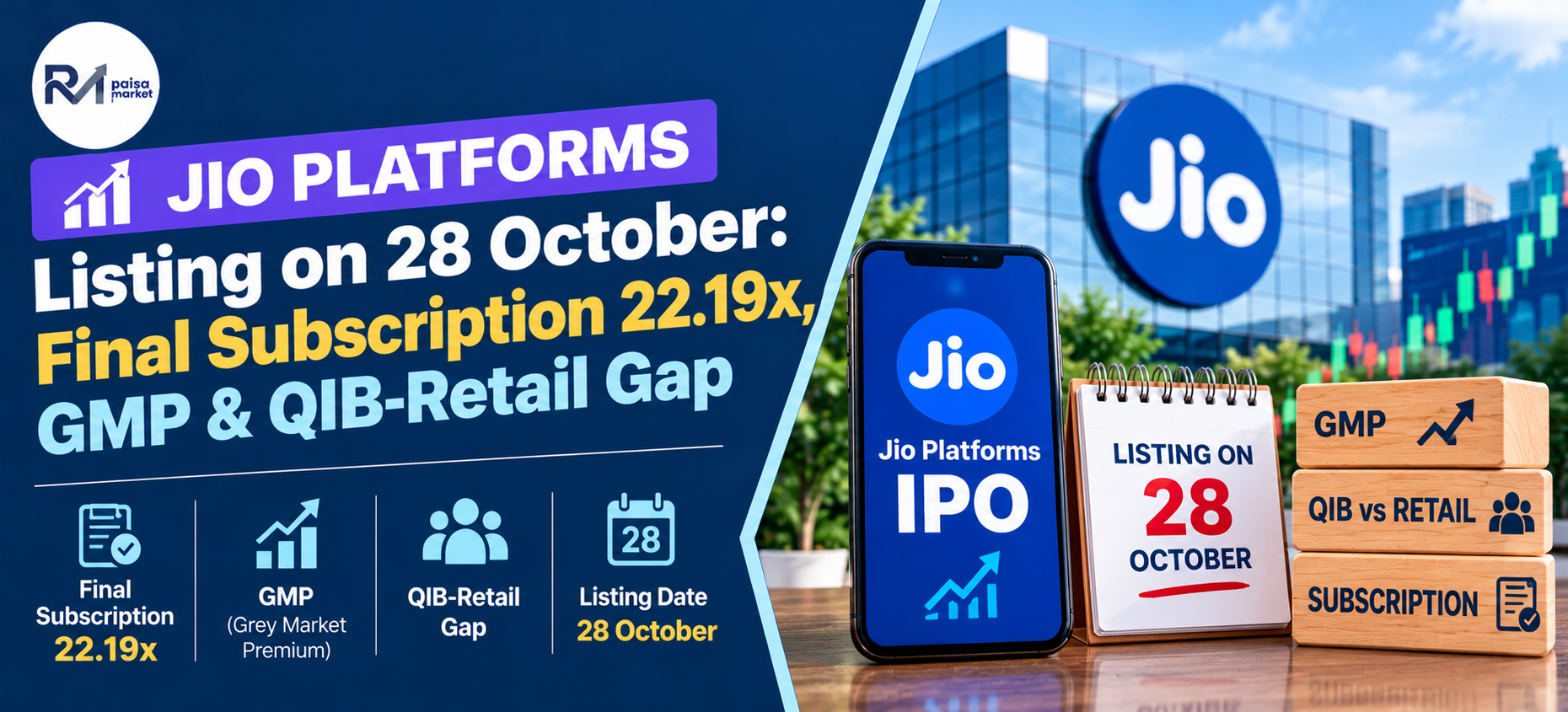
Jio Platforms’ ₹30,213 crore IPO closed on 23 October 2026 with a final subscription of 22.19 times. The most striking feature of the book was the sharp divergence between categories: Qualified Institutional Buyers (QIBs) subscribed more than 70 times their quota, while retail investors subscribed only about 2.72 times. Allotment is expected on 26 October and the shares are scheduled to list on 28 October.
This gap between institutional and retail demand, together with the prevailing grey market premium, is the key signal retail investors should understand before the stock begins trading. Here’s a clear breakdown of the final numbers, what they suggest about listing-day behaviour, and the practical steps you should take now.
Table of Contents
Jio Platforms IPO Final Subscription – The Big Numbers
The issue attracted strong overall demand, but the pattern across investor categories was uneven.
Overall Subscription at Close
By the close of bidding on 23 October, the IPO was subscribed approximately 22.19 times. Investors bid for roughly 438 crore shares against the 19.75 crore shares on offer. Detailed category-wise figures confirming the heavy institutional demand are available in Economic Times’ report on Jio Platforms IPO closing 22.19 times subscribed with QIBs at 70.55 times.
QIB vs Retail vs NII Category-Wise Breakdown
- Qualified Institutional Buyers (QIBs): 70.55 times
- Non-Institutional Investors (NIIs): 14 times (big NIIs above ₹10 lakh at about 15.9 times; smaller NIIs at about 10.2 times)
- Retail Individual Investors: 2.72 times
- Employee category: around 2.93 times
- Shareholder reservation: around 7.60 times
The institutional portion was therefore subscribed many times more aggressively than the retail portion.
What the Massive QIB-Retail Gap Signals
The difference between 70-times QIB demand and roughly 2.7-times retail demand is the most important takeaway from the subscription data.
Why Institutions Subscribed 67–70 Times
Large domestic institutions, foreign portfolio investors, banks, insurers and mutual funds showed very strong conviction. This level of oversubscription usually reflects confidence in the company’s scale, cash-flow potential and long-term position in India’s digital ecosystem. Institutions also had the benefit of detailed pre-IPO research and access to management discussions that retail investors typically do not.
Why Retail Demand Stayed Moderate at Around 2.7 Times
Retail investors were more measured. Several factors likely played a role, including the absolute size of the minimum investment and the valuation at the upper end of the price band. For the original analysis of the issue structure, lot size and the decision framework before bidding opened, see our earlier guide on whether retail investors should apply in the Jio Platforms IPO given the price band, lot size and grey market premium.
What This Divergence Means for Listing Day
When institutions dominate the book so heavily, listing-day volatility can be influenced by how those large investors choose to book profits or add further. Strong institutional support often provides a floor, but it does not guarantee a smooth upward trajectory. Moderate retail participation can sometimes reduce the intensity of immediate post-listing selling pressure that is common when retail is heavily oversubscribed.
Current GMP of Jio Platforms and Expected Listing Gain
The grey market continues to price in a meaningful premium.
Latest Grey Market Premium
As of 24 October, the grey market premium is being quoted in the range of roughly ₹243–₹250 per share over the upper price band of ₹1,119. This translates to an indicative premium of about 21–22%.
Indicative Listing Price and Gain per Lot
At a GMP of around ₹245, the indicative listing price would be near ₹1,364. On one lot of 12 shares, that would imply a notional gain of approximately ₹2,940 before costs, subject to the actual opening price on 28 October.
How Reliable Is GMP This Close to Listing
Grey market premiums are unofficial and can change quickly in the final days before listing. They reflect current demand-supply sentiment in an unregulated market and should be treated only as one input among many. Actual listing prices have often diverged from the last-traded GMP, sometimes significantly.
Allotment Status – When and How to Check
Expected Allotment Date – 26 October
The basis of allotment is expected to be finalised on 26 October 2026. Shares are likely to be credited to demat accounts on 27 October, with refunds for unsuccessful applications also processed around the same time.
How to Check Allotment on BSE, NSE or Registrar Website
You can check status on:
- The registrar’s website (KFin Technologies)
- BSE and NSE IPO allotment status pages
- Your broker’s app or net-banking portal
You will need your PAN, application number or DP ID / client ID.
What Happens If You Are Not Allotted
If you do not receive allotment, the blocked amount under UPI will be released. There is no further action required from your side. You can still buy the shares on the open market after listing if you wish.
Key Risks Retail Investors Should Watch Before Listing
Even with strong institutional demand, several factors remain relevant.
Valuation at the Upper End of the Price Band
The issue was priced at the upper end of the ₹1,065–₹1,119 band. At this valuation, the stock will need to deliver consistent growth and margin expansion to justify further upside after listing.
Parent Company and Broader Market Sentiment
Jio Platforms’ performance will be watched in the context of Reliance Industries’ overall strategy and the broader market mood. Any sharp correction in the larger market or in the telecom/digital sector could weigh on the stock in the initial weeks.
Telecom Tariff and Regulatory Overhang
Future tariff increases, competitive intensity and any regulatory developments in the telecom or digital services space will remain important variables for medium-term performance.
What to Do on Listing Day (28 October)
Strategy If You Get Allotment
Decide in advance whether you are investing for a quick listing gain or for a longer holding period. If your primary goal was listing gain and the stock opens at a healthy premium, many investors choose to book partial or full profits on day one. If you believe in the long-term digital story, you may prefer to hold through initial volatility.
Strategy If Shares Open with a Strong Premium
A strong opening does not always translate into sustained gains through the day. Watch the pre-open session and the first 30–60 minutes of trading for volume and price action before deciding.
When Holding for the Long Term May Make Sense
Investors with a multi-year horizon who are comfortable with the valuation and the competitive landscape may choose to hold regardless of the listing-day move. In that case, the listing premium becomes less important than the company’s ability to grow earnings over time.
Practical Checklist for Allottees and Applicants
- Check allotment status on 26 October via the registrar, BSE, NSE or your broker.
- Track the latest GMP and pre-open indications on 27–28 October, but treat them as indicative only.
- Decide your exit or hold plan before the market opens on 28 October, based on your risk appetite and investment horizon.
- Keep funds or margin available if you plan to buy additional shares on listing day.
- Avoid last-minute emotional decisions driven solely by the opening price.
Frequently Asked Questions on Jio Platforms Listing
What was the final subscription of Jio Platforms IPO?
The IPO was subscribed approximately 22.19 times overall. QIBs subscribed 70.55 times, NIIs 14 times and retail investors 2.72 times.
Why was QIB demand so much higher than retail?
Institutions showed strong conviction in the company’s scale and long-term potential, while retail investors appear to have been more cautious on valuation and ticket size.
What is the current GMP?
The grey market premium is currently quoted around ₹243–₹250, implying an indicative premium of roughly 21–22% over the upper price band of ₹1,119. GMP is unofficial and can change.
When will allotment status be available?
Allotment is expected to be finalised on 26 October 2026. You can check status on the registrar’s website, BSE, NSE or your broker’s platform.
Should I sell on listing day or hold?
There is no single correct answer. It depends on whether your goal was a listing gain or a longer-term investment, your risk tolerance, and how the stock behaves in the opening session. Decide your approach before the market opens rather than in the heat of the moment.
Final Takeaway – What the QIB-Retail Gap and GMP Mean for You
The Jio Platforms IPO closes with very strong institutional backing and more moderate retail participation. The 70-times QIB subscription signals confidence among large professional investors, while the 2.7-times retail figure shows that many individual investors remained measured on valuation.
The current grey market premium points to a healthy listing-day gain, but GMP is only an indication and can shift. Allotment results on 26 October will tell you whether you have shares to trade or hold on 28 October.
The practical approach is straightforward: check your allotment, review the latest pre-listing indications, and enter listing day with a clear plan based on your own risk appetite and time horizon. The QIB-retail gap and the GMP together suggest a well-supported but not frenzy-driven listing — a situation that rewards preparation more than last-minute speculation.