
 contact.paisamarket@gmail.com
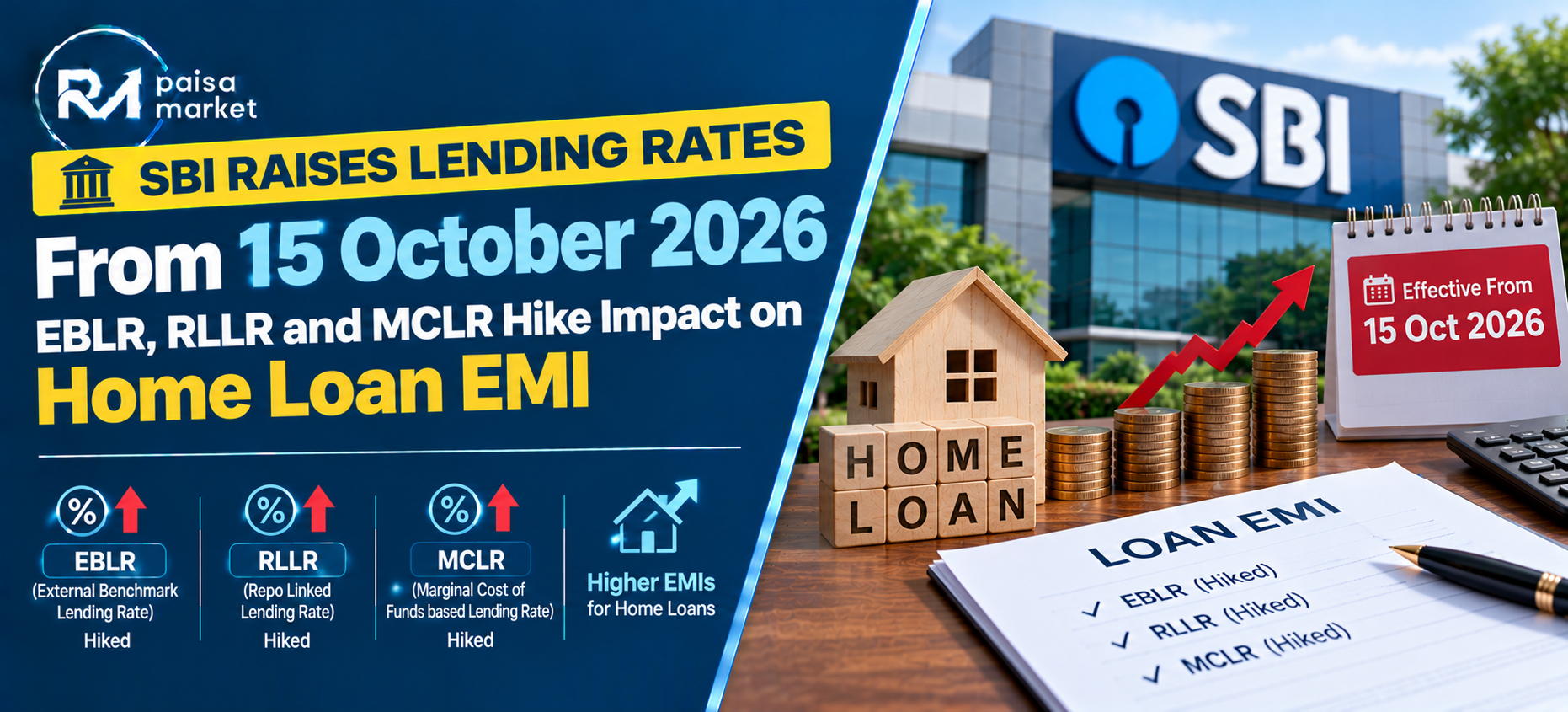
State Bank of India has revised its key lending rates with effect from 15 October 2026, following the RBI’s recent 25-basis-point repo rate hike. The bank has increased its External Benchmark Linked Rate (EBLR) and Repo Linked Lending Rate (RLLR) by 25 basis points, and raised the Marginal Cost of Funds Based Lending Rate (MCLR) by 15 basis points on several tenures.
If your home loan or personal loan is linked to any of these benchmarks, your interest rate and eventually your EMI is set to rise. The exact impact depends on the type of loan, the benchmark it is linked to, and your next interest reset date. Here’s a clear, practical guide to what has changed and what you should do.
Table of Contents
SBI Raises Lending Rates from 15 October 2026 – What Has Changed
State Bank of India has revised its key lending rates with effect from 15 October 2026, following the RBI’s recent 25-basis-point repo rate hike. The bank has increased its EBLR and RLLR by 25 basis points and raised MCLR by 15 basis points on several tenures, as detailed in reports on SBI revising EBLR, RLLR and MCLR rates effective 15 October.
MCLR Hike Across Key Tenures
The bank has raised MCLR by 15 basis points on tenures ranging from three months to three years. Overnight and one-month MCLR have been left unchanged at 7.85%.
Changes in EBLR and RLLR
EBLR has been increased by 25 basis points to 8.15% + CRP + BSP. RLLR has also been raised by 25 basis points to 7.75% + CRP. These are the benchmarks used for most home loans sanctioned in recent years.
Which Rates Remain Unchanged
Overnight and one-month MCLR stay at 7.85%. Fixed-rate loans are not affected by these revisions.
New SBI MCLR Rates Effective 15 October
The revised MCLR structure is now live. The one-year rate is particularly important because many older floating-rate loans are still linked to it.
Complete Tenure-Wise Rate Chart
| Tenure | Earlier MCLR | Revised MCLR (from 15 Oct) |
|---|---|---|
| Overnight | 7.85% | 7.85% |
| One Month | 7.85% | 7.85% |
| Three Months | 8.25% | 8.40% |
| Six Months | 8.60% | 8.75% |
| One Year | 8.70% | 8.85% |
| Two Years | 8.75% | 8.90% |
| Three Years | 8.80% | 8.95% |
One-Year MCLR – Most Relevant for Home Loans
The one-year MCLR has moved from 8.70% to 8.85%. Borrowers whose home loans are still linked to the one-year MCLR will see a 15-basis-point increase in their interest rate at the next reset.
How SBI’s Rate Hike Affects Home Loan EMIs
The impact is not uniform. It depends on whether your loan is linked to MCLR or to an external benchmark (EBLR/RLLR), and on when your interest rate is next due for revision.
This follows the broader trend of banks passing on the RBI’s repo rate hike. For a wider view of how other lenders have already revised rates and when EMIs typically rise, see our earlier analysis of banks starting to raise home loan rates after the RBI hike.
Impact on Existing Floating-Rate Home Loans
- Loans linked to EBLR or RLLR will typically see a 25-basis-point rise in the interest rate.
- Loans still linked to MCLR will see a 15-basis-point rise (if the relevant tenure has been revised).
- Fixed-rate home loans remain unaffected.
Approximate EMI Increase on ₹30 Lakh, ₹50 Lakh and ₹75 Lakh Loans
On a 20-year remaining tenure, a 25-basis-point increase roughly translates to:
- ₹30 lakh outstanding → about ₹400–₹450 extra per month
- ₹50 lakh outstanding → about ₹650–₹750 extra per month
- ₹75 lakh outstanding → about ₹1,000–₹1,100 extra per month
A 15-basis-point MCLR-linked increase would be proportionately lower (roughly 60% of the above figures).
Example Calculation of Extra Monthly Outgo
Take a borrower with ₹50 lakh outstanding at 8.50% and 20 years left. The approximate EMI is around ₹43,390. After a 25-basis-point rise to 8.75%, the EMI moves to roughly ₹44,100 — an increase of about ₹710 per month. Over the remaining tenure, the extra interest cost adds up to a meaningful amount.
Impact on Personal Loan EMIs
Personal loans are usually shorter in tenure and often linked to MCLR or other internal benchmarks, though some newer ones may be linked to external benchmarks.
Which Personal Loans Will See Higher Interest
Floating-rate personal loans linked to the revised MCLR tenures or to EBLR/RLLR will see an increase. Fixed-rate personal loans are not affected.
Expected Rise in Monthly Instalment
Because personal loan tenures are shorter (typically 1–5 years), the absolute EMI increase is smaller than on long-tenure home loans, but the percentage impact on the monthly outflow can still be noticeable.
When Will the Higher EMI Actually Hit Your Account?
A rate hike by the bank does not automatically change your EMI the next day. The new rate is applied only on your loan’s next reset date.
Role of Interest Rate Reset Date
Every floating-rate loan has a reset clause. On the reset date, the bank applies the latest applicable benchmark rate (plus your spread) to the outstanding principal.
Typical Lag Between Rate Revision and EMI Change
Depending on when your last reset occurred, you may see the higher rate applied anywhere from a few weeks to a few months after 15 October. Some borrowers will feel the impact in November or December; others may see it only in early 2027.
How to Find Your Next Reset Date in SBI YONO or Statement
Log in to the YONO app or internet banking, open your loan account details, and look for the interest rate reset frequency or next review date. It is also usually mentioned in the original sanction letter and in recent loan statements. If you cannot locate it, call SBI customer care or your relationship manager.
What Existing SBI Borrowers Should Check Right Now
A few quick checks will tell you exactly where you stand.
Current Interest Rate and Benchmark (MCLR / EBLR / RLLR)
Note the exact interest rate you are paying and whether the loan is linked to MCLR, EBLR or RLLR. This determines whether you face a 15 bps or 25 bps increase.
Outstanding Loan Amount and Remaining Tenure
These two numbers decide how much the EMI (or the tenure) will change. Keep them ready when you run calculations or speak to the bank.
Whether EMI or Tenure Has Already Been Adjusted
Some borrowers may already have seen an automatic adjustment. Check your latest EMI amount and compare it with the previous one.
Options If the Higher EMI Feels Tight
You are not without choices if the increased EMI strains your monthly budget.
Request for Tenure Extension Instead of EMI Increase
Many borrowers prefer to keep the EMI unchanged and extend the loan tenure. This reduces the immediate burden but increases the total interest paid over the life of the loan. SBI usually allows this option on request.
Part-Prepayment to Reduce Future Impact
If you have surplus funds, making a part-prepayment reduces the outstanding principal. The same interest rate on a smaller principal results in a lower EMI or a shorter remaining tenure.
Switching the Loan to Another Bank or Product
A balance transfer to another lender offering a lower rate is possible, but you must factor in processing fees, legal charges, and any lock-in conditions. Calculate the net saving carefully before switching.
MCLR-Linked vs EBLR/RLLR-Linked Loans – Key Difference
Understanding which benchmark your loan follows is essential.
How Transmission Works in Each Case
EBLR and RLLR are external benchmarks linked to the RBI repo rate. Changes in the repo rate are transmitted more directly and usually faster. MCLR is an internal benchmark based on the bank’s cost of funds, so transmission can be slower and the quantum of change may differ.
Which Type of Loan Is More Affected by This Hike
Loans linked to EBLR or RLLR face the full 25-basis-point increase. MCLR-linked loans face a 15-basis-point increase on the revised tenures. Newer home loans are predominantly linked to external benchmarks, so most recent borrowers will see the larger 25 bps impact.
Practical Checklist for SBI Home Loan & Personal Loan Borrowers
A short checklist will help you stay in control.
Log in to YONO or Net Banking Today
Check the latest interest rate, outstanding amount, and any communication about rate revision.
Note Down Current Rate and Reset Date
These two details determine when and how much your EMI will change.
Calculate Possible EMI Increase
Use SBI’s EMI calculator or any reliable online tool. Input the new expected rate and see the difference.
Contact Relationship Manager If Needed
If the higher EMI will stretch your budget, discuss tenure extension or part-prepayment options early.
Frequently Asked Questions on SBI Rate Hike
By how much has SBI increased MCLR from 15 October?
SBI has raised MCLR by 15 basis points on three-month to three-year tenures. Overnight and one-month rates remain unchanged at 7.85%. The one-year MCLR is now 8.85%.
Will my home loan EMI rise immediately?
No. The higher rate applies only from your loan’s next interest reset date. Until then, your current EMI continues.
How much extra EMI on a ₹50 lakh home loan?
On a ₹50 lakh outstanding amount with around 20 years remaining, a 25-basis-point increase typically raises the EMI by roughly ₹650–₹750 per month. The exact figure depends on the precise outstanding amount and remaining tenure.
Does this hike affect fixed-rate loans?
No. Fixed-rate loans are not linked to MCLR, EBLR or RLLR, so they remain unaffected by this revision.
Can I ask SBI to keep the same EMI and extend tenure?
Yes. Most banks, including SBI, allow borrowers to keep the EMI unchanged and extend the loan tenure when interest rates rise. You need to make a formal request.
Summary – What SBI’s Lending Rate Hike Means for Your EMIs
From 15 October 2026, SBI has raised its EBLR and RLLR by 25 basis points and its MCLR by 15 basis points on key tenures. Borrowers with floating-rate home loans and personal loans linked to these benchmarks will see their interest rates rise at the next reset date.
The EMI increase is manageable for most borrowers but still worth preparing for. Check your current benchmark, outstanding amount and next reset date without delay. If the higher EMI feels uncomfortable, explore tenure extension or part-prepayment. Fixed-rate loans remain untouched.
Staying informed and acting early is the simplest way to manage the change smoothly.

 Aakash Yadav