 Aakash Yadav
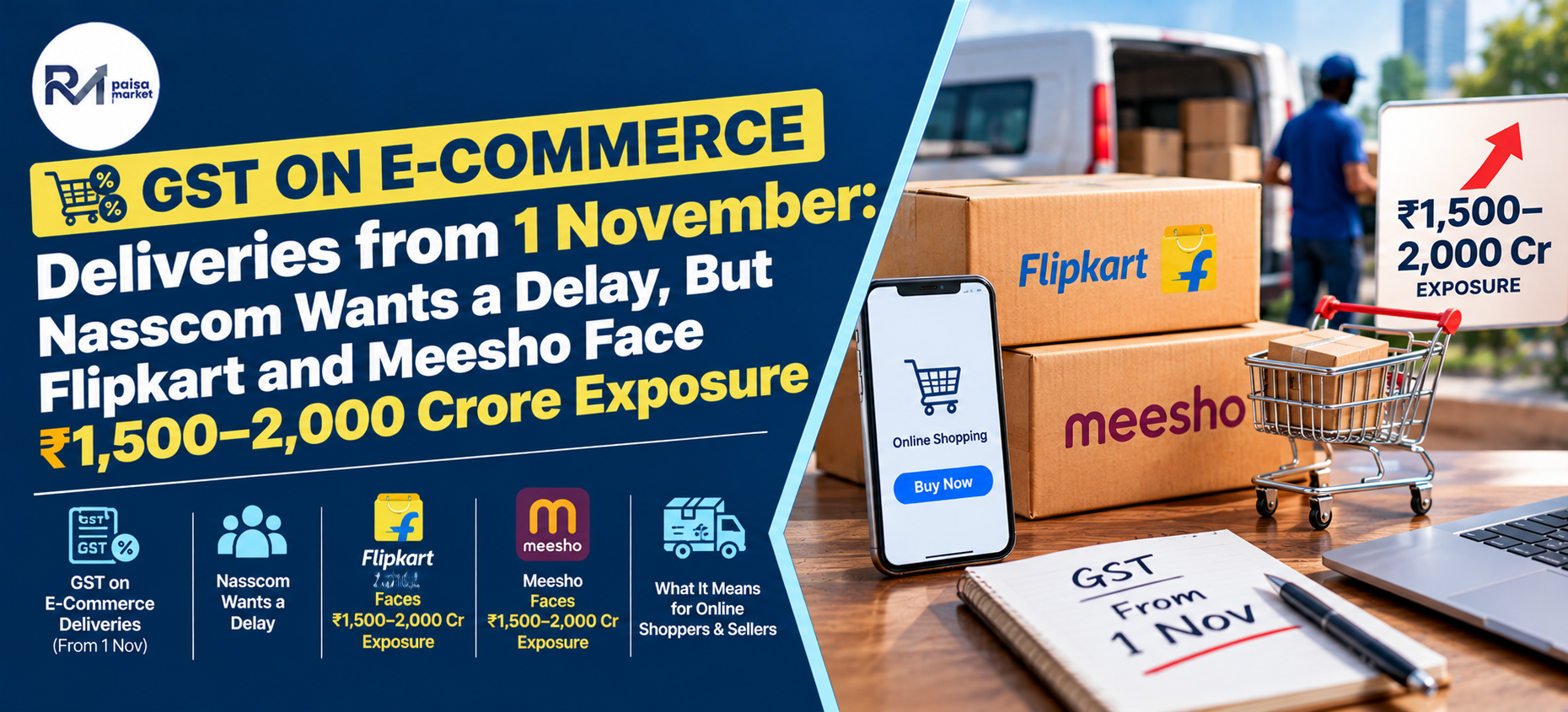
From 1 November 2026, every delivery of goods ordered through an e-commerce platform will attract a uniform 5% GST without input tax credit. The change ends the earlier Goods Transport Agency exemption that some platforms had been using and shifts liability clearly onto the platforms in many cases.
Nasscom has already written to the Finance Ministry seeking a deferment to 1 January 2027, arguing that companies need more time to reconfigure systems. Meanwhile, estimates suggest Flipkart’s logistics arm Ekart alone could face an annual exposure of ₹1,500–2,000 crore. Meesho’s Valmo is also significantly affected. Amazon, which was already paying a higher rate with credit, may see a different net impact.
This article explains exactly what is changing, why the industry is pushing back, who stands to lose the most, and what shoppers and sellers should expect in the coming days.
Table of Contents
What Exactly Changes for E-Commerce Deliveries from 1 November 2026
The GST Council, at its 57th meeting on 8 October, decided to bring uniformity to the tax treatment of deliveries linked to online orders. The same meeting also delivered major enforcement reforms, including the removal of arrest powers and the raising of the prosecution threshold. For the complete set of decisions taken that day, see our detailed coverage of the 57th GST Council’s key reforms on arrest powers, prosecution limits and process changes.
Until now, the tax treatment depended heavily on how a platform structured its logistics. Some claimed the Goods Transport Agency exemption through their captive logistics arms. Others paid 18% GST and claimed input tax credit. From 1 November, that variation ends.
5% GST Without Input Tax Credit on Delivery Services
A flat 5% GST will apply on delivery services for goods ordered through e-commerce platforms. Importantly, no input tax credit will be available on this tax. The lower rate is offered only on the condition that credit is not claimed. This removes the earlier incentive to structure deliveries in ways that maximised credit or claimed exemptions.
Who Pays the Tax – Platform or Delivery Person
Where the actual delivery person or small logistics provider is not required to be registered under GST (most individual riders and many small operators fall in this category), the e-commerce platform itself becomes liable to pay the 5% tax under Section 9(5) of the CGST Act. Where the delivery service provider is registered, that provider pays the tax at 5% without ITC. In practice, the bulk of last-mile deliveries will see the platform discharging the liability.
End of the Goods Transport Agency (GTA) Exemption
The earlier route of claiming GTA exemption through in-house logistics arms has been closed for these deliveries. This is the provision that platforms such as Flipkart (through Ekart) had relied on for a large share of their volume. The removal of this exemption is the single biggest reason the financial impact is concentrated on certain players.
Why Nasscom Is Seeking a Deferment
On 28 October, Nasscom submitted a formal representation to the Ministry of Finance requesting that the new rules be deferred to 1 January 2027. The industry body has also asked for a structured consultation with platforms and logistics providers before the final rollout. Full details of the request and the estimated impact on platforms are covered in Financial Express’s report on Nasscom seeking more time to implement the revised GST rules on e-commerce deliveries.
Operational and Systems Challenges for Platforms
E-commerce companies process millions of delivery transactions every day through tightly integrated technology stacks. Changing the tax treatment requires updates to ERP systems, invoicing logic, tax calculation engines, input-credit accounting, and GST return processes. Nasscom has pointed out that these are not simple rate changes; they require testing across the entire order-to-cash and logistics chain to avoid errors in customer invoices or compliance filings.
Request for Implementation from 1 January 2027
The body has specifically asked for a two-month extension so that companies can complete the necessary technology, accounting and operational changes in an orderly manner. Given that the notification itself came only days before the proposed start date, the request for breathing room is understandable from an implementation standpoint.
Call for Industry Consultation Before Rollout
Nasscom has also urged the government to hold discussions with electronic commerce operators and logistics providers. The aim is to clarify residual ambiguities, align on documentation requirements, and reduce the risk of inconsistent application across platforms in the early weeks.
Who Gets Hit Hardest – Flipkart, Meesho vs Amazon
The financial impact is not uniform. It depends on how each platform was taxing deliveries until now.
Flipkart and Ekart Estimated Exposure of ₹1,500–2,000 Crore
Flipkart has routed a very large share of its deliveries (industry estimates put it at 85–90%) through its captive logistics arm Ekart and claimed the GTA exemption. With that exemption removed and a 5% tax without credit now applying, the annual incremental cost is estimated in the range of ₹1,500–2,000 crore. This is the most frequently cited figure in recent reporting and represents a material hit to the cost structure.
Meesho and Valmo Position
Meesho’s logistics arm Valmo handles a substantial portion of the platform’s orders (around half, according to sources). Because Valmo also operated under a structure that benefited from the earlier treatment, Meesho faces a meaningful increase in delivery-related tax cost. The exact number is smaller than Flipkart’s in absolute terms but still significant relative to Meesho’s scale and margins.
Why Amazon May Face a Lower Effective Rate
Amazon has generally been paying 18% GST on deliveries and claiming input tax credit. Moving to a 5% rate without credit produces a different arithmetic. While the headline rate falls, the loss of credit on inputs (fuel, vehicles, warehousing, etc.) means the net saving is limited. In some analyses, the effective cost may not decline dramatically and could even rise slightly depending on the credit previously claimed. The relative impact on Amazon is therefore expected to be milder than on platforms that were fully in the exemption zone.
What This Means for Consumers and Delivery Fees
The immediate question for shoppers is whether delivery charges will rise.
Likelihood of Higher Delivery Charges
Platforms facing a sudden increase in tax cost will look to recover at least part of it. This can happen through higher delivery fees on certain pin codes or order values, tighter free-delivery thresholds, or adjustments in the overall pricing algorithm. Not every order will see an immediate jump, but the direction of travel is towards higher logistics costs being passed on over time.
Possible Platform Pricing Adjustments
Some platforms may absorb the cost temporarily to protect conversion rates, especially during the ongoing festive season. Others may adjust more quickly. Sellers who bear part of the logistics cost under certain commercial arrangements could also see revised rate cards.
Short-Term Impact on Online Shopping Costs
In the next few weeks, consumers are most likely to notice changes in free-delivery eligibility and small increases in paid delivery charges rather than a uniform hike across the board. The full effect will become clearer once platforms complete their system changes and decide how much of the new tax to absorb versus pass through.
Can the Deferment Request Succeed Before 1 November?
With only a couple of days left before the notified date, the window for a formal deferment is extremely tight.
Timeline Left for Government Response
The rules were notified on 27 October and are scheduled to take effect on 1 November. Nasscom’s representation was submitted on 28 October. Any decision to defer would need to be taken and communicated almost immediately to give companies meaningful relief.
Factors That Could Influence a Delay Decision
The government has in the past granted short transition windows when industry-wide system changes were required. The fact that the notification itself came close to the effective date strengthens the case for some breathing room. At the same time, the GST Council’s recommendation has already been accepted and notified, so a deferment is not automatic. Clarity in the next 48–72 hours will be decisive.
What to Watch in the Next 72 Hours
The situation remains fluid.
Any Official Response to Nasscom’s Representation
The most important signal will be whether the Finance Ministry or CBIC issues any clarification, FAQ, or formal deferment order. Silence would mean the 1 November date holds.
Platform Communications to Sellers and Customers
Watch for emails or app notifications from Flipkart, Meesho, Amazon and others explaining how delivery charges or seller rate cards will change. These communications will reveal how each platform intends to handle the cost.
Clarity on Invoicing and Compliance Requirements
Platforms and their tax advisors will be looking for confirmation on exact invoicing formats, place-of-supply rules, and how the Section 9(5) liability is to be reported in returns. Any FAQ or circular on these points will reduce implementation friction.
Practical Takeaway for Shoppers and Sellers
What Online Shoppers Should Expect on Delivery Charges
Do not assume delivery will remain as cheap as it was last month. Free-delivery thresholds may tighten and paid delivery fees may edge up on some orders. Comparing final payable amounts (including delivery) across platforms before placing an order will be more useful than before.
What Sellers on Major Platforms Need to Track
Sellers should watch for revised logistics rate cards or changes in how delivery costs are shared. Those who use platform logistics heavily should model the potential impact on their margins. Keeping an eye on official communications from the platforms in the first week of November is essential.
How to Stay Updated Before the Rule Kicks In
Follow announcements from the CBIC, GST portal, and the major platforms. Nasscom’s request is public; any government response will also be public. In the absence of a deferment, assume the 5% without ITC regime applies from 1 November and plan accordingly.
Frequently Asked Questions on GST for E-Commerce Deliveries
What is the new GST rate on e-commerce deliveries from 1 November?
A uniform 5% GST without input tax credit will apply on delivery services for goods ordered through e-commerce platforms.
Why is Nasscom asking for a delay?
The industry body has cited the need for significant changes to technology systems, invoicing, tax calculations and compliance processes, and has requested time until 1 January 2027 along with stakeholder consultation.
Which platforms face the highest financial impact?
Flipkart (through Ekart) faces the largest estimated exposure at ₹1,500–2,000 crore annually because it had relied heavily on the GTA exemption. Meesho’s Valmo is also materially affected. Amazon’s net impact is expected to be lower.
Will delivery fees rise for customers?
It is likely that platforms will pass on at least part of the additional tax cost over time, either through higher delivery charges or tighter free-delivery thresholds. The exact timing and extent will vary by platform.
Has the government responded to the deferment request?
As of 29 October 2026, no formal deferment has been announced. The rules remain scheduled for 1 November unless the government issues a fresh notification.
Final Outlook – Will the 1 November Deadline Hold?
The new 5% GST without input tax credit on e-commerce deliveries is designed to create uniformity and close the earlier exemption route. Nasscom’s request for a deferment to January 2027 is reasonable from an implementation perspective, given how late the notification arrived. Whether the government grants that request in the remaining hours will determine if companies get breathing room or have to scramble.
For now, the prudent assumption is that the 1 November date holds. Platforms that were using the GTA exemption face a clear cost increase, with Flipkart’s exposure estimated in the ₹1,500–2,000 crore range. Consumers should prepare for the possibility of higher delivery charges, and sellers should track platform communications closely.
The next 72 hours will tell us whether the deadline is extended or whether the new tax regime begins as notified.
 contact.paisamarket@gmail.com