 contact.paisamarket@gmail.com
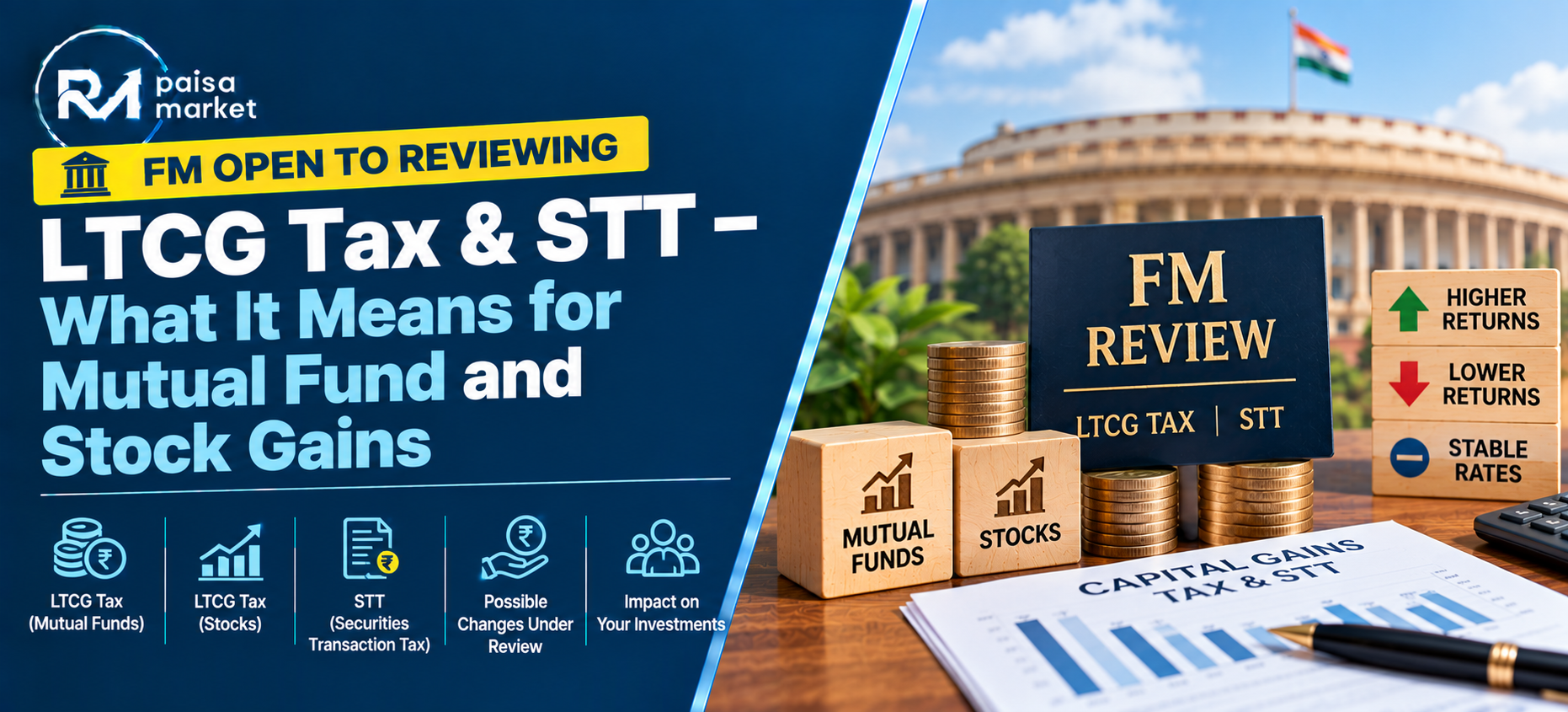
On 13 October 2026, Finance Minister Nirmala Sitharaman said the government is open to hearing views on long-term capital gains (LTCG) tax and securities transaction tax (STT). The comments were made at the Bloomberg New Economy Forum in New Delhi and quickly caught the market’s attention. Sensex and Nifty extended their gains after she spoke.
What she actually said, however, was carefully worded. There is no announcement of any tax cut, removal, or timeline. She only indicated that the government is willing to listen during the ongoing Budget consultation process. For mutual fund investors and stock market participants, this creates both hope and uncertainty. This article explains the current rules clearly, what might change, what remains the same, and what you should actually do with your money right now.
Table of Contents
What Did the Finance Minister Say on LTCG Tax and STT?
On 13 October 2026, Finance Minister Nirmala Sitharaman said the government is open to hearing views on long-term capital gains (LTCG) tax and securities transaction tax (STT). Her carefully worded comments at the Bloomberg New Economy Forum are covered in detail in reports by CNBC on Finance Minister Sitharaman’s openness to hearing views on LTCG tax and STT.
Key Comments Made by FM Nirmala Sitharaman
Sitharaman acknowledged that LTCG tax has drawn a lot of commentary from investors within India and from those she meets outside the country. She also referred to the parallel debate on securities transaction tax and the broader question of whether different asset classes should be taxed in a similar manner. She described this entire discussion as “healthy” and said she would be keen to hear the views of stakeholders.
She was equally clear that Budget preparations have already begun. Because of that, she said it may not be the best time for her to state what she will or will not consider. In short, she opened the door for discussion without walking through it.
No Immediate Change Announced – Only Open to Discussion
This distinction is important. Opening the door to feedback is not the same as proposing a change. No draft amendment, no official consultation paper, and no specific relief has been announced. The existing tax rates and rules continue to apply in full until any formal change is made through the Budget or subsequent legislation.
Current LTCG Tax Rules on Stocks and Equity Mutual Funds
Until the law actually changes, every investor must follow the rules that are currently in force. Understanding these rules is the starting point for any discussion about possible relief.
Long-Term Capital Gains Tax Rate and Exemption Limit
Listed equity shares and equity-oriented mutual funds that are held for more than 12 months attract long-term capital gains tax at the rate of 12.5%. There is an annual exemption of ₹1.25 lakh. This means the first ₹1.25 lakh of long-term equity gains in a financial year is tax-free. Gains above that limit are taxed at 12.5% without the benefit of indexation.
This rate is significantly lower than the tax on many other forms of income, which is one reason equity has remained attractive for long-term investors even after the reintroduction of LTCG.
Short-Term Capital Gains Tax on Equity Investments
If you sell equity shares or equity mutual fund units within 12 months of buying them, the gains are treated as short-term. Short-term capital gains on equity are taxed at 20%. This higher rate is designed to discourage very short-term speculative trading and to create a clear distinction between investors and traders.
Holding Period for Equity and Equity Mutual Funds
For listed equity shares and equity-oriented mutual funds, the holding period that separates short-term from long-term is 12 months. This is shorter than the holding period applicable to most other assets (such as debt funds, gold, or property). The relatively short 12-month window is one of the features that makes equity taxation comparatively favourable for patient investors.
What is STT and How Does It Affect Your Trades?
Securities Transaction Tax is different from capital gains tax. It is charged at the time of the transaction itself, whether you make a profit or a loss.
Securities Transaction Tax on Equity Delivery Trades
On delivery-based trades in equity shares, STT is levied on both the purchase and the sale. The rate is a small percentage of the transaction value and is collected by the broker and deposited with the government. For most long-term investors who buy and hold, the absolute amount of STT paid over the years is relatively modest because they do not trade frequently.
STT on Futures and Options (Recent Changes)
In the Union Budget 2026, the government increased STT rates on equity derivatives. The tax on futures was raised, and the rates applicable to options (both on premium and on exercise) were also hiked. These changes were aimed at curbing excessive speculation in the F&O segment. As a result, frequent derivatives traders now pay noticeably more in transaction taxes than they did before April 2026.
What Could Change If LTCG Tax is Reviewed?
Any change in LTCG rules would require a formal announcement, most likely in the Union Budget, followed by legislative changes. Until that happens, everything remains speculative. Still, it is useful to understand the kinds of outcomes investors are discussing.
Possible Scenarios Investors Are Hoping For
Some market participants have suggested complete removal of LTCG on listed equity, an increase in the annual exemption limit beyond ₹1.25 lakh, or a change in the holding period. Others have argued for closer alignment between the tax treatment of different asset classes. None of these ideas has been officially proposed by the government so far. They remain points of discussion rather than policy.
Impact on Equity Mutual Fund Gains
Equity mutual fund investors, especially those who have been running SIPs for many years, often accumulate substantial long-term gains. A lower LTCG rate or a higher exemption limit would allow them to keep a larger portion of those gains. This would improve post-tax returns without requiring any change in investment behaviour. For SIP investors who stay invested for five, seven or ten years, even a modest reduction in tax can make a visible difference over time.
Impact on Direct Stock Investments
Direct equity investors would benefit in a similar way. Those who periodically book long-term profits would pay less tax on the gains they realise. Investors who rarely sell would see less immediate impact, but the overall attractiveness of holding Indian equities for the long term would still improve if the tax burden were reduced.
What a Review of STT Could Mean for Investors
STT affects the cost of transacting rather than the tax on profits. Its impact is therefore felt differently by different types of market participants.
Effect on Frequent Traders vs Long-Term Investors
Active traders and participants in the futures and options segment pay STT on almost every transaction. For them, even a small change in STT rates can affect overall profitability. Long-term investors who buy shares or mutual fund units and hold them for years are far less affected, because they transact infrequently. Any reduction in STT would be more meaningful for traders than for buy-and-hold investors.
Combined Impact of LTCG and STT on Returns
When both LTCG and STT are taken together, they reduce the net return an investor finally takes home. LTCG applies only when you book a profit after the holding period, while STT applies on every eligible transaction. Relief in either levy would improve post-tax outcomes, but the benefit would be distributed unevenly — long-term investors would gain more from LTCG relief, while frequent traders would gain more from STT relief.
What Has Not Changed as of Now
In the middle of market optimism, it is easy to lose sight of what has actually remained the same.
Existing Tax Rates Still Apply
The LTCG rate of 12.5%, the ₹1.25 lakh annual exemption, the 20% short-term capital gains rate, and the current STT rates are all fully in force. Every sale of equity shares or equity mutual fund units continues to be governed by these rules.
No Official Proposal or Timeline Announced Yet
There is no government white paper, no draft bill, and no official timeline for any change. The Finance Minister has only indicated a willingness to listen. Until a concrete proposal is placed in the Budget or through a separate legislative process, the tax treatment of equity gains remains exactly as it is today.
How This Debate Affects Mutual Fund and Stock Investors
Different investors will experience this discussion in different ways.
Impact on SIP Investors and Long-Term Holders
For people who invest regularly through SIPs and stay invested for the long term, the current LTCG regime is already relatively mild. The 12.5% rate and the annual exemption mean that a large part of modest annual gains can escape tax altogether. Any future relief would be welcome, but it should not be the reason to start or stop an SIP. Consistency and time in the market matter far more than possible tax changes.
Impact on Active Traders and Portfolio Managers
Traders who book profits frequently and those who actively manage portfolios are more sensitive to both capital gains tax and STT. They are watching the debate closely because even small changes can affect their net returns and trading strategies.
What Foreign and Domestic Investors Are Watching
Foreign portfolio investors have been among the more vocal groups on the issue of LTCG competitiveness. Some have pointed to tax regimes in other markets as a benchmark. Domestic institutional and retail investors are also interested, but most long-term retail investors are unlikely to change their core strategy on the basis of this discussion alone.
What Should Investors Do Right Now?
The most useful response is also the most straightforward one. Until any formal change is announced, investors must continue to calculate and report capital gains accurately. For a clear explanation of how to match tax credits while filing returns, refer to our practical guide on Form 16, Form 16A and Form 26AS for accurate ITR filing.
Continue Following Existing Tax Rules
Calculate and pay capital gains tax exactly as the current law requires. Report gains accurately in your income tax return. Do not assume any relief has already been granted.
Avoid Making Decisions Based Only on Speculative Changes
Selling investments solely because a tax review might happen, or delaying fresh investments in the hope of a future cut, is usually counterproductive. Tax laws can take time to change, and the final shape of any relief (if it comes) may be different from what is currently being discussed.
Focus on Asset Allocation and Goals Instead of Tax Speculation
Your asset allocation, investment horizon, risk tolerance and financial goals should remain the primary drivers of decisions. Tax is an important factor, but it works best as an input into a larger plan rather than the sole reason for entering or exiting the market.
Possible Outcomes and Timeline to Watch
If any change does occur, it will follow a predictable process.
Pre-Budget Consultations and Stakeholder Feedback
The government normally holds consultations with industry associations, investor groups, and experts before the Budget. The Finance Minister’s comments suggest that LTCG and STT will be part of those conversations this year.
When Any Actual Change Could Come (If At All)
The earliest formal opportunity for a policy change would be the next Union Budget. Even then, there is no guarantee that any modification will be announced. Investors should treat the current phase as a period of discussion, not as a signal that relief is certain or imminent.
Frequently Asked Questions on LTCG Tax & STT Review
Has the government decided to remove LTCG tax?
No. The Finance Minister has only said the government is open to hearing views on the subject. There is no decision to remove or reduce LTCG tax at this stage.
Will STT be reduced or abolished?
There is no announcement regarding any reduction or abolition of STT. The Minister simply acknowledged that a debate on the subject exists and described it as healthy.
How does LTCG tax currently apply to equity mutual funds?
Equity-oriented mutual funds held for more than 12 months are subject to long-term capital gains tax at 12.5% on gains exceeding ₹1.25 lakh in a financial year. Gains up to ₹1.25 lakh in a year are exempt.
Should I sell my stocks or mutual funds before any change?
There is no tax or regulatory reason to sell solely because of the current discussion. Any decision to sell should be based on your own financial plan, the valuations of your holdings, and your need for funds.
When will the next Budget decide on these taxes?
The next Union Budget is the formal occasion when the government usually presents tax proposals. Until a change is actually announced and notified, the existing rules continue to apply.
Summary – What FM’s Comments Mean for Your Mutual Fund and Stock Gains
Finance Minister Nirmala Sitharaman’s comments on 13 October 2026 have opened the door to a discussion on LTCG tax and STT. Markets responded positively, but the remarks stop well short of any policy change. The current tax rates, exemption limits, holding periods, and STT provisions all remain fully in force.
For most long-term mutual fund and equity investors, the practical implications today are limited. The existing LTCG regime is already relatively moderate by historical standards. Any future relief would improve post-tax returns, but it should not drive hasty decisions in either direction.
The sensible approach is to continue investing according to your financial plan, follow the tax rules that are currently applicable, and treat the ongoing debate as a development to watch rather than a reason to act. If and when a concrete proposal is announced, there will be time to understand its exact impact and adjust if necessary. Until then, discipline and clarity matter more than speculation.

 Aakash Yadav