
 contact.paisamarket@gmail.com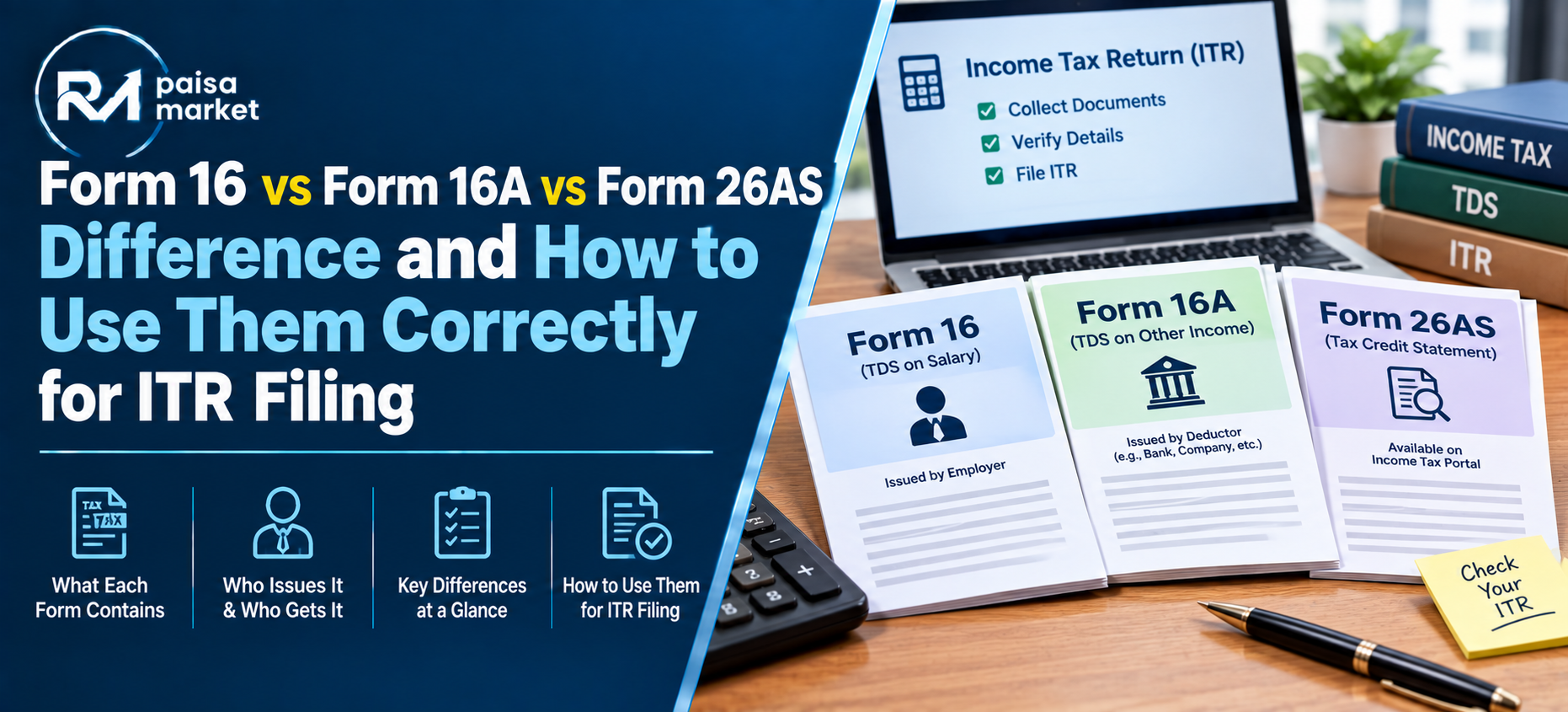
If you are filing your Income Tax Return, these three documents keep coming up: Form 16, Form 16A and Form 26AS. Many people treat them as interchangeable, which leads to mistakes. In reality, each one serves a distinct purpose. Understanding the exact difference and knowing how to use them together is one of the simplest ways to file an accurate return and avoid notices later.
Table of Contents
Form 16 vs Form 16A vs Form 26AS – Quick Overview
Form 16 is the annual TDS certificate your employer gives you for salary income. Form 16A is the TDS certificate issued by anyone else who has deducted tax on your non-salary income (banks, tenants, clients, etc.). Form 26AS is the consolidated tax credit statement generated by the Income Tax Department that shows all TDS, TCS and taxes paid against your PAN.
In short:
- Form 16 → Salary income and salary TDS
- Form 16A → Non-salary income and related TDS
- Form 26AS → The government’s final record of tax credits you can actually claim
What is Form 16?
Form 16 is the most familiar document for salaried taxpayers. It is the certificate that proves your employer has deducted tax from your salary and deposited it with the government.
Who Issues Form 16 and When
Your employer (or the pension-paying authority in case of pensioners) issues Form 16. It is given once a year after the end of the financial year, usually by 15 June. Every salaried employee whose income was subject to TDS should receive it.
What Information Does Form 16 Contain?
Form 16 has two parts.
Part A contains the employer’s TAN and PAN, your PAN, and a quarter-wise summary of the TDS deducted and deposited, along with the challan details.
Part B gives the detailed breakup of your salary: gross salary, exemptions (such as HRA, LTA), deductions under Chapter VI-A (80C, 80D, etc.), taxable salary, and the final tax computation.
Together, these two parts give a complete picture of your salary income and the tax already paid on it.
How to Use Form 16 While Filing ITR
When you file your return, Form 16 is the primary source for reporting salary income. You take the gross salary, exemptions, and deductions from Part B and enter them in the relevant schedules of the ITR. The TDS figure from Part A is used to claim credit for tax already deducted. Most people find that the salary section of the ITR can be filled almost entirely from Form 16.
What is Form 16A?
Form 16A is the TDS certificate for income other than salary. Whenever tax is deducted on interest, rent, professional fees, commission or similar payments, the person or entity deducting the tax issues Form 16A.
Who Issues Form 16A and for Which Income
Any deductor other than your employer can issue Form 16A. This includes banks, companies paying professional fees, tenants paying rent above the threshold, clients, and contractors. Unlike Form 16, Form 16A is issued quarterly after the deductor files the TDS return.
Common Types of Income Covered Under Form 16A
Typical examples include:
- Interest on fixed deposits or recurring deposits
- Rent received from a property
- Professional or consultancy fees
- Commission income
- Payments under contracts
If you have any of these incomes and tax has been deducted, you should receive a Form 16A from the concerned party.
How to Use Form 16A in ITR Filing
Each Form 16A helps you report the related non-salary income and the TDS deducted on it. Collect all Form 16As for the year, note the income and TDS from each, and enter them in the appropriate heads of the ITR. Always cross-check the TDS amount with Form 26AS before claiming the credit.
What is Form 26AS?
Form 26AS is the consolidated tax credit statement generated by the Income Tax Department that shows all TDS, TCS and taxes paid against your PAN. The official Income Tax portal also lists it as one of the key documents needed while filing returns — see the Income Tax Department’s guidance on documents required for ITR.
Who Issues Form 26AS and How to Download It
Form 26AS is generated by the Income Tax Department through the TRACES system. You can download it from the income tax e-filing portal after logging in with your PAN. It is also accessible through the TRACES website. The statement is available for multiple years and can be viewed or downloaded in PDF or other formats.
What All Information Appears in Form 26AS
Form 26AS consolidates:
- TDS deducted by all parties (salary as well as non-salary)
- TCS collected
- Advance tax and self-assessment tax paid by you
- Refunds issued
- Certain high-value transaction details (where applicable)
It is essentially the government’s record of every tax credit linked to your PAN.
Why Form 26AS is the Most Important Document for ITR
The Income Tax Department gives credit only for the TDS and TCS that appear in Form 26AS. Even if your Form 16 or Form 16A shows a higher amount of tax deducted, you can claim only what is reflected in Form 26AS. This is why matching the figures before filing is essential.
Exact Difference Between Form 16, Form 16A and Form 26AS
| Point | Form 16 | Form 16A | Form 26AS |
|---|---|---|---|
| Purpose | TDS certificate for salary | TDS certificate for non-salary income | Consolidated tax credit statement |
| Issued by | Employer | Any other deductor (bank, tenant, etc.) | Income Tax Department (TRACES) |
| Frequency | Once a year | Quarterly | Continuously updated |
| Income covered | Salary only | Interest, rent, fees, commission, etc. | All incomes on which tax was deducted/collected |
| Main use in ITR | Report salary income and salary TDS | Report non-salary income and related TDS | Verify and claim total tax credit |
| Shows tax credit | Only salary TDS | Only the TDS of that particular deductor | All TDS, TCS and taxes paid against PAN |
How to Use All Three Forms Together for Accurate ITR Filing
Step-by-Step Process to Reconcile the Forms
- Download the latest Form 26AS from the e-filing portal.
- Collect Form 16 from your employer.
- Collect all Form 16As issued to you during the year.
- Match the TDS amounts shown in Form 16 and Form 16As with the corresponding entries in Form 26AS.
- Report the income figures from Form 16 and Form 16As in the correct heads of the ITR.
- Claim TDS credit only to the extent it appears in Form 26AS.
Following this sequence minimises the chances of mismatch-related notices.
Once you have reconciled Form 16, Form 16A and Form 26AS, the next step is to file within the applicable deadline. For the latest extended dates for tax audit and ITR (especially for audit cases), see our update: Tax Audit & ITR Deadline Extended for AY 2026-27.
What to Do When Figures Do Not Match
Mismatches are common. They usually happen when the deductor files the TDS return late, enters the wrong PAN, or makes an error in the challan details. In such cases, do not claim the higher amount shown in Form 16 or Form 16A. Instead, contact the deductor (employer or bank) and request them to file a correction statement. Once the correction is processed, Form 26AS will update and you can then claim the correct credit.
Practical Example – How the Three Forms Work Together
Suppose you are a salaried employee with the following details for the year:
- Gross salary: ₹12 lakh
- TDS deducted by employer: ₹80,000 (shown in Form 16)
- Fixed deposit interest: ₹40,000
- TDS deducted by bank: ₹4,000 (shown in Form 16A)
Form 26AS should ideally show both the ₹80,000 salary TDS and the ₹4,000 bank TDS. While filing the ITR, you will report salary income using Form 16, report the FD interest under “Income from Other Sources”, and claim total TDS of ₹84,000 only if both amounts appear in Form 26AS. If the bank TDS is missing from Form 26AS, you should first get it corrected rather than claim it.
Common Mistakes People Make with These Forms
- Claiming TDS purely on the basis of Form 16 without verifying Form 26AS
- Forgetting to report non-salary income and the related Form 16A
- Downloading Form 26AS too early and missing later updates
- Entering incorrect TAN or challan details while filing
- Assuming that a higher TDS figure in Form 16 automatically means higher credit
Avoiding these mistakes saves time and prevents unnecessary notices.
Which Form is Mandatory for ITR Filing?
None of these forms is required to be uploaded as an attachment in most cases. However, Form 26AS is critical because the tax credit you claim must match what the department has on record. Form 16 is essential for salaried taxpayers to report income correctly. Form 16A becomes necessary whenever you have non-salary income on which TDS has been deducted.
Form 16 vs Form 16A vs Form 26AS – Summary Table for Quick Reference
| Form | Issued By | Frequency | Main Content | Primary Use in ITR |
|---|---|---|---|---|
| Form 16 | Employer | Yearly | Salary + salary TDS | Report salary income & claim salary TDS |
| Form 16A | Other deductors | Quarterly | Non-salary income + related TDS | Report other income & claim related TDS |
| Form 26AS | Income Tax Department | Updated regularly | All tax credits against PAN | Verify and claim total tax credit |
Frequently Asked Questions
What if TDS in Form 16 is higher than Form 26AS?
You can claim only the amount that appears in Form 26AS. Contact your employer to file a correction so that the missing credit reflects in Form 26AS.
Can I file ITR without Form 16?
Yes, it is possible if you have salary slips and Form 26AS. However, Form 16 makes the process much easier and more accurate, especially for exemptions and deductions.
Is Form 26AS the same as Form 16?
No. Form 16 is issued by your employer and covers only salary. Form 26AS is issued by the Income Tax Department and shows all tax credits linked to your PAN.
How many Form 16A can a person receive in a year?
There is no fixed limit. You can receive multiple Form 16As from different banks, clients or tenants, depending on how many parties have deducted tax on your non-salary income.
Is Form 26AS updated in real time?
It is updated periodically as deductors file their TDS returns and the data is processed. It is not instantaneous, which is why it is advisable to check it close to the time of filing.
Do I need Form 16A if I have only salary income?
No. If your only income is salary and no other party has deducted TDS, you will not receive Form 16A.
Final Takeaway – How to Use These Forms Correctly
Use Form 16 to report your salary income and the related deductions. Use Form 16A to report any non-salary income on which tax has been deducted. Always treat Form 26AS as the final authority for claiming tax credit.
The simple rule that prevents most problems is this: report income on the basis of Form 16 and Form 16A, but claim TDS only to the extent it appears in Form 26AS. Following this approach keeps your return accurate and reduces the chances of future discrepancies.