 contact.paisamarket@gmail.com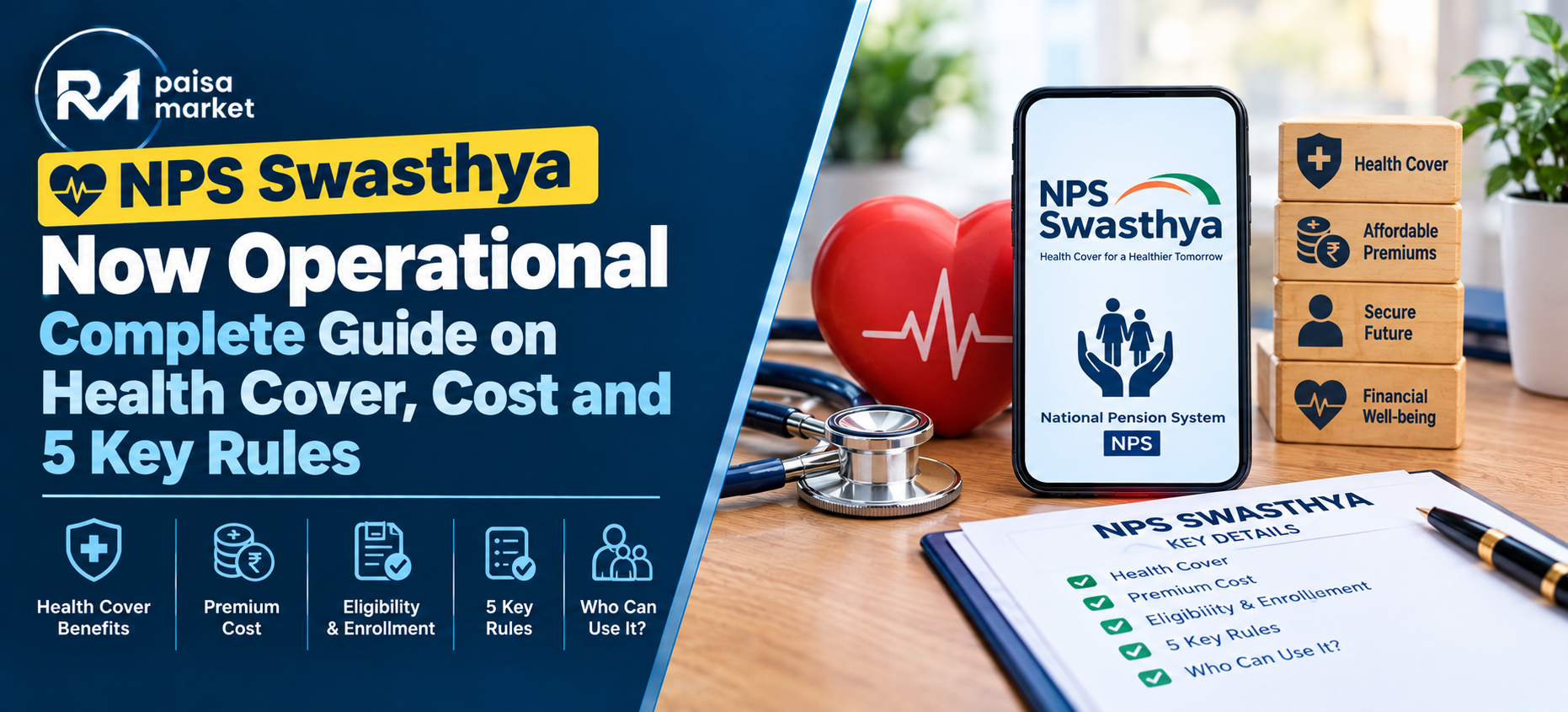
Updated: October 2026
NPS Swasthya is now operational. This guide covers everything a subscriber needs to know, from the basic idea to practical decision-making.
NPS Swasthya is a new version of the National Pension System that tries to solve two problems at once: building a retirement corpus and having some health protection linked to the same account.
It is not a regular health insurance policy. It is also not just another NPS account. It sits somewhere in between. Here’s a clear, practical walk-through of how it actually works and whether it makes sense for you.
Table of Contents
What is NPS Swasthya?
NPS Swasthya has two separate parts that run together:
- An investment account (similar to regular NPS) where your money grows for retirement.
- A mandatory super top-up health insurance policy.
The two parts are legally and operationally separate. The operational framework is set out in the PFRDA Operational Guidelines for NPS Swasthya, 2026. The insurance is compulsory if you want to open this type of account. You cannot take only the investment part or only the insurance part under this scheme.
How the Health Cover Works
The health insurance under NPS Swasthya is a super top-up family floater policy.
This is important to understand. It does not start paying from the first rupee of a hospital bill. You first have to cross an annual deductible that you choose at the time of joining. Only after the family’s eligible medical expenses in a policy year cross that deductible does the insurance kick in.
The cover includes the subscriber, spouse, and up to two dependent children. Parents are not covered under the standard policy.
Available Cover Options
You get four combinations to choose from:
| Annual Deductible | Maximum Family Cover |
|---|---|
| ₹10,000 | ₹1 lakh |
| ₹50,000 | ₹5 lakh |
| ₹1,00,000 | ₹10 lakh |
| ₹3,00,000 | ₹30 lakh |
The deductible is calculated on the total eligible medical expenses of the entire covered family during the policy year, not claim by claim.
Who Can Join?
Anyone who is eligible to join the regular NPS can join NPS Swasthya.
Entry age for the health cover is 18 to 70 years. The policy can be renewed up to age 85, subject to the insurer’s terms and payment of premium. You can join even if you already have a normal NPS account.
How Much Do You Need to Start?
There is no single fixed amount because the biggest component is the first-year insurance premium, which depends on your age and the cover option you choose.
At the time of joining you need to pay:
- The first-year health insurance premium (including taxes)
- ₹200 + taxes as annual maintenance charge
- At least ₹1,000 that goes into the NPS Swasthya investment account
After the account is opened, you can contribute as little as ₹10 at a time.
The Useful Medical Withdrawal Facility
This is one of the more practical features of NPS Swasthya.
You can withdraw up to 25% of the contributions you have made (not 25% of the total corpus) for eligible outpatient and inpatient healthcare expenses. There is no waiting period and no restriction on how many times you can use this facility.
The money is not given to you in cash. It is paid directly to the hospital or healthcare provider. This keeps the facility focused on actual medical needs.
How is This Different from Regular Health Insurance?
A normal health insurance policy (especially a base policy) often starts paying after a small deductible or even from the first rupee. NPS Swasthya only starts after a higher deductible that you choose.
Regular policies frequently offer options to cover parents. NPS Swasthya does not cover parents under the standard policy.
The biggest difference is the ability to dip into your own NPS Swasthya contributions for medical expenses. Ordinary health insurance does not give you that kind of access to a savings corpus.
In short, NPS Swasthya works best as an additional layer on top of a regular health policy rather than as a replacement for one.
Should You Join If You Already Have Health Insurance?
For many people, yes — especially if you already have a decent base policy and want higher cover for bigger medical events.
The super top-up structure + the ability to use part of your NPS contributions for medical bills can be useful. It is less attractive if you only want a simple policy that pays early and covers parents, or if you prefer to keep your pension savings completely untouched.
Who Benefits the Most?
NPS Swasthya tends to suit people who:
- Already have (or plan to buy) a basic health insurance policy
- Want a higher cover layer for large medical expenses
- Like the idea of being able to use a portion of their retirement savings for health needs when required
- Are in the 30–60 age group and want both pension and health protection in one system
It is less suitable if you need parents covered under the same policy, prefer zero or very low deductible insurance, or want to keep pension and health completely separate.
NPS Swasthya sits alongside other retirement-focused products such as EPF. If you are already reviewing your social-security coverage, you may also find our earlier guide useful: EPF Wage Ceiling Raised to ₹25,000 – What Changes for Employees.
Simple Example of How a Claim Works
Suppose you chose the ₹50,000 deductible with ₹5 lakh cover.
If your family’s total eligible medical bills in a year stay at ₹35,000, you pay the entire amount. The insurance pays nothing because the deductible has not been crossed.
If the family’s eligible bills reach ₹2.8 lakh in the same year, you pay the first ₹50,000. The NPS Swasthya policy can then cover the remaining eligible expenses (subject to the policy terms and the ₹5 lakh limit).
Charges You Should Know About
You will pay the regular NPS charges that apply under the All Citizen Model. On top of that, the pension fund may charge up to 0.08% per year on the NPS Swasthya corpus. There is also the ₹200 + taxes annual maintenance charge.
Common Mistakes to Avoid
- Treating it like a regular base health insurance policy
- Expecting parents to be covered
- Assuming you will receive cash in hand for medical withdrawals
- Choosing a very high deductible without having adequate base cover
- Joining without checking the exact premium for your age band
Should You Join? A Simple Way to Decide
Join if you want retirement savings and an extra health cover layer in one place, you already have or will buy a base health policy, and you like the flexibility of using part of your contributions for medical needs.
Think twice if you need parents covered, want insurance that pays from the first rupee, or prefer to keep your pension corpus completely separate from health expenses.
Final Takeaway
NPS Swasthya is now live. It gives you an NPS investment account plus a mandatory family floater super top-up health cover (options ranging from ₹1 lakh to ₹30 lakh). You can withdraw up to 25% of your own contributions for eligible medical expenses, with the money going directly to the hospital or provider.
It is not a replacement for regular health insurance. It works best as an additional layer. Understand the deductible system, check the premium for your age, and see whether the combination of pension savings and this specific health facility fits your needs before joining.