 contact.paisamarket@gmail.com
Updated: 27 September 2026 | EPF wage ceiling raised to ₹25,000 per month effective 17 September 2026. Over 51 lakh additional employees brought under mandatory coverage.
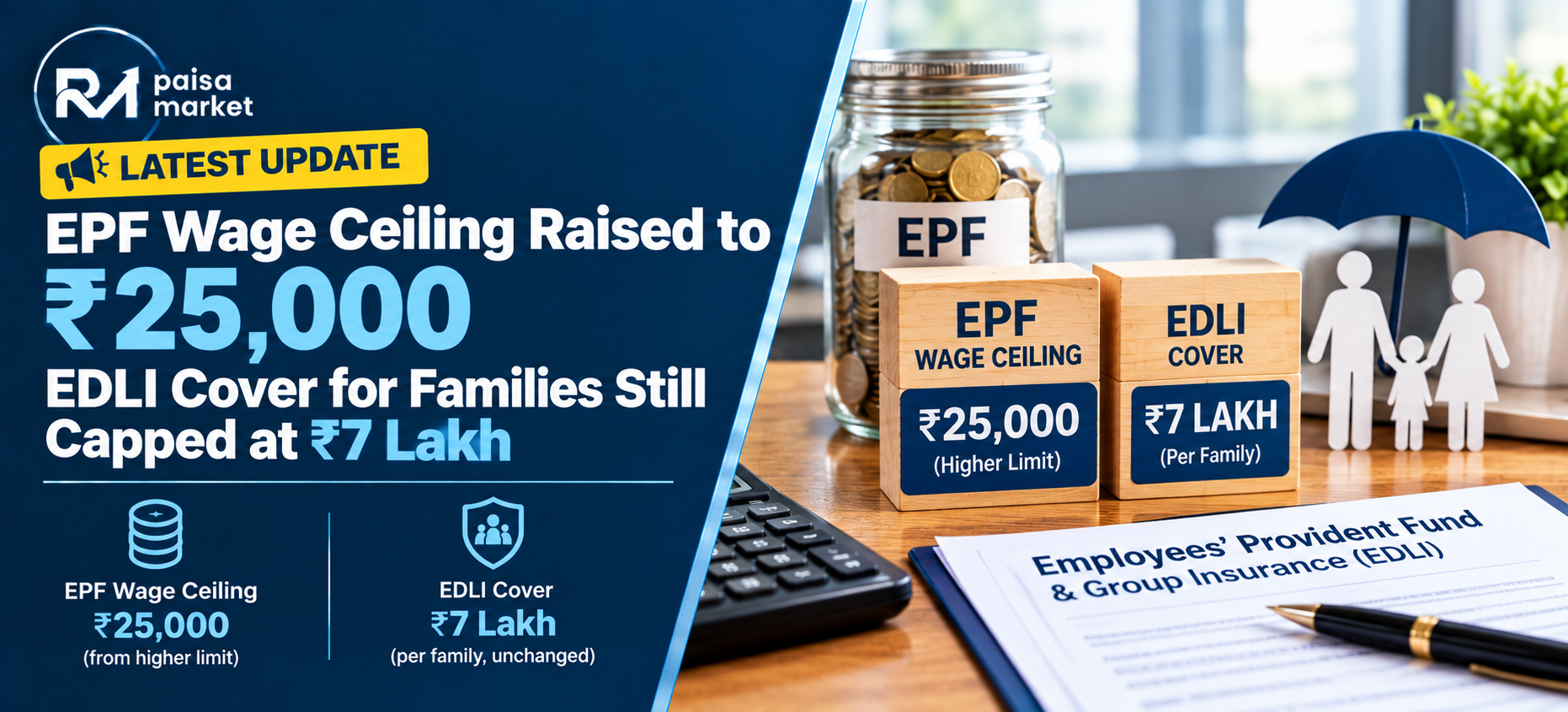
From 17 September 2026, the statutory wage ceiling for Employees’ Provident Fund (EPF) has been raised from ₹15,000 to ₹25,000 per month.
Employees whose wages (as defined under the Code on Social Security) fall between ₹15,001 and ₹25,000 now come under mandatory EPF, EPS and EDLI coverage.
For those already contributing on the old ₹15,000 ceiling, the maximum employee PF contribution rises from ₹1,800 to ₹3,000 per month. This can reduce monthly take-home pay by up to ₹1,200.
Employer contribution also increases correspondingly. Pension (EPS) and insurance (EDLI) benefits improve because of the higher contribution base.
Bottom line: Higher retirement savings and social security coverage, but lower take-home salary for many employees in the ₹15,000–₹25,000 wage band.
This is the first revision of the EPF wage ceiling in more than 12 years. The previous increase (from ₹6,500 to ₹15,000) took effect in September 2014. The government has stated that the change is expected to bring over 51 lakh additional employees into the mandatory social security net.
Table of Contents
What Exactly Has Changed
The Ministry of Labour and Employment notified the revised ceiling through S.O. 5109(E) dated 17 September 2026 under the Code on Social Security, 2020. It took effect from the date of publication in the Official Gazette — 17 September 2026.
Old vs New EPF Wage Ceiling
| Parameter | Earlier (till 16 Sept 2026) | New (from 17 Sept 2026) |
|---|---|---|
| Statutory wage ceiling | ₹15,000 | ₹25,000 |
| Max employee PF contribution (12%) | ₹1,800 | ₹3,000 |
| Max employer EPS contribution (8.33%) | ₹1,250 | ≈ ₹2,083 |
| Max employer EPF contribution (3.67%) | ₹550 | ≈ ₹917 |
| EDLI contribution (0.5%) | ₹75 | ₹125 |
These figures apply when contributions are restricted to the statutory ceiling. Where an employer was already contributing on actual higher wages, the total outgo may not change in the same way, though the split between EPS and EPF can shift.
Who Is Affected – Focus on the ₹15,000–₹25,000 Band
The impact is not uniform. It depends on whether an employee was already a member and on what wage base contributions were being made.
Three Categories of Employees
- Newly covered employees (wages ₹15,001–₹25,000 who were previously outside mandatory coverage)
These employees now come under mandatory EPF + EPS + EDLI. They must be enrolled if they were treated as excluded earlier solely because their wages exceeded the old ₹15,000 threshold at the time of joining. - Existing members contributing only on the ₹15,000 ceiling
Their contribution base rises (up to the new ceiling of ₹25,000 or actual PF wages, whichever is lower). This leads to a higher deduction from salary. - Employees already contributing on actual wages above ₹25,000
There is limited or no change in the total contribution amount, depending on the company’s existing policy. The statutory minimum is now higher, but many progressive employers were already contributing on full basic + DA.
Important clarification
The ceiling applies to “wages” as defined under the Code on Social Security, 2020. This primarily includes basic pay, dearness allowance and certain other components that form part of the statutory definition. It is not the same as full CTC or gross salary. Many employees whose gross pay is higher than ₹25,000 may still have PF wages within or below the new ceiling, depending on how their salary is structured.
Impact on Take-Home Salary
The most immediate and visible effect for many employees is a reduction in monthly take-home pay because the employee’s 12% contribution is deducted from salary.
How Much Can Take-Home Reduce?
Example calculation (employee contribution only)
| PF Wages | Old Employee Contribution (12% of ₹15,000) | New Employee Contribution | Extra Deduction from Salary |
|---|---|---|---|
| ₹15,000 | ₹1,800 | ₹1,800 | Nil |
| ₹18,000 | ₹1,800 | ₹2,160 | ₹360 |
| ₹20,000 | ₹1,800 | ₹2,400 | ₹600 |
| ₹22,000 | ₹1,800 | ₹2,640 | ₹840 |
| ₹25,000 | ₹1,800 | ₹3,000 | ₹1,200 |
At the full new ceiling of ₹25,000, the extra monthly deduction is ₹1,200. Over a year this works out to ₹14,400 lower take-home pay.
The actual reduction depends on the employee’s precise PF wages. Employees whose PF wages were already below ₹15,000 see no change in the contribution rate. Those between ₹15,001 and ₹25,000 see a proportionate increase.
Employers also contribute an additional matching amount (or the differential up to the new ceiling). This does not come out of the employee’s salary but increases the company’s cost.
Impact on PF Contribution & Retirement Savings
Higher monthly contributions mean a larger corpus over time, helped by compounding and the interest credited by EPFO.
Both the employee and the employer now contribute on a higher base (where the ceiling applies). The long-term benefit is a bigger EPF balance at the time of withdrawal or retirement.
Split of Employer’s 12% Contribution
- 8.33% goes to the Employees’ Pension Scheme (EPS)
- 3.67% goes to the Employees’ Provident Fund (EPF)
With the higher ceiling, a larger absolute amount flows into the pension scheme. This improves the potential pension at retirement, subject to the EPS formula, years of service and other scheme rules.
This higher contribution base builds on the broader changes under the new social security framework. For the complete set of rules that now apply, see our detailed guide on EPFO EPF Scheme 2026 and what the new rules mean for employees.
Employees who stay in the system for a long period stand to gain meaningfully from the higher accumulation and the improved pension base.
Impact on EPS Pension & EDLI Insurance
Better Pension Prospect
The maximum monthly EPS contribution rises from approximately ₹1,250 to about ₹2,083. Because pension is linked to the contribution history and the wage on which contributions were paid, a higher contribution base can support a higher pension at the time of superannuation (subject to the prevailing EPS rules and the member’s service period).
Higher EDLI Cover
The Employees’ Deposit Linked Insurance Scheme (EDLI) provides a life insurance benefit linked to the EPF account. The contribution (0.5%) and the potential benefit also scale up with the higher wage ceiling. For an employee at the full new ceiling, the EDLI contribution rises from ₹75 to ₹125 per month, and the insurance cover improves correspondingly under the scheme provisions.
When Will the Higher Deduction Appear in Salary Slip?
The notification is effective from 17 September 2026.
Most employers are expected to implement the revised ceiling from the September 2026 salary (with pro-rata calculation for the period after 17 September) or from the October 2026 salary, depending on their payroll cycle, system readiness and internal processes.
Some payroll software already supports pro-rata calculation for September (old ceiling till 16 September and new ceiling from 17 September). Employees should carefully check the September and October salary slips, the PF wage figure mentioned, and any remarks or annexures that explain the revised contribution.
Form 23 / Form 24 or the online EPFO passbook will eventually reflect the updated contributions once the employer files the returns.
What Employees Should Do Now
Here is a practical checklist:
- Check the “PF wages” or “pensionable wages” figure on your latest salary slip. This is the number that matters, not the full gross or CTC.
- Confirm with your HR or payroll team whether you fall in the newly mandatory band or were earlier contributing only on the old ₹15,000 ceiling.
- Review the September and October payslips carefully for any increase in the PF deduction.
- Log in to the EPFO member portal (or the UMANG app) and ensure your UAN is active, KYC is complete, and nomination details are up to date.
- Calculate the approximate reduction in take-home pay and adjust your monthly budget if the extra deduction is significant for you.
- If the extra deduction feels significant, review your overall cash flow and emergency buffer — our guide on building an emergency fund can help you decide how much to keep ready.
- View the higher contribution as forced long-term savings. The money continues to earn interest and builds your retirement corpus and pension eligibility.
- If you are a newly covered employee, complete the necessary enrolment formalities (UAN generation or linking, Aadhaar seeding, etc.) promptly so that contributions start without delay.
Frequently Asked Questions
Is the new ₹25,000 ceiling on basic salary or gross salary?
It applies to “wages” as defined under the Code on Social Security, 2020. This primarily covers basic pay, dearness allowance and certain other components specified in the definition. It is not the same as full gross salary or CTC. Salary structure determines the exact PF wage figure.
Will my take-home salary reduce from September 2026 itself?
It depends on when your employer implements the change in the payroll system. Many companies will apply it from the September salary (possibly on a pro-rata basis from 17 September) or from October. Check your next two salary slips.
I was not under PF earlier (salary ₹18,000–₹24,000). Do I have to join now?
Yes, if your wages as defined under the Code fall between ₹15,001 and ₹25,000, you now come under mandatory coverage, subject to the applicable membership rules. Your employer is required to enrol you.
Can I opt out of the higher contribution?
No. Once you are under mandatory coverage, the statutory contributions on the applicable wage (up to the new ceiling) are compulsory. There is no general opt-out for the higher ceiling.
How much extra will my employer contribute?
Where contributions were earlier capped at ₹15,000, the employer’s total 12% contribution can rise by up to ₹1,200 per month (matching the employee’s increase). The exact amount depends on the employee’s PF wages. The employer’s share is split between EPS (8.33%) and EPF (3.67%).
Will my EPS pension increase because of this change?
The higher contribution base improves the potential pension because a larger amount is credited to the EPS account each month. The final pension depends on the EPS formula, the period of contribution, and the wages on which contributions were paid over the service period.
Does this apply to private limited companies, LLPs and startups?
Yes. The Code on Social Security and the EPF provisions apply to covered establishments regardless of the legal form (private limited, LLP, etc.), subject to the threshold number of employees and other applicability conditions under the law.
What happens if my company was already contributing on actual wages above ₹15,000?
If the company was already contributing on actual PF wages higher than the old ceiling (and possibly higher than ₹25,000), the total contribution amount may not increase. However, the statutory ceiling is now ₹25,000, and the split between EPS and EPF follows the prescribed percentages up to that ceiling.
Closing Summary
The EPF wage ceiling hike to ₹25,000 (effective 17 September 2026) expands mandatory social security coverage to employees in the ₹15,000–₹25,000 wage band and increases the contribution base for many existing members. While take-home pay can reduce by up to ₹1,200 per month, the long-term benefit is higher provident fund savings, better pension prospects under EPS, and improved EDLI insurance cover.
Employees should check their next salary slip, confirm their PF wage figure with HR, and plan their monthly cash flow accordingly. The change strengthens the social security net for a larger section of the formal workforce and aligns the contribution ceiling more closely with current wage levels after more than a decade.