 contact.paisamarket@gmail.com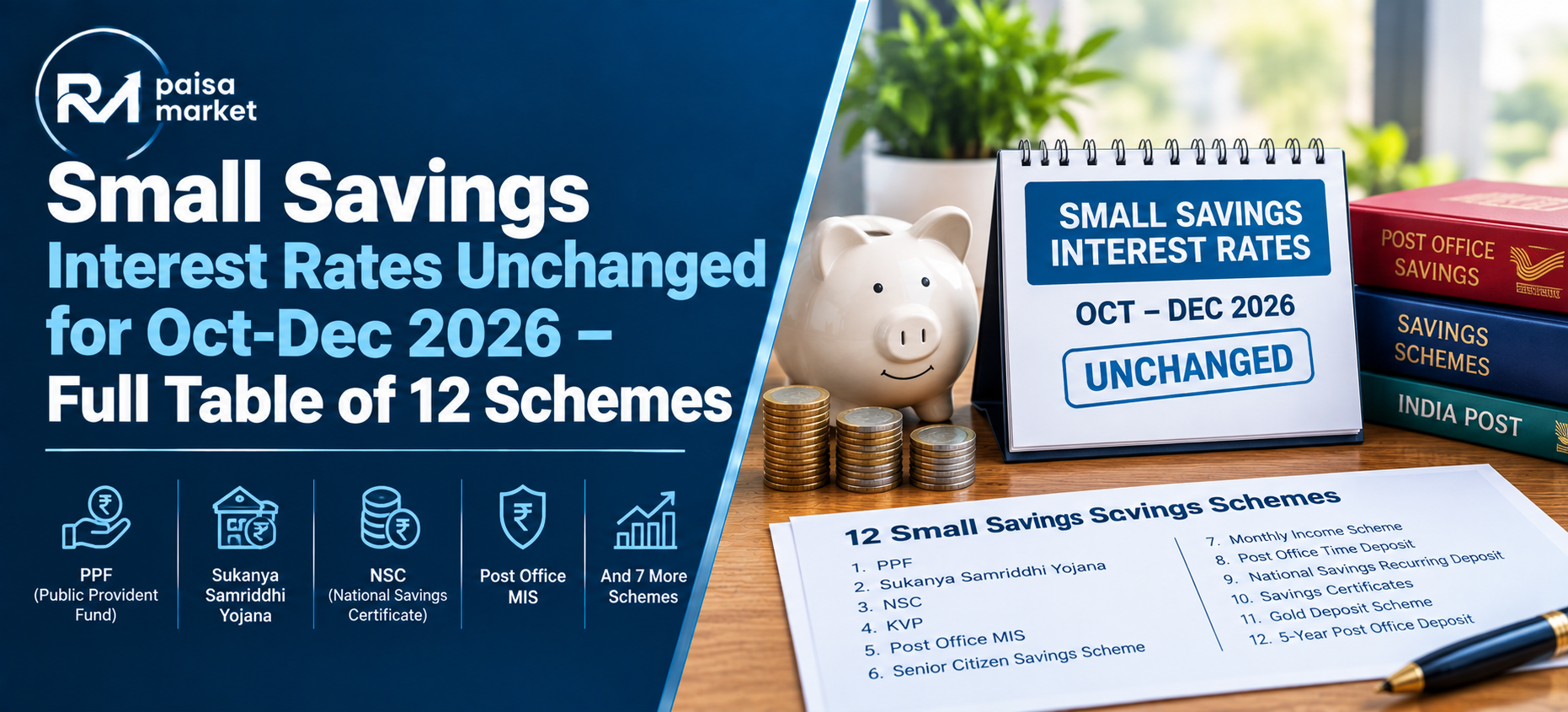
Updated: 30 September 2026
The Finance Ministry has kept interest rates on all small savings schemes unchanged for the October–December 2026 quarter, as confirmed in the official notification. This is now the 10th consecutive quarter with no change.
The government has decided not to change interest rates on small savings schemes for the October to December 2026 quarter.
If you’re already investing in PPF, SCSS, Sukanya Samriddhi or NSC, nothing changes for you. You’ll continue earning the same rates. If you’re planning to start fresh, you now know exactly what return to expect for the next three months.
Here’s the complete picture.
Full Interest Rate Table (October–December 2026)
| Scheme | Interest Rate | How it’s paid / compounded |
|---|---|---|
| Public Provident Fund (PPF) | 7.1% | Annually |
| Senior Citizen Savings Scheme (SCSS) | 8.2% | Quarterly |
| Sukanya Samriddhi Yojana | 8.2% | Annually |
| National Savings Certificate (NSC) | 7.7% | Annually |
| Kisan Vikas Patra (KVP) | 7.5% | Matures in 115 months |
| Post Office Monthly Income Scheme | 7.4% | Monthly |
| 5-Year Time Deposit | 7.5% | Quarterly |
| 3-Year Time Deposit | 7.1% | Quarterly |
| 2-Year Time Deposit | 7.0% | Quarterly |
| 1-Year Time Deposit | 6.9% | Quarterly |
| 5-Year Recurring Deposit | 6.7% | Quarterly |
| Post Office Savings Account | 4.0% | Annually |
What this long period of stable rates actually means
The government reviews these rates every quarter. For the last ten quarters, they have chosen not to change them.
For most ordinary investors, this stability is actually helpful. You don’t have to keep checking every three months wondering whether your PPF or SCSS rate will suddenly drop. The return is predictable, at least for now.
PPF at 7.1%
PPF continues at 7.1%. The interest you earn is completely tax-free, and the money you deposit still qualifies for Section 80C.
Yes, the 15-year lock-in feels long. But that’s also why many people like it — the money stays invested and compounds quietly without the temptation to withdraw early. For long-term goals, it remains one of the cleanest options available.
SCSS at 8.2% – Still one of the best for senior citizens
The Senior Citizen Savings Scheme stays at 8.2% with interest paid every quarter.
If you or your parents are above 60, this continues to be one of the higher government-backed rates with regular income. The tenure is five years (extendable by three more years). For many senior citizens, this is still hard to beat when you factor in safety.
Sukanya Samriddhi at 8.2%
Parents of a girl child below 10 years can still earn 8.2% tax-free. The account matures when the girl turns 21 (or on marriage after 18).
Both the interest and the maturity amount are tax-free, and deposits get 80C benefit. It’s still one of the stronger options specifically meant for a daughter’s future education or marriage expenses.
NSC at 7.7%
National Savings Certificate continues at 7.7% with a five-year lock-in. Interest is reinvested and qualifies for 80C (except in the final year). Some people also use it as collateral for loans. It’s a straightforward medium-term option if you want a fixed return with government backing.
What you should do now
If you already have these accounts running, you don’t need to do anything. Your existing investments will continue at the same rates.
If you’re thinking of putting in fresh money:
- Want long-term tax-free growth? PPF or Sukanya are still solid.
- Senior citizen looking for regular income? SCSS remains attractive.
- Need something for 5 years? NSC or the 5-year time deposit are worth comparing with bank FDs.
Just remember to compare these rates with what banks are currently offering on fixed deposits (especially senior citizen FDs). Our recent guide on the new FD rate disclosure rules from 1 October explains how bulk and retail FD rates are now published and compared.
Just remember to compare these rates with what banks are currently offering on fixed deposits (especially senior citizen FDs), and factor in the tax treatment before deciding.
Quick tax picture
| Scheme | Is interest taxable? | 80C benefit | Tax on maturity |
|---|---|---|---|
| PPF | No | Yes | No |
| SCSS | Yes | Yes | Interest is taxable |
| Sukanya Samriddhi | No | Yes | No |
| NSC | Yes (reinvested) | Yes | Final interest taxed |
Final take
The government has once again chosen stability over change. For the October–December 2026 quarter, all small savings rates stay exactly where they were.
For most people who use these schemes, that’s perfectly fine. You know what return you’re getting, the money is safe, and in the case of PPF and Sukanya, the tax treatment is still excellent.
If you were waiting for a rate hike before investing, you’ll have to wait a bit longer. The next review will happen towards the end of December for the January–March 2027 quarter.