 contact.paisamarket@gmail.com
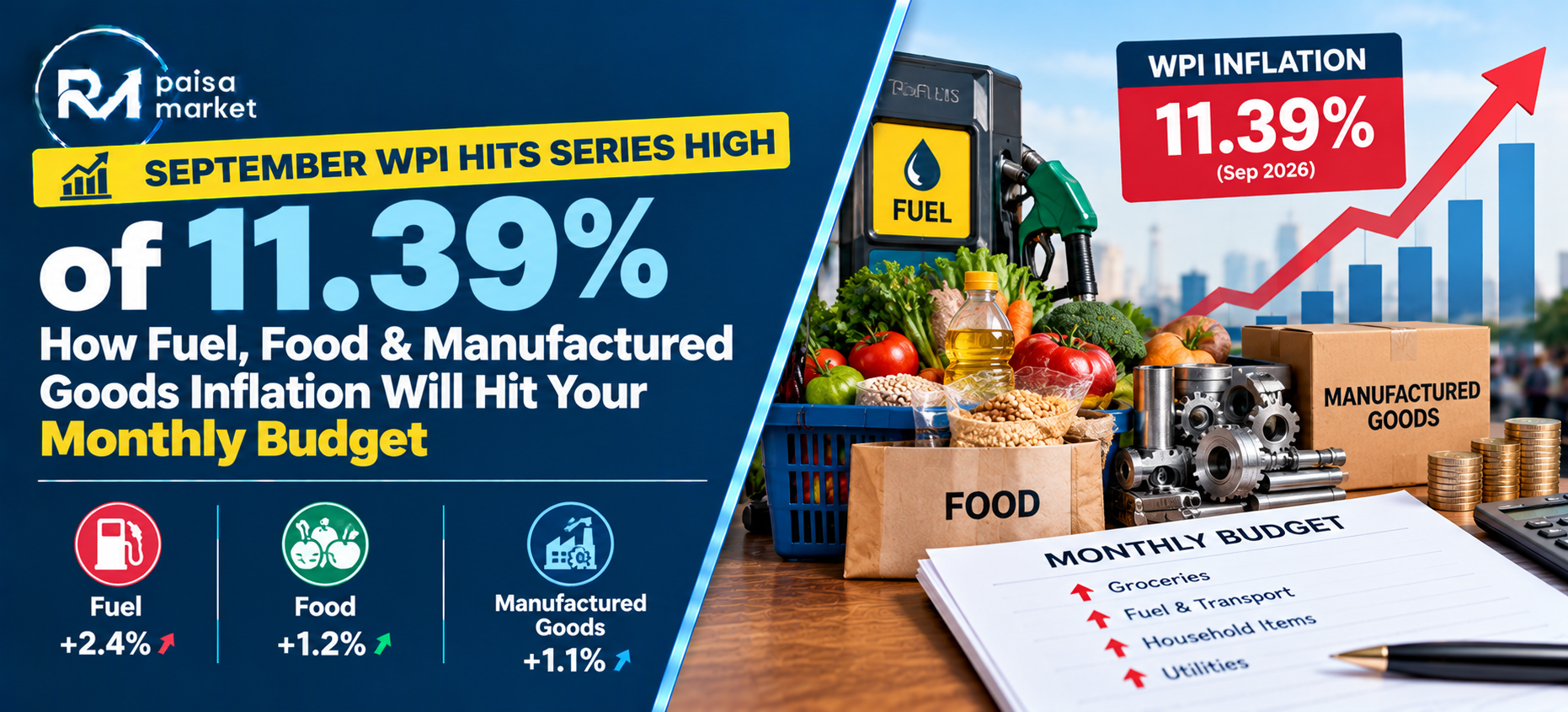
India’s wholesale price inflation rose sharply to 11.39% in September 2026, marking the highest reading in the current 2022-23 base-year series. Provisional data released by the Ministry of Commerce and Industry on 14 October showed the rate accelerating from 9.92% in August. The jump was broad-based, with fuel and power, food articles and manufactured products all recording stronger year-on-year increases.
Wholesale prices sit upstream of the prices households actually pay. When the cost of crude, refined fuels, vegetables, edible oils, metals, chemicals and textiles rises at the wholesale level, the increase gradually appears at petrol pumps, vegetable markets, grocery shelves and in the prices of everyday manufactured goods. The September numbers therefore carry direct implications for monthly household budgets in the coming weeks and months.
Table of Contents
What the September 2026 WPI Data Shows
Overall Wholesale Inflation Reaches Series Peak
The all-commodities Wholesale Price Index climbed to 112.5 in September from 110.8 in August. Year-on-year inflation accelerated by 1.47 percentage points to 11.39%. This is the highest print since the new series began. Cumulative WPI inflation for the April–September period stood at 9.85%, a sharp contrast to the mild contraction of 0.20% recorded in the corresponding period of the previous year. The sequential rise in the index itself (about 1.5%) indicates that price pressures strengthened even within the month.
Fuel and Power: The Sharpest Driver
Fuel and power inflation accelerated to 25.85% from 22.93% in August, remaining the strongest contributor among the three major groups. Inside this category the increases were particularly steep:
- Crude petroleum and natural gas inflation surged to 57.32% from 34.41%.
- Mineral oils (petrol, diesel and other petroleum products) rose to 40.02% from 38.48%.
- Coal and lignite inflation jumped to 9.31% from just 1.57%.
These movements reflect elevated global energy prices and supply-side pressures that have persisted through much of 2026. Because fuel carries a significant weight and feeds into transport and industrial costs, its impact is felt widely across the economy.
Food Index Climbs to 8.66%
The WPI Food Index, which combines primary food articles and manufactured food products (combined weight of nearly 25%), rose to 8.66% from 7.05% in August. Primary food articles inflation accelerated to 8.14% from 5.67%, reaching a 21-month high. Vegetables, cereals, pulses and fruits were among the key drivers. Manufactured food products also contributed, although the pace of increase in that sub-group was somewhat more moderate. The firming of food prices at the wholesale level typically feeds into retail mandi and supermarket rates within a short lag.
Manufactured Products Hit Series High of 9.76%
Manufactured products, which account for roughly 63% of the WPI basket, recorded inflation of 9.76% — the highest in the current series — up from 8.37% in August. The rise was driven by several industrial segments: basic metals (16.96%), chemicals and chemical products (16.74%), textiles, rubber and plastic products, and electrical equipment. Higher input costs are gradually being passed through the production chain. Because manufactured goods cover a wide range of items that households buy regularly, this component exerts a broad and persistent influence on the cost of living.
How Fuel Inflation Will Affect Your Monthly Budget
Petrol, Diesel and CNG Prices
Wholesale fuel inflation running close to 26% usually translates into higher pump prices with a lag of a few weeks. Even small retail revisions raise the cost of daily commuting, school transport and weekend travel. Households that depend on two-wheelers or cars experience the impact most directly through larger monthly fuel bills. For those using CNG vehicles the effect appears through higher cylinder or station prices.
LPG and PNG Cooking Costs
Elevated wholesale energy prices also put upward pressure on domestic LPG cylinders and piped natural gas tariffs. Any increase in the price of a domestic cooking-gas cylinder or in PNG rates immediately raises the monthly kitchen budget for the large majority of urban and semi-urban households. Because cooking fuel is a non-discretionary expense, families have limited ability to absorb or postpone these costs.
Indirect Transport and Logistics Pass-Through
Higher diesel prices raise freight rates for goods moved by road. These additional logistics costs are eventually reflected in the retail prices of vegetables, fruits, packaged foods, dairy products and many other essentials. The indirect effect is often less visible than a direct petrol-price hike but adds to the overall rise in the monthly grocery and household bill.
How Food Inflation Will Squeeze Household Expenses
Vegetables, Fruits, Cereals and Pulses
Primary food articles inflation at 8.14% points to firming wholesale prices for perishables and staples. When wholesale vegetable and fruit prices remain elevated, retail rates in local markets and supermarkets usually follow within days or a couple of weeks. Cereals and pulses form a substantial share of the monthly ration budget for most families. Sustained pressure in these categories reduces the room available for discretionary spending and can force adjustments in dietary patterns for lower- and middle-income households.
Packaged and Processed Foods
Manufactured food products are also contributing to the higher Food Index. Items such as edible oils, biscuits, snacks, dairy products, ready-to-eat foods and packaged spices tend to see price revisions when input costs rise. Households that rely heavily on packaged groceries will notice gradual increases in their monthly grocery bills. Because these products are purchased frequently, even small unit-price increases accumulate into a meaningful addition to monthly outgo.
Overall Food Basket Pressure
With the WPI Food Index at 8.66%, the combined effect of primary and manufactured food inflation is likely to keep retail food inflation elevated in the near term. Food remains the single largest component of most household budgets. Higher food prices therefore reduce real purchasing power more directly than increases in many other categories, especially for families whose incomes are fixed or rising only slowly.
Manufactured Goods: The Quiet Pressure on Everyday Items
Metals, Chemicals and Intermediate Goods
Sharp rises in basic metals and chemical products raise the cost of manufacturing a wide range of consumer goods — from kitchen utensils and packaging materials to soaps, detergents, plastics and many household items. Producers eventually pass these higher costs downstream. The effect appears gradually in the prices of everyday products that households buy without closely tracking wholesale indices.
Textiles, Apparel and Household Products
Inflation in textiles and related categories can push up the prices of clothing, home furnishings, bed linen and school uniforms. Rubber, plastic and electrical-equipment inflation affects kitchenware, storage containers, small appliances, wiring and a host of other commonly purchased items. Because these goods are bought less frequently than food or fuel, the impact is often noticed only when a replacement purchase is required.
Broader Cost of Living Impact
Since manufactured products dominate the WPI basket, sustained double-digit wholesale inflation in this segment creates a broad-based upward bias in non-food, non-fuel prices. Over time this raises the overall cost of maintaining a household’s standard of living and reduces the surplus available for savings or discretionary expenditure.
What This Means for Your Monthly Budget in the Coming Months
Wholesale inflation at 11.39% does not appear overnight in every retail bill, but transmission is usually visible within one to three months. Fuel and fresh food prices tend to adjust faster; packaged goods and durables take longer. Households already experiencing elevated retail inflation (CPI stood at 5.54% in September) are likely to face further pressure on three key fronts: monthly fuel and transport expenses, grocery and kitchen budgets, and spending on clothing, household essentials and personal-care items.
Fixed-income families, pensioners and households with limited savings buffers will feel the squeeze most acutely. Discretionary spending on dining out, entertainment, non-essential clothing or gadgets may need to be scaled back to protect essential outflows. Families that carefully track vegetable prices, fuel rates and packaged-goods MRPs will be better placed to adjust purchasing patterns in real time.
The cumulative April–September WPI inflation of 9.85% also indicates that wholesale price pressures have been building through the first half of the fiscal year. If global energy prices remain elevated and domestic food supply conditions stay tight, the pass-through to retail prices could remain noticeable through the rest of the calendar year.
Bottom Line – Preparing for Higher Wholesale-Driven Costs
September’s WPI reading of 11.39% is the highest in the current series and reflects broad-based price pressures across fuel, food and manufactured goods. While policymakers monitor these trends closely, the practical implication for households is a tighter monthly budget. Tracking retail fuel prices, local vegetable and fruit rates, and the MRPs of frequently purchased packaged goods over the next few weeks will provide the clearest real-time picture of how quickly these wholesale increases are reaching consumers. Early awareness allows families to adjust spending priorities and protect essential expenses before the full impact is felt.
 Aakash Yadav