 contact.paisamarket@gmail.com
Updated: 19 August 2026 | RBI MPC minutes released for the August 3–5, 2026 meeting.
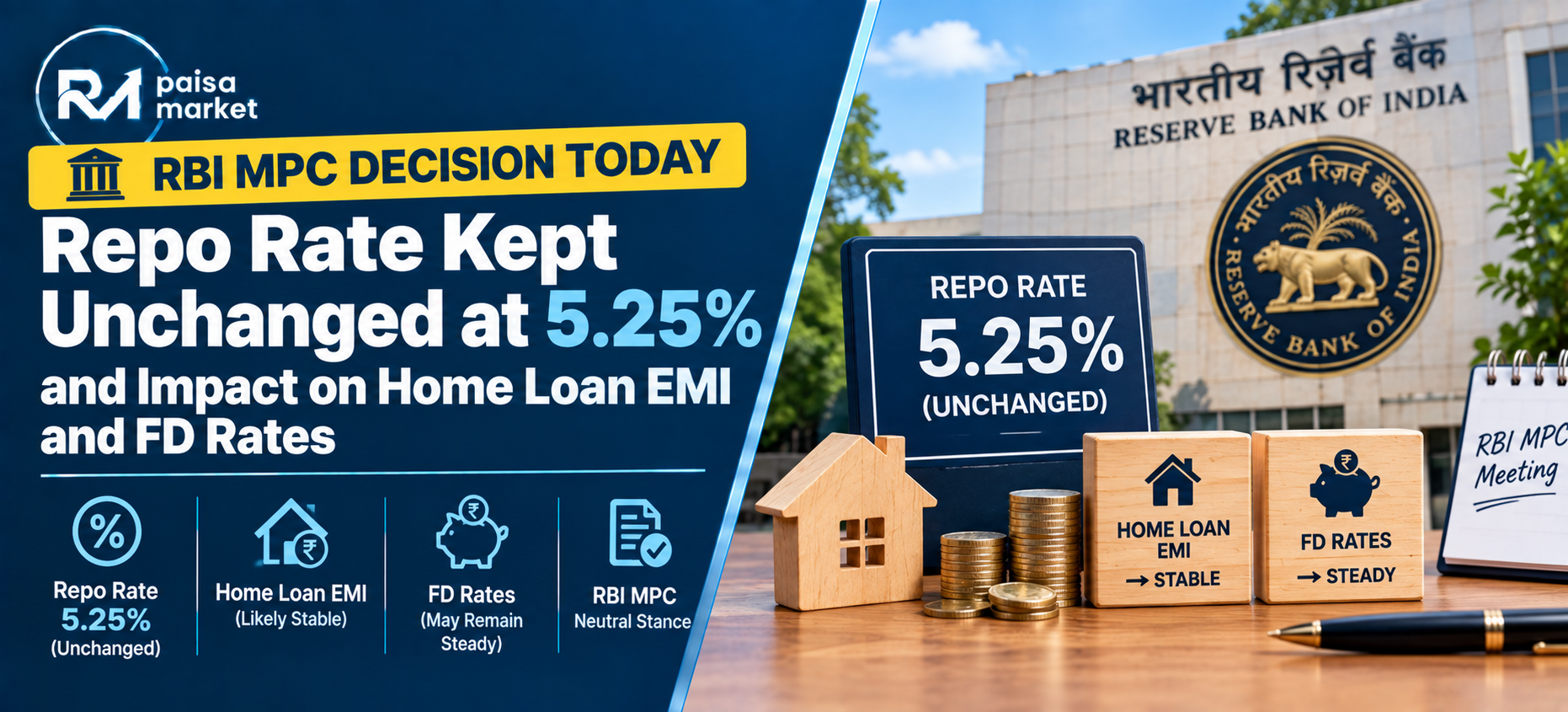
The Reserve Bank of India’s August 2026 MPC minutes have introduced a more cautious tone on inflation and left open the possibility of policy tightening if price pressures become broader or more persistent. The RBI, however, has not announced a rate hike: the repo rate remains at 5.25% and the policy stance remains neutral.
For borrowers, that means there is no automatic EMI increase today. For FD investors, there is also no automatic change in deposit rates. The bigger takeaway is what the minutes could mean for the direction of RBI policy in the coming months.
Bottom line: The RBI has not raised the repo rate. But the August MPC minutes signal that further rate cuts may have limited room and that a rate hike could become an option if inflation risks intensify.
RBI MPC Minutes: Key Facts
| Particular | Details |
|---|---|
| MPC meeting | 3–5 August 2026 |
| Minutes released | 19 August 2026 |
| Repo rate | 5.25% |
| Policy stance | Neutral |
| August rate decision | Repo rate unchanged |
| Main concern | Inflation and upside risks |
| Rate-hike signal | Possible if inflation risks materialise |
| Immediate EMI impact | No automatic change |
The MPC retained the repo rate at 5.25% and continued with a neutral stance at its August meeting.
The RBI’s current policy rates include an SDF rate of 5.00% and MSF and Bank Rate of 5.50%.
Why the RBI MPC Minutes Sound More Hawkish
The important change is not a rate hike itself. It is the language around future policy.
The minutes show policymakers becoming more focused on the possibility that inflation pressures could become broader, particularly if food, fuel and other input costs begin feeding into prices across the economy.
Governor Sanjay Malhotra warned that evidence of inflation risks materialising could require policy tightening. Deputy Governor Poonam Gupta indicated that there was no scope for further monetary easing at the current juncture and that a rate hike could emerge later if inflation risks warranted it.
That distinction matters.
The MPC is not saying that a rate hike is certain. Instead, the minutes suggest that the RBI wants to retain the flexibility to tighten policy if inflation develops in a way that threatens price stability.
In simple terms: the RBI has paused, but it has not closed the door on higher rates.
What Triggered the Rate-Hike Concern?
July inflation moved above the RBI’s 4% target
India’s July 2026 retail inflation rose to 4.45%, compared with 4.38% in June. Food inflation increased to 5.52% from 5.32%.
That was the second consecutive month in which headline CPI inflation was above the RBI’s 4% medium-term target, although it remained within the central bank’s 2%–6% tolerance band.
The July CPI release also showed rural inflation at 4.84% and urban inflation at 3.96%.
The RBI is watching whether inflation spreads
Food inflation by itself does not automatically require a rate hike. The bigger concern for monetary policy is whether higher food, fuel or input costs begin affecting other prices and creating broader inflation.
The minutes therefore put considerable emphasis on:
- Food-price volatility
- Energy and fuel costs
- Global economic uncertainty
- Exchange-rate movements
- Imported inflation
- Supply-side risks
- Domestic growth conditions
The RBI’s concern is essentially about persistence and second-round effects, rather than one month’s CPI number alone. Reuters reported that policymakers were particularly alert to oil-price risks and the possibility that supply pressures could become more broad-based.
RBI’s Inflation Outlook: Why 5.9% Matters
The August policy outlook had already incorporated greater inflation risks.
Governor Sanjay Malhotra projected that inflation could peak at around 5.9% in Q3 FY27 before moderating, according to reporting on the minutes.
This is important because the 4.45% July CPI reading is actual provisional data, while the 5.9% figure is an RBI projection or risk assessment.
They should not be treated as the same thing.
The RBI also reduced its FY27 headline inflation projection to 5.0%, while raising its FY27 GDP growth forecast to 6.7% at the August policy meeting.
That combination helps explain the cautious approach: growth remains resilient, while inflation risks have become more uncertain.
What Could Happen to the Repo Rate?
There are several possible paths from here.
| Scenario | Possible RBI response | Likely effect |
|---|---|---|
| Inflation eases | Rates remain unchanged; future easing remains possible | Borrowing costs could stay stable |
| Inflation remains elevated | RBI maintains a cautious stance | Rate cuts become less likely |
| Inflation accelerates sharply | Rate hike becomes more likely | Loan rates could rise after transmission |
| Growth weakens materially | RBI balances inflation and growth risks | Policy remains data-dependent |
The key point is that the MPC minutes do not announce the timing or size of any future rate hike.
The next policy decision will depend on incoming inflation, growth, liquidity, financial-market conditions and other risks.
Will Home-Loan EMIs Rise?
No. Home-loan EMIs will not increase automatically because the MPC minutes were released.
A monthly policy document does not directly change the interest rate on your loan.
For a floating-rate home loan, the actual impact depends on:
- The benchmark linked to the loan
- The lender’s spread
- The reset frequency
- The applicable interest rate
- The contractual reset mechanism
If the RBI eventually raises the repo rate and a lender passes the increase through to borrowers, the loan’s interest cost could rise.
That could show up as:
- A higher EMI
- A longer repayment period
- Or a combination of both
What about fixed-rate home loans?
A fixed-rate home loan is not automatically repriced because of an RBI policy change.
The loan agreement determines when and how the interest rate can change.
What you should check: your loan type, benchmark, spread and next reset date before assuming that an RBI rate move will immediately change your EMI.
A 25-Basis-Point Rate Hike: What Would It Mean?
Suppose the RBI eventually raises the repo rate by 25 basis points, or 0.25 percentage point, and the lender passes the full increase through.
That could increase the interest cost on a floating-rate loan.
But there is no single EMI increase applicable to every borrower.
The actual impact depends on:
- Outstanding principal
- Remaining tenure
- Existing interest rate
- Loan type
- Lender’s reset mechanism
- Whether the lender changes the EMI, tenure or both
For that reason, it would be misleading to say that a 25-basis-point RBI hike automatically means a fixed rupee increase in everyone’s EMI.
What About Personal Loan Interest Rates?
Personal loans can also be affected by the interest-rate cycle, but the impact depends on the terms of the individual loan.
Existing borrowers
If your personal loan has a floating rate, a future lender repricing could increase your borrowing cost.
If it is fixed-rate, the rate does not automatically change because of the MPC minutes.
New borrowers
Banks and NBFCs may adjust the rates offered to new borrowers depending on their funding costs, risk assessment and expectations about future monetary conditions.
That means the impact of a potential RBI rate hike may show up in new loan pricing even before every existing loan is repriced in exactly the same way.
Check these four things
Before making a refinancing or prepayment decision, check:
- Interest-rate type
- Benchmark
- Reset frequency
- Prepayment or refinancing charges
The MPC minutes alone are not enough information to decide whether refinancing or prepayment makes sense for a particular borrower.
What Does It Mean for Bank Fixed Deposits?
The impact on fixed deposits is less direct than many savers assume.
A possible RBI rate hike does not guarantee that every bank will immediately increase its FD rates.
Banks also consider:
- Deposit mobilisation needs
- Credit demand
- Liquidity
- Competition
- Funding costs
- Deposit-to-credit conditions
The relationship between the RBI repo rate and FD rates is therefore not one-to-one.
If interest rates rise
Banks may increase FD rates to attract deposits.
That could benefit:
- People opening new FDs
- Investors whose FDs are maturing
- Savers looking to reinvest at higher rates
What happens to an existing FD?
If you already hold a fixed-rate FD, its contracted interest rate generally continues until maturity, subject to the terms of the deposit.
The more important number for an existing FD investor may therefore be the renewal rate when the deposit matures.
If rates remain unchanged
Banks could leave FD rates broadly stable.
That means savers should compare actual bank offers rather than assuming that an RBI announcement will automatically translate into a higher FD rate.
What the RBI Minutes Mean for Borrowers and Depositors
| Group | Immediate position | What to watch |
|---|---|---|
| Floating-rate home-loan borrowers | No automatic change | Lender reset and future RBI action |
| Fixed-rate home-loan borrowers | No direct change | Contract terms |
| Personal-loan borrowers | No automatic change | Benchmark and lender repricing |
| New borrowers | Future pricing could vary | Loan offers and spreads |
| Existing FD holders | Contracted rate generally continues | Renewal rate at maturity |
| New FD investors | Could benefit if banks raise rates | Bank-wise FD revisions |
RBI MPC Minutes: Myths vs Facts
| Claim | Fact |
|---|---|
| RBI has already announced a rate hike | Incorrect. The repo rate remains 5.25%. |
| EMIs will rise immediately | Incorrect. A lender must first revise the applicable loan rate. |
| The MPC minutes guarantee a rate hike | Incorrect. They indicate that tightening could emerge if inflation risks intensify. |
| A neutral stance means rate cuts are certain | Incorrect. Policy remains data-dependent. |
| All bank FD rates will rise now | Not guaranteed. Banks set deposit rates based on their own funding and market conditions. |
| Fixed-rate loans will automatically become costlier | Incorrect. The loan contract governs the applicable rate. |
| Higher inflation always leads to a rate hike | Incorrect. The RBI also considers growth, liquidity and other risks. |
What Borrowers Should Do Now
There is no need to change a loan simply because the MPC minutes have been released.
Instead, borrowers can use this period to understand their existing loan terms.
For home-loan borrowers
- Check whether your loan is fixed or floating.
- Confirm the benchmark.
- Check your current spread.
- Find your next reset date.
- Understand whether a rate change affects EMI, tenure or both.
- Stress-test your household budget for a possible future rate increase.
Avoid making a refinancing or prepayment decision based solely on the MPC minutes.
For personal-loan borrowers
Check your interest-rate type and benchmark.
If you are considering a new loan, compare the total borrowing cost, not simply the advertised interest rate.
What FD Investors Should Do Now
A possible shift towards higher rates can make the next FD renewal more important.
Before investing or renewing:
- Compare rates across banks.
- Check the maturity period.
- Review premature-withdrawal rules.
- Consider taxation.
- Compare the effective return rather than focusing only on the headline rate.
- Consider staggering maturities rather than putting all funds into one maturity.
Most importantly, don’t assume that every bank will increase its FD rate immediately after an RBI signal.
What Happens Next?
The RBI will have more inflation and economic data to assess before making its next policy decision.
The key indicators to watch are:
- Food inflation
- Core inflation
- Fuel and energy prices
- Global crude oil prices
- Inflation expectations
- Domestic economic growth
- Liquidity and financial-market conditions
- The spread of food and input-cost pressures into broader inflation
The important question is no longer simply whether inflation has crossed 4%.
It is whether the increase proves temporary or persistent.
RBI MPC Minutes Timeline
- 3–5 August 2026: RBI Monetary Policy Committee meeting held.
- 5 August 2026: Repo rate retained at 5.25%; neutral stance continued.
- 12 August 2026: July CPI inflation came in at 4.45%, with food inflation at 5.52%.
- 19 August 2026: August MPC minutes released.
- Next: RBI will assess incoming inflation, growth and financial conditions before its next policy decision.
FAQ: RBI MPC Minutes and Rate Hike
Did the RBI announce a rate hike in the August MPC minutes?
No. The RBI kept the repo rate at 5.25% at its August meeting. The minutes indicate that a rate hike could emerge if inflation risks materialise, but they do not announce a future hike.
Will home-loan EMIs rise immediately?
No. The release of the MPC minutes does not automatically change your EMI. A lender would first need to revise the applicable interest rate according to the loan’s benchmark and reset mechanism.
Will personal-loan rates increase?
Not automatically. Floating-rate personal-loan borrowers could face higher costs if lenders reprice loans following a future RBI rate increase.
Will bank FD rates rise?
They may rise if banks need to attract deposits or if market funding conditions change, but the MPC minutes do not require banks to increase FD rates.
What is the current RBI repo rate?
The repo rate is 5.25% following the August 2026 MPC meeting. The RBI’s current-rate page also lists the SDF at 5.00% and MSF and Bank Rate at 5.50%.
Does a neutral policy stance rule out a rate hike?
No. A neutral stance allows the RBI to respond in either direction as economic conditions change.
Why are RBI MPC minutes important?
The policy decision tells you what the RBI did. The minutes provide more detail about how MPC members viewed inflation, growth and the risks behind that decision.
That makes the minutes particularly useful for understanding the possible direction of future policy.
Final Takeaway
The August 2026 RBI MPC minutes do not announce a rate hike, but they have made the policy outlook more cautious.
The repo rate remains at 5.25%, and the stance remains neutral. There is therefore no automatic increase in home-loan EMIs, personal-loan rates or bank FD rates because of the minutes.
What has changed is the risk assessment.
With July CPI at 4.45%, food inflation at 5.52%, and policymakers watching for signs that food, fuel and input costs could create broader inflation, the RBI has left the door open to tightening if those risks become persistent.
For borrowers and savers, the practical message is simple: don’t react to a rate hike that has not happened, but don’t ignore the possibility that the interest-rate cycle could turn less favourable either.
Sources
- Reserve Bank of India — August 2026 Monetary Policy and current policy rates. (Reserve Bank of India)
- RBI MPC minutes reporting and member comments. (Indian Express)
- Ministry of Statistics and Programme Implementation — July 2026 CPI release. (Press Information Bureau)
- Reuters — August 2026 RBI policy and inflation outlook. (Reuters)