 contact.paisamarket@gmail.com
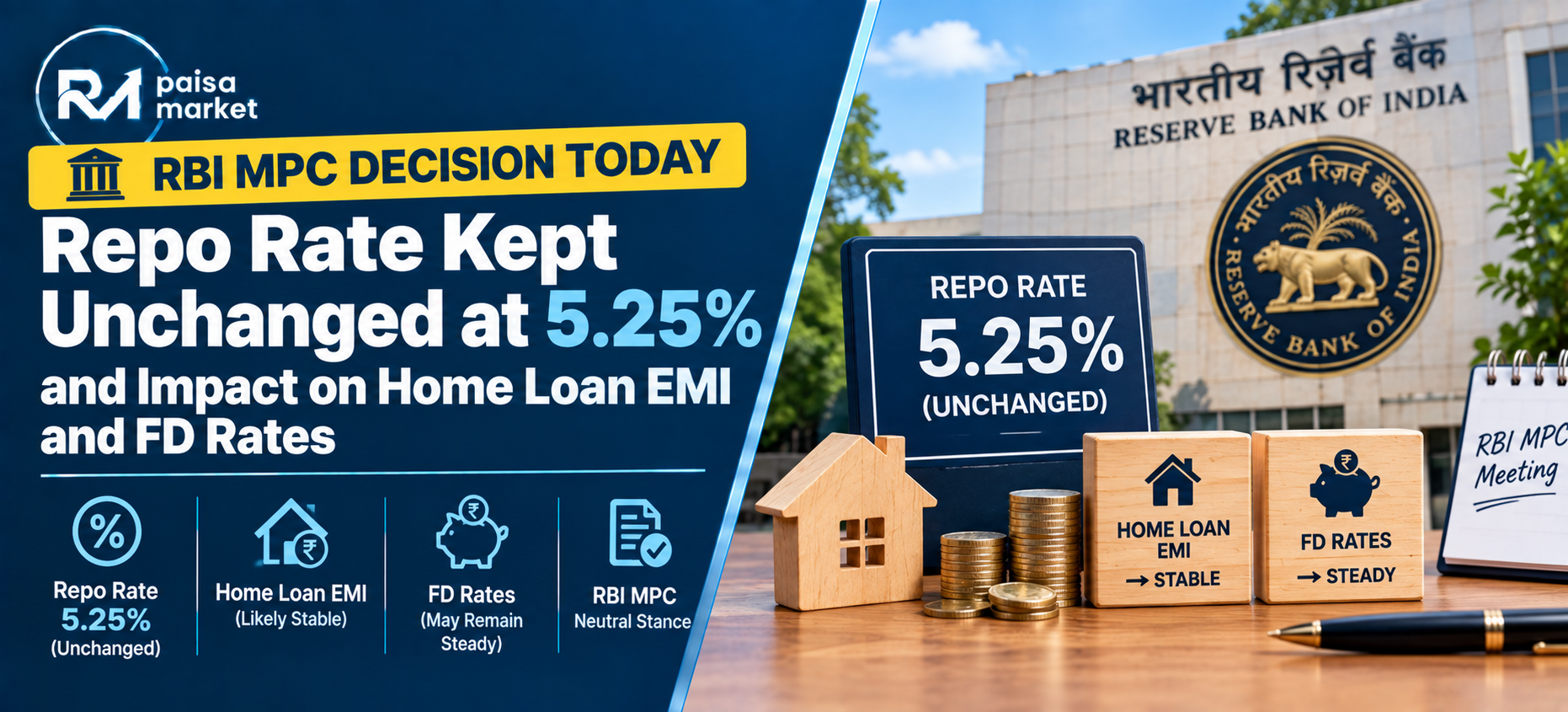
The Reserve Bank of India (RBI) has kept the repo rate unchanged at 5.25% following the Monetary Policy Committee (MPC) meeting held from 3–5 August 2026. The six-member committee unanimously voted to maintain the policy rate while retaining its neutral monetary policy stance.
For borrowers and savers, the decision means no immediate change in repo-linked home loan EMIs, personal loan interest rates, or bank fixed deposit (FD) rates. Instead, existing borrowers can expect repayment stability, while depositors are unlikely to see banks revise FD rates in the near term.
Key Takeaways
- Repo rate remains unchanged at 5.25%.
- Home loan EMIs linked to the repo rate will remain unchanged.
- Personal loan interest rates are expected to stay stable in the near term.
- Bank FD rates are unlikely to witness immediate revisions.
- Other policy rates: Standing Deposit Facility (SDF) at 5.00%, while the Marginal Standing Facility (MSF) and Bank Rate remain at 5.50%.
Quick Facts
| Particular | Details |
|---|---|
| Policy Repo Rate | 5.25% (Unchanged) |
| Policy Stance | Neutral |
| Standing Deposit Facility (SDF) | 5.00% |
| Marginal Standing Facility (MSF) | 5.50% |
| Bank Rate | 5.50% |
| MPC Meeting Dates | 3–5 August 2026 |
| Decision | Unanimous |
| FY27 GDP Growth Forecast | 6.7% |
| FY27 CPI Inflation Forecast | 5.0% |
What Did the RBI Announce?
Repo Rate Remains Unchanged at 5.25%
In its latest monetary policy review, the RBI’s Monetary Policy Committee decided to keep the benchmark repo rate unchanged at 5.25%. The committee also retained the neutral stance, signalling that future policy decisions will continue to depend on incoming inflation and growth data rather than committing to either a rate hike or a cut.
This marks the fourth consecutive MPC meeting where the central bank has maintained the status quo on policy rates after the last reduction in the repo rate.
For consumers, the decision provides stability, particularly for borrowers whose loans are directly linked to the repo rate.
Growth Outlook Improves, Inflation Forecast Softens
Alongside the policy decision, the RBI marginally revised its macroeconomic outlook.
The central bank:
- Raised FY2026–27 GDP growth projection to 6.7%, reflecting continued strength in domestic demand and economic activity.
- Lowered the CPI inflation forecast to 5.0%, indicating expectations of relatively softer inflation compared to earlier projections, while continuing to monitor food prices, weather-related risks and global uncertainties.
The RBI noted that although inflation has moderated in recent months, risks arising from volatile food prices, crude oil movements and geopolitical developments continue to warrant caution.
Impact on Home Loan EMIs
The RBI’s decision has the biggest impact on millions of existing and prospective home loan borrowers. However, whether your EMI changes depends largely on how your home loan is linked to interest rates.
Repo-Linked Floating Rate Home Loans
If your home loan is linked directly to the RBI repo rate through an External Benchmark Lending Rate (EBLR), there is no immediate change in your interest rate.
That means:
- Your lending rate remains unchanged.
- Your monthly EMI remains the same.
- Your loan tenure also remains unchanged unless your bank revises the spread applicable to your loan.
Since the RBI has not changed the benchmark rate, banks have no reason to automatically adjust repo-linked home loan interest rates.
MCLR-Linked Home Loans
Some borrowers continue to have loans linked to the Marginal Cost of Funds Based Lending Rate (MCLR).
For these borrowers:
- Interest rates do not change immediately after every RBI policy announcement.
- Banks review MCLR periodically based on their own funding costs.
- Any change becomes effective only on your scheduled loan reset date.
As a result, the RBI’s latest decision does not automatically affect MCLR-linked borrowers.
Fixed-Rate Home Loans
Borrowers who opted for a fixed-rate home loan are completely insulated from changes in the repo rate.
Whether the RBI raises, cuts or pauses interest rates:
- Your interest rate remains fixed for the agreed period.
- Your EMI remains unchanged.
- Future RBI policy decisions do not directly impact your repayment unless your loan converts to a floating-rate structure.
EMI Illustration: Why Nothing Changes
The easiest way to understand the RBI’s latest decision is to compare it with a hypothetical scenario where the central bank had reduced rates.
| Loan Amount | Tenure | EMI After RBI Decision | EMI if Repo Rate Had Fallen by 25 bps | Difference Today |
|---|---|---|---|---|
| ₹50 lakh | 20 Years | Unchanged | Would have reduced | ₹0 |
| ₹75 lakh | 20 Years | Unchanged | Would have reduced | ₹0 |
Because the repo rate has not changed, borrowers will continue paying their existing EMIs.
What Existing Home Loan Borrowers Should Do
Instead of waiting for another rate cut, borrowers should focus on optimising the overall cost of their loan.
Some practical steps include:
- Review your current interest rate once or twice a year.
- Compare your lender’s rate with competing banks.
- Consider a balance transfer only if the savings comfortably exceed processing and switching costs.
- Continue making prepayments whenever possible to reduce overall interest costs.
Advice for New Home Loan Applicants
If you’re planning to take a home loan, the current policy provides a relatively stable borrowing environment.
Rather than delaying your purchase in anticipation of future rate cuts, compare lenders based on:
- Effective interest rate (including spread)
- Processing charges
- Prepayment and foreclosure rules
- Customer service and digital experience
- Flexibility in EMI options
A difference of even 0.20–0.30 percentage points in the lending rate can translate into substantial savings over a 20-year loan tenure.
Impact on Personal Loans and Other Retail Loans
While home loans receive the most attention after every RBI monetary policy announcement, the repo rate also influences other retail borrowing products such as personal loans, auto loans and education loans. Since the RBI has kept the repo rate unchanged at 5.25%, borrowers should not expect any immediate changes in interest rates purely because of this policy decision.
Repo-Linked Personal Loans
Some banks offer personal loans linked to an external benchmark such as the RBI’s repo rate.
For these borrowers:
- Interest rates remain unchanged.
- Monthly EMIs continue at current levels.
- Loan tenure remains the same unless the lender revises the applicable spread.
Since the benchmark rate has not changed, lenders have no regulatory requirement to alter repo-linked personal loan rates immediately.
Fixed-Rate Personal Loans
Most personal loans in India are sanctioned at a fixed interest rate.
For these borrowers:
- The RBI’s latest policy has no direct impact on the interest rate.
- EMIs remain unchanged throughout the loan tenure unless the loan agreement specifically allows revisions.
This means borrowers with existing fixed-rate personal loans can continue with their repayment plans without any immediate changes.
Auto Loans and Education Loans
The same principle broadly applies to other retail loan products.
- Auto loans linked to floating benchmarks are unlikely to see any immediate revision.
- Education loans linked to the repo rate will also remain unchanged unless the lending bank modifies the applicable spread or lending policy.
- Fixed-rate vehicle and education loans remain unaffected.
Although the repo rate is an important benchmark, banks also consider their own funding costs, liquidity position and credit risk while pricing retail loans.
Impact on Bank Fixed Deposits (FDs)
The RBI’s policy decision also matters for millions of depositors who invest in bank fixed deposits (FDs).
Unlike repo-linked loans, however, FD rates do not automatically change after every monetary policy announcement.
Banks determine deposit rates based on several factors, including:
- Liquidity requirements
- Credit demand
- Deposit mobilisation targets
- Competition from other banks
- Overall interest-rate outlook
As a result, a stable repo rate generally means banks have little immediate incentive to sharply increase or reduce FD interest rates.
What Can FD Investors Expect?
With the repo rate unchanged:
- Existing FDs continue earning the contracted interest rate.
- Banks are unlikely to revise deposit rates immediately.
- New FD rates are expected to remain broadly stable in the near term, unless individual banks change their deposit strategy.
For savers, this provides a relatively predictable interest-rate environment.
Indicative FD Interest Rate Trends
Although actual rates vary across banks and tenures, the market currently reflects a broadly stable trend.
| Bank Category | Typical 1–3 Year FD Rate Range* |
|---|---|
| Public Sector Banks | Around prevailing market rates |
| Private Sector Banks | Around prevailing market rates |
| Small Finance Banks | Generally higher than large banks |
*Actual rates vary by bank, tenure, customer category and special deposit schemes.
Before investing, compare the latest rates offered by individual banks instead of relying only on category averages.
Should You Lock in an FD Now?
A stable interest-rate environment can be a good opportunity to review your savings strategy.
Instead of investing your entire amount in a single fixed deposit, many financial planners recommend FD laddering.
Under this approach, you divide your investment across multiple FDs with different maturities—for example:
- 1 year
- 2 years
- 3 years
- 5 years
This strategy offers several benefits:
- Regular liquidity as deposits mature at different times.
- Flexibility to reinvest if interest rates rise.
- Reduced reinvestment risk.
- Better balance between returns and access to funds.
For conservative investors, laddering remains a practical approach when interest rates are expected to stay broadly stable.
Why Did the RBI Keep the Repo Rate Unchanged?
The RBI’s Monetary Policy Committee balances two key objectives—controlling inflation and supporting economic growth. In the August 2026 policy review, the committee concluded that maintaining the current policy rate best supports both goals.
Inflation Requires Continued Vigilance
Although inflation has moderated compared with previous highs, the RBI believes certain risks remain.
These include:
- Food price volatility
- Fluctuations in global crude oil prices
- Weather-related uncertainties affecting agricultural output
- Geopolitical developments that may disrupt global supply chains
Keeping the repo rate unchanged allows the central bank to monitor these evolving risks before considering further policy action.
India’s Growth Outlook Remains Strong
At the same time, the RBI expressed confidence in the domestic economy by raising its FY2026–27 GDP growth forecast to 6.7%.
Growth continues to be supported by:
- Strong domestic consumption
- Government capital expenditure
- Healthy services sector activity
- Improving investment momentum
The upward revision suggests that economic activity remains resilient despite global uncertainties.
Neutral Policy Stance Offers Flexibility
The RBI also retained its neutral monetary policy stance.
A neutral stance means the central bank is not signalling a predetermined direction for future interest rates. Instead, future decisions will depend on incoming economic data, particularly inflation, growth, liquidity conditions and global developments.
For borrowers and depositors, this indicates that while interest rates are stable for now, future policy actions will continue to be data-driven rather than pre-committed.
What Should Borrowers and Depositors Do Now?
The RBI’s decision to keep the repo rate unchanged at 5.25% provides stability for both borrowers and savers. While there is no immediate impact on loan EMIs or fixed deposit rates, this is a good time to review your financial decisions and ensure you’re getting the best available deal.
If You Already Have a Home Loan
Existing borrowers with repo-linked floating-rate home loans can expect their EMIs to remain unchanged.
Here’s what you should consider:
- Continue paying your current EMI without expecting an immediate reduction.
- Review your interest rate periodically to ensure it remains competitive.
- Consider a home loan balance transfer only if the savings outweigh processing fees and other switching costs.
- Make part-prepayments whenever possible to reduce your overall interest burden.
If You’re Planning to Take a Home Loan
The current interest-rate environment is relatively stable, making it a good time to compare lenders instead of waiting for another policy review.
Before applying, compare:
- Effective interest rate (not just the advertised rate)
- Processing fees and other charges
- Prepayment and foreclosure rules
- Loan tenure flexibility
- Customer service and digital loan management options
Even a small difference in interest rates can significantly reduce the total cost of borrowing over the life of the loan.
If You’re Applying for a Personal Loan
Personal loan applicants are also unlikely to see immediate changes in lending rates due to the RBI’s latest policy.
Before choosing a lender:
- Compare Annual Percentage Rate (APR), not just the headline interest rate.
- Check processing fees and foreclosure charges.
- Borrow only what you genuinely need.
- Maintain a healthy credit score to improve your chances of securing better terms.
If You’re Investing in Bank Fixed Deposits
For depositors, the stable repo rate suggests that banks are unlikely to make significant changes to FD rates in the immediate future.
You may consider:
- Locking in current rates if they meet your investment goals.
- Using an FD laddering strategy to spread investments across different maturities.
- Comparing rates offered by public sector, private sector and small finance banks before investing.
- Reviewing senior citizen FD schemes if you are eligible, as they often offer higher returns.
Keep an Eye on the Next MPC Meeting
Although interest rates remain unchanged today, future policy decisions will depend on inflation, economic growth and global developments.
Borrowers and investors should watch the next RBI Monetary Policy Committee meeting scheduled for October 2026, which could provide fresh guidance on the interest-rate outlook.
Key Numbers at a Glance
| Parameter | Current Status | Immediate Impact |
|---|---|---|
| Repo Rate | 5.25% | No change in repo-linked loan rates |
| Policy Stance | Neutral | Future decisions remain data-dependent |
| Home Loan EMI | Unchanged | Repo-linked floating-rate loans remain stable |
| Personal Loan Rates | Stable | No automatic revision |
| Bank FD Rates | Broadly Stable | No immediate pressure to increase or decrease |
| FY27 GDP Forecast | 6.7% | Improved growth outlook |
| FY27 CPI Inflation Forecast | 5.0% | Slightly lower inflation projection |
| Next RBI MPC Review | October 2026 | Markets will watch for any policy shift |
Frequently Asked Questions (FAQs)
-
Will bank FD rates fall now?
There is no immediate indication that banks will reduce fixed deposit rates because of this policy. Banks also consider liquidity, competition and deposit mobilisation while deciding FD rates.
-
Should I wait before taking a home loan?
If you need a home loan now, it is generally better to compare available offers based on the overall borrowing cost rather than delaying your purchase in anticipation of future rate cuts.
-
Will personal loan interest rates change?
Not immediately. Existing repo-linked personal loans are expected to remain unchanged, while fixed-rate personal loans are unaffected by the RBI’s policy decision.
-
Will my home loan EMI reduce after this policy?
No. Since the repo rate has remained unchanged, borrowers with repo-linked floating-rate home loans will generally continue paying the same EMI unless their lender changes the applicable spread.
-
Why did the RBI keep the repo rate unchanged?
The RBI maintained the repo rate at 5.25% to balance inflation management with economic growth. While inflation has moderated, the central bank continues to monitor food prices, crude oil movements and global uncertainties before making further policy changes.
-
What is the RBI repo rate?
The repo rate is the interest rate at which the Reserve Bank of India lends short-term funds to commercial banks. It serves as a key benchmark influencing borrowing costs across the economy.
Conclusion
The RBI’s decision to keep the repo rate unchanged at 5.25% provides welcome stability for borrowers and depositors alike. Home loan EMIs linked to the repo rate will remain unchanged, personal loan interest rates are expected to stay broadly stable, and banks are unlikely to revise FD rates immediately.
Rather than trying to predict the RBI’s next move, borrowers should focus on securing competitive loan terms, while depositors should compare FD offerings across banks and choose tenures that align with their financial goals.
With the next Monetary Policy Committee meeting scheduled for October 2026, borrowers and investors should continue monitoring policy developments, but for now, the message is clear: interest rates remain steady, and so do your borrowing and savings costs.