 contact.paisamarket@gmail.com
Updated: 12 August 2026, 10:53 p.m. IST | July 2026 CPI data is provisional.
India’s retail inflation rose to 4.45% in July 2026, up from 4.38% in June, according to provisional data released by the Ministry of Statistics and Programme Implementation (MoSPI). Food inflation accelerated to 5.52%, with rural inflation at 4.84% and urban inflation at 3.96%.
The July CPI reading is above the Reserve Bank of India’s 4% inflation target for the second consecutive month. However, it does not automatically mean higher home-loan EMIs or an immediate RBI rate hike.
Bottom line: Food prices were the biggest pressure point in July. Your EMI will not change simply because CPI rose to 4.45%. The inflation data could, however, influence expectations about future RBI policy.
Key Numbers: July 2026 CPI Inflation
| Indicator | July 2026 (Provisional) | June 2026 (Final) | Change |
|---|---|---|---|
| Headline CPI | 4.45% | 4.38% | ↑ |
| Food Inflation (CFPI) | 5.52% | 5.32% | ↑ |
| Rural CPI | 4.84% | 4.74% | ↑ |
| Urban CPI | 3.96% | 3.93% | ↑ |
| RBI Medium-Term Target | 4% | — | Above target |
The July figures are based on the new CPI series with 2024 as the base year. MoSPI has classified the July 2026 CPI and CFPI figures as provisional.
Why Did Inflation Rise in July 2026?
The main pressure came from food prices. All-India food inflation, measured by the Consumer Food Price Index (CFPI), increased to 5.52% in July from 5.32% in June. Rural food inflation was higher at 5.79%, compared with 5.05% in urban areas.
Some individual food items recorded particularly sharp year-on-year increases.
Food Items With Sharp Inflation
| Item | July 2026 Inflation |
|---|---|
| Ginger | 83.62% |
| Garlic | 35.36% |
| Onion | 22.54% |
MoSPI’s July data also showed deflation in several items. Potato inflation was -16.56%, tomato was -4.59%, lady’s finger was -5.52% and peas was -5.27%. This means the 5.52% food-inflation figure is an aggregate measure rather than an increase in the price of every food item.
Housing inflation was 2.22% in July, while rural headline inflation at 4.84% remained significantly above urban inflation at 3.96%.
What July CPI Inflation Means for Your Household Budget
For households, the most visible impact is likely to come through food spending.
A household buying vegetables, spices and other food products may see different price changes depending on its consumption pattern. The national CFPI number of 5.52% is an average index and should not be interpreted as saying every family’s food bill has increased by exactly 5.52%.
For illustration, if a household spends ₹10,000 on a comparable food basket and prices for that basket rise by 5.52%, the same basket would cost about ₹10,552. This is only a mathematical illustration; actual household spending depends on the items purchased and changes in consumption.
What matters most for your budget: track the specific food categories that make up a large share of your monthly spending rather than relying only on headline CPI.
What Does 4.45% CPI Inflation Mean for the RBI?
July CPI inflation at 4.45% puts headline inflation above the RBI’s 4% target for a second consecutive month.
That can support a more cautious approach to further monetary-policy easing. But a single CPI reading does not automatically trigger a rate hike.
The RBI considers a wider set of factors, including inflation trends, food prices, growth, liquidity, global developments and other risks when deciding monetary policy.
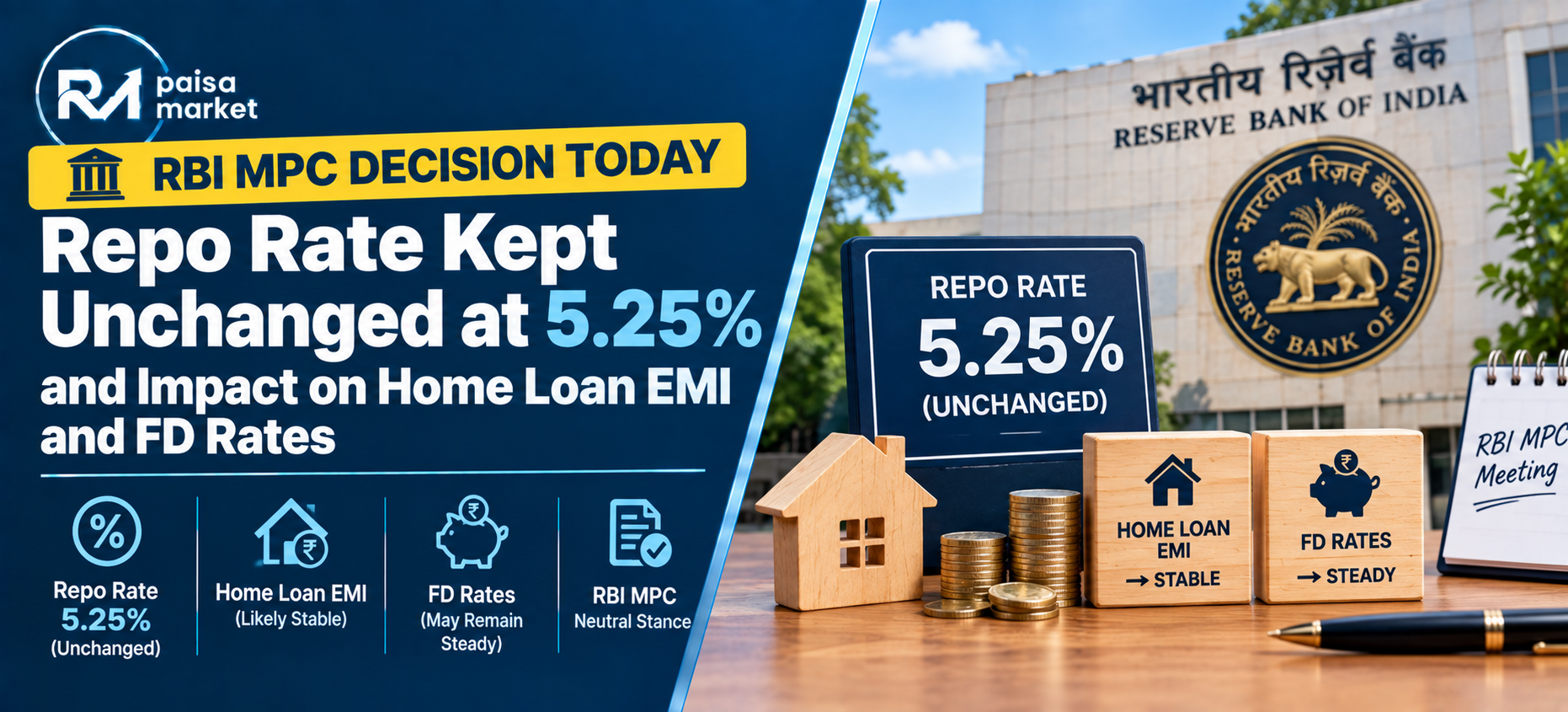
The current policy repo rate is 5.25%. The July CPI release therefore comes after the August 2026 MPC decision rather than before it. The inflation data will be relevant to expectations for subsequent policy decisions, not to the August decision that has already been announced.
Important: 4.45% inflation does not mean the RBI must raise the repo rate. It simply adds to the information the central bank will assess when considering future policy.
Will Your Home-Loan EMI Rise After July CPI Inflation?
No — not because of the CPI release itself.
A monthly CPI print does not directly reprice your home loan. Your EMI or interest rate changes only if your lender revises the applicable lending rate under your loan’s terms.
For floating-rate loans, the relevant factors can include the external benchmark, the lender’s spread and the contractual reset date.
How Different Home Loans Are Affected
- Repo-linked/external-benchmark floating loans: A future change in the benchmark rate can affect the loan when the lender applies the change under the loan’s reset mechanism.
- MCLR-linked loans: Changes generally depend on the applicable reset date and the lender’s MCLR.
- Fixed-rate loans: A CPI release does not by itself change the contracted interest rate.
So, if you are a borrower, the important question is not simply whether July CPI rose to 4.45%. Check which benchmark your loan uses, your spread, your reset frequency and the terms of your loan agreement.
A Simple EMI Illustration
Suppose a borrower has a ₹50 lakh home loan with a 20-year remaining tenure.
A hypothetical 25-basis-point change in the interest rate can materially affect the interest cost and repayment structure. But the actual EMI impact depends on the outstanding principal, remaining tenure, lender’s reset mechanism and whether the borrower chooses to keep the EMI unchanged or alter the tenure.
Do not assume that a CPI change automatically means a 25-basis-point loan-rate change. They are separate events.
What About Personal Loans, Fixed Deposits and Investments?
Personal Loans
The same basic principle applies to personal loans: CPI does not directly change the interest rate on your existing loan.
If a lender changes the applicable interest rate under the loan agreement, the repayment cost can change. Otherwise, the CPI release itself does not automatically alter your EMI.
Fixed Deposits
Inflation matters when evaluating the real return from a fixed deposit.
For example, a hypothetical FD earning 7% a year against 4.45% inflation would imply a simple pre-tax difference of roughly 2.55 percentage points. This is not the exact real return calculation because compounding, taxes and the applicable inflation measure also matter.
FD rates themselves are determined by banks based on factors including funding requirements, liquidity and market conditions. A CPI release does not automatically force banks to change FD rates.
Stocks and Bonds
Inflation can also influence financial markets because investors use inflation data when assessing interest-rate expectations, bond yields, corporate costs and future earnings.
The market reaction, however, can vary by sector and by how the actual CPI number compares with expectations.
What Should You Watch Next?
The July CPI number is only one part of the inflation story.
Keep an eye on:
- August food prices, particularly vegetables and other volatile categories.
- Core inflation estimates, which analysts commonly calculate after excluding food and fuel.
- Rural versus urban inflation, given the current gap between the two.
- Fuel and energy-related prices and their effect on household costs.
- Future RBI MPC communication and how policymakers assess the inflation-growth balance.
- Whether food inflation eases or remains elevated in the coming months.
The next CPI release is scheduled for 14 September 2026, according to MoSPI’s July release.
July CPI Inflation Trend: May to July 2026
| Month | CPI Inflation |
|---|---|
| May 2026 | 3.93% |
| June 2026 | 4.38% |
| July 2026 | 4.45% (Provisional) |
The sequence shows headline CPI moving higher for two consecutive months, from 3.93% in May to 4.38% in June and 4.45% in July. The June figure is final, while July remains provisional.
July CPI Inflation: Myths vs Facts
| Claim | Fact |
|---|---|
| 4.45% CPI means the RBI will immediately hike rates | Not automatic. The RBI considers multiple economic indicators. |
| Home-loan EMIs rise whenever CPI rises | Incorrect. Loan rates depend on the lender’s applicable benchmark, spread and reset mechanism. |
| Every food item became 5.52% more expensive | Incorrect. 5.52% is the aggregate CFPI inflation rate. |
| Rural and urban inflation were the same | Incorrect. Rural CPI was 4.84% versus 3.96% for urban CPI. |
| July CPI is final | Incorrect. The July 2026 figure is provisional. |
| A CPI release directly changes FD rates | Incorrect. Banks determine deposit rates based on broader funding and market conditions. |
FAQ: July CPI Inflation 2026
What was India’s July 2026 CPI inflation?
India’s headline CPI inflation was 4.45% in July 2026, according to provisional MoSPI data. It was 4.38% in June 2026.
What was India’s July 2026 food inflation?
Food inflation, measured by the Consumer Food Price Index, was 5.52% in July 2026, compared with 5.32% in June.
Will the RBI raise the repo rate because CPI reached 4.45%?
Not automatically. The July inflation reading may support a cautious policy approach, but the RBI considers inflation, growth and other economic and financial conditions before changing the repo rate.
Will my home-loan EMI increase because CPI rose?
No, not because of the CPI release alone. Your EMI or interest rate changes only when the applicable lending rate is revised under your loan’s terms and reset mechanism.
Why was rural inflation higher than urban inflation?
July rural CPI inflation was 4.84%, compared with 3.96% in urban areas. Different consumption patterns and price movements across regions can produce different inflation rates.
Is 4.45% CPI inflation above the RBI target?
Yes. The RBI’s medium-term inflation target is 4%, so July’s 4.45% reading is above the target. However, it remains within the broader 2%-6% tolerance band.
What You Can Do Now
For households and borrowers, the July CPI number is more useful as a signal than as a trigger for an immediate financial decision.
If you have a home loan:
- Check whether your loan is fixed, MCLR-linked or external-benchmark-linked.
- Check the applicable interest rate and spread.
- Check your next reset date.
- Review prepayment or refinancing decisions only after comparing the applicable rate, fees and other costs.
If you are managing household expenses:
- Track your actual food basket rather than the headline CPI alone.
- Review categories where prices have risen sharply.
- Avoid assuming that every household experiences the national inflation rate in the same way.
If you are a fixed-deposit investor:
- Compare the FD rate with inflation and taxes.
- Consider your investment horizon before locking money into a particular tenure.
- Do not assume that one CPI reading will immediately change bank deposit rates.
The Bottom Line
India’s July CPI inflation rose to 4.45%, from 4.38% in June, while food inflation increased to 5.52%. Rural inflation at 4.84% remained higher than urban inflation at 3.96%.
The biggest immediate pressure is on household food budgets. For the RBI, the reading keeps headline inflation above its 4% target and may reinforce a cautious approach to future monetary-policy decisions.
But there is an important distinction for borrowers: July CPI inflation does not automatically increase your home-loan EMI, personal-loan rate or FD rate. Any change in borrowing costs depends on lender decisions, benchmarks, contractual reset mechanisms and future RBI policy.
The July figures are provisional, so future revisions should be checked against the latest MoSPI release.
Sources
- MoSPI/PIB — Consumer Price Index for July 2026: official provisional CPI, CFPI, rural and urban inflation figures.
- Reserve Bank of India — Current Policy Rates: repo rate currently listed at 5.25%.
Editorial note: July 2026 CPI data is provisional. PaisaMarket will update this article if MoSPI revises the published figures.