 contact.paisamarket@gmail.com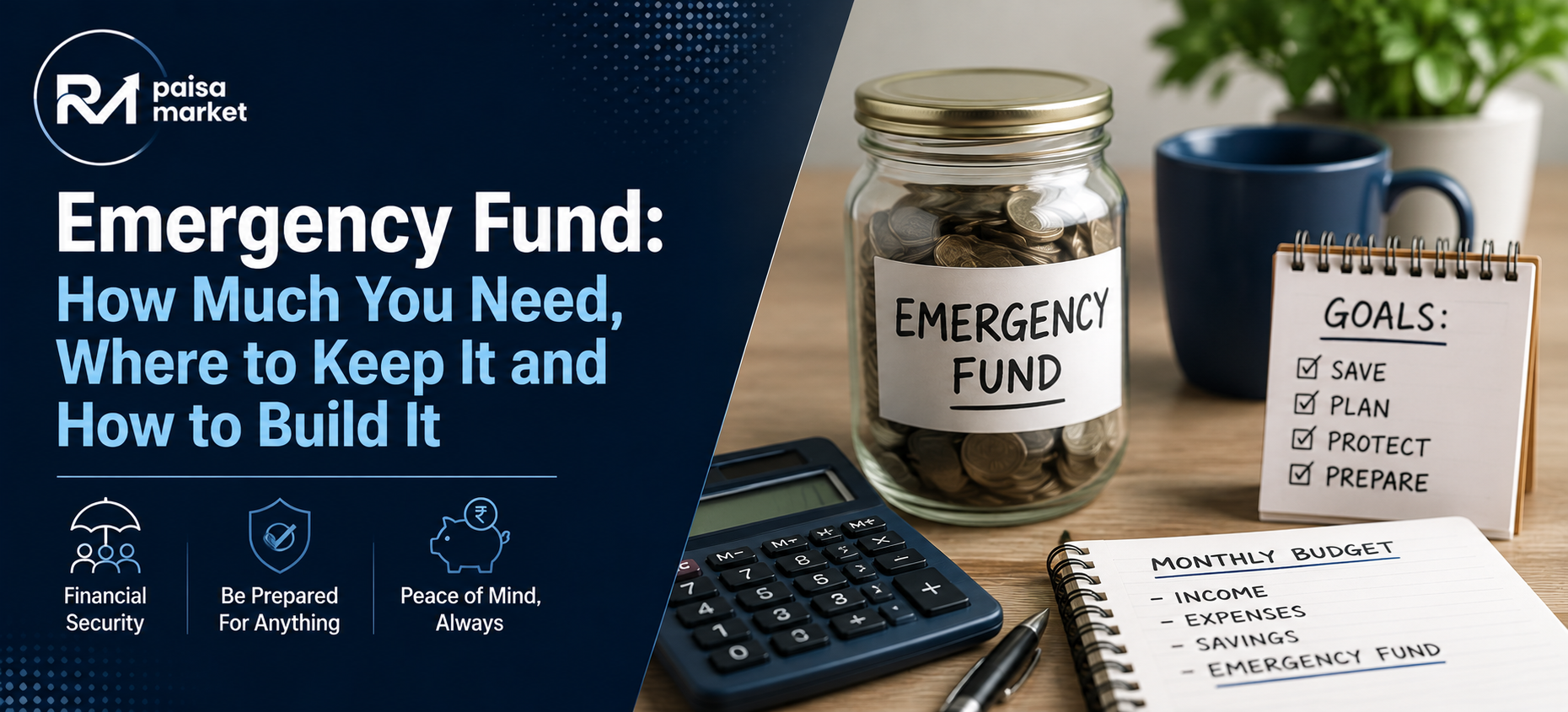
An emergency fund is money kept aside for unexpected and necessary expenses, such as job loss, medical treatment, urgent repairs or a sudden family need.
But how much emergency fund should you have?
A common starting point is three to six months of essential expenses, but the right amount depends on your income stability, dependants, debt and financial responsibilities.
Quick answer
- Start with one month of essential expenses if you currently have no emergency savings.
- Gradually build towards three to six months of essential expenses.
- If your income is irregular or several people depend on you, consider a larger buffer.
- Keep emergency money accessible and relatively low-risk rather than chasing the highest return.
The important thing is not to build a perfect emergency fund overnight. Start with an amount you can sustain and build it gradually.
How Much Emergency Fund Do You Need?
There is no single emergency-fund amount that works for everyone.
Instead of looking at your salary, start by calculating how much you need to cover your essential monthly expenses.
Step 1: Identify your essential expenses
Your emergency fund should generally cover expenses you cannot simply stop paying during a financial emergency.
These can include:
- Rent or home-loan EMI
- Groceries and basic household expenses
- Electricity, internet and phone bills
- School or essential care costs
- Insurance premiums
- Transport
- Minimum loan repayments
- Necessary medicines and medical expenses
You can separate expenses such as:
- Vacations
- Eating out
- Shopping
- Entertainment
- Optional subscriptions
- Planned investments
These are not normally part of your basic emergency-fund calculation.
Step 2: Decide how many months you need
A useful planning framework is:
| Situation | Starting range |
|---|---|
| Stable income and low financial obligations | 3 months |
| Single-income household or dependants | 4–6 months |
| Freelance, commission-based or irregular income | 6–12 months |
| High EMI, medical or employment uncertainty | Closer to the higher end |
These are planning ranges, not official financial rules.
Someone with a stable salaried job and limited responsibilities may be comfortable with a smaller buffer. A freelancer supporting a family may need considerably more.
Step 3: Use the emergency-fund formula
Emergency-fund target = Essential monthly expenses × Number of months
For example, suppose your essential monthly expenses are ₹40,000.
- 3 months = ₹1.2 lakh
- 6 months = ₹2.4 lakh
- 12 months = ₹4.8 lakh
You do not necessarily need to reach the final number immediately.
Recalculate the target whenever your rent, EMI, family responsibilities, income or other essential expenses change.
Build Your Emergency Fund in Stages
Looking at a target of ₹2 lakh or ₹3 lakh can feel overwhelming if you are starting from zero.
A staged approach is easier.
Stage 1: Create a starter buffer
Start with one month of essential expenses.
If that feels difficult, start with an amount that can cover a common urgent expense. The goal is to create your first layer of financial breathing room.
Stage 2: Reach three months
For many households with relatively stable income, three months of essential expenses can provide a useful basic buffer.
Stage 3: Expand based on your situation
Consider moving towards six months or more if you:
- Have irregular income
- Are self-employed
- Have several dependants
- Have high fixed expenses
- Have significant EMIs
- Face greater employment uncertainty
The goal is not to hit a particular number because someone else recommends it. Your emergency fund should reflect your own financial situation.
What Counts as an Emergency?
An emergency fund is meant for expenses that are unexpected, necessary and difficult to postpone.
Situations where you may use it
Examples include:
- Loss of employment or sudden income disruption
- Urgent medical treatment
- Essential home repairs
- Necessary vehicle repairs
- Emergency travel because of a family situation
- Essential expenses during a temporary income gap
What usually does not count as an emergency?
Generally, you should not treat the following as emergencies:
- Holidays
- New phones or gadgets
- Festival shopping
- Planned weddings
- Routine annual bills
- A planned property down payment
- Lifestyle upgrades
There is an important distinction here.
A large annual insurance premium may be necessary, but if you know when it is due, it is predictable. It can therefore be handled through a separate savings bucket rather than your emergency fund.
The same applies to school fees, annual maintenance and planned festivals.
Where Should You Keep an Emergency Fund?
The emergency fund has a different job from a long-term investment.
Its priorities should generally be:
- Safety of principal
- Easy access
- Reasonable return
You should not sacrifice access or take unnecessary market risk simply to earn a little more.
Common options
| Option | Access | Main advantage | Main limitation |
|---|---|---|---|
| Savings account | Immediate | Simple and highly accessible | Interest may be relatively low |
| Sweep-in or flexi FD | Usually quick | Can offer better returns than a regular savings account in some cases | Rules and premature-withdrawal terms vary |
| Short-term FD | Usually available after breaking it | Predictable return | Penalty or reduced interest may apply |
| Liquid mutual fund | Usually next business day, subject to fund process | Can be an alternative for part of the fund | Not a bank deposit; value and access are not identical to a savings account |
| Overnight mutual fund | Designed for very short-term holdings | Lower duration risk than longer-duration debt funds | Still a market-linked mutual fund |
A simple way to divide the fund
You do not necessarily have to keep the entire emergency fund in one place.
For example, the amount you may need immediately can remain in a savings account.
A second layer could potentially be kept in a sweep-in FD or another highly liquid option, provided you understand its access rules.
Market-linked options should only be considered after you understand their risks, redemption process and tax treatment.
The basic principle is simple:
An emergency fund should be available when you need it, not just valuable on paper.
What about deposit insurance?
Bank deposits and mutual funds are not the same thing.
Eligible bank deposits are covered by DICGC deposit insurance up to ₹5 lakh per depositor per bank, including principal and interest, subject to applicable rules such as the “same right and same capacity” condition.
A mutual fund does not receive DICGC deposit insurance simply because it invests in short-term debt instruments.
So do not treat every product marketed as a low-risk option as equivalent to a bank deposit.
Emergency Fund vs Other Savings Goals
One common mistake is mixing emergency money with money meant for predictable or long-term goals.
| Goal | Main priority | Broad category |
|---|---|---|
| Emergency fund | Access and capital protection | Savings account, sweep-in FD or carefully selected liquid option |
| Annual insurance or school payment | Predictability and timing | Separate savings or short-term deposit |
| House purchase in 1–3 years | Capital preservation and time horizon | Suitable short-term deposits or low-risk options |
| Retirement or long-term wealth | Long-term growth | Investments appropriate to your risk capacity |
The same financial product does not necessarily make sense for every goal.
For example, money you need in an emergency should not be treated like retirement money that can remain invested for decades.
How to Build an Emergency Fund Step by Step
Once you know your target, the next question is: How do you actually get there?
Step 1: Calculate your target
Use essential expenses rather than your entire monthly spending.
For example:
₹40,000 essential expenses × 6 months = ₹2.4 lakh target.
Step 2: Create a separate savings bucket
Keep the emergency fund separate from your everyday spending account.
This reduces the chance of accidentally spending it.
Step 3: Automate a sustainable contribution
Set up an automatic transfer after your salary or regular income arrives.
The amount should be realistic enough that you can continue it every month.
Saving ₹5,000 consistently is better than setting an unrealistic target of ₹20,000 and stopping after two months.
Step 4: Use windfalls selectively
Bonuses, tax refunds or other irregular income can help accelerate the fund.
You do not have to put all of a windfall into the emergency fund. The important thing is to use such income deliberately rather than allowing it to disappear into discretionary spending.
Step 5: Increase savings when income rises
When your salary or income increases, consider directing part of the increase towards the emergency fund until you reach your target.
Step 6: Review the target periodically
Your emergency-fund requirement can change.
Review it after:
- A job change
- Marriage
- Having a child
- Taking a major loan
- Moving to a higher-rent home
- A significant change in medical needs
- A major change in household income
Step 7: Replenish the fund after using it
If you genuinely need to use your emergency fund, use it.
That is what it is there for.
After the emergency has passed, start rebuilding the amount instead of feeling that you have failed at saving.
How to Use Your Emergency Fund Without Feeling Guilty
An emergency fund is not supposed to sit untouched forever.
If you lose your job and need it to pay rent, or face an urgent repair that you cannot postpone, using the fund is exactly what it was designed for.
After withdrawing money:
- Record how much you used.
- Note the reason.
- Temporarily reduce non-essential spending if necessary.
- Restart your monthly contributions.
- Rebuild the fund in stages.
You do not need to wait until you can replace the entire amount in one go.
Common Emergency-Fund Mistakes
Even people who save regularly can make mistakes with their emergency fund.
1. Calculating the target from income
Your emergency fund should generally be based on essential expenses, not your salary.
2. Keeping everything as physical cash
Keeping some emergency cash at home may be useful for very small immediate needs, but keeping the entire fund as physical cash creates security and loss risks.
3. Investing the entire fund in equities
Stocks can fall precisely when you need the money.
An emergency fund and a long-term equity portfolio serve different purposes.
4. Locking all the money away
A product offering a higher return is not necessarily better if accessing the money during an emergency is difficult or expensive.
5. Keeping it in your spending account
If emergency savings sit alongside your normal spending money, it can become easier to spend them accidentally.
6. Counting your credit-card limit as savings
A credit card is a borrowing facility, not an emergency fund.
If you cannot repay the balance, the emergency can become an expensive debt problem.
7. Counting future income
An expected bonus or future salary is not the same as money already available.
Do not build your emergency plan around money you have not received.
8. Ignoring penalties and redemption rules
Before using an FD or mutual fund as part of your emergency arrangement, understand how quickly you can access the money and what charges or tax implications may apply.
9. Never increasing the target
If your essential expenses rise from ₹40,000 to ₹55,000 a month, your old emergency-fund target may no longer provide the same protection.
10. Using the emergency fund for predictable expenses
Planned expenses should ideally have their own savings buckets.
That leaves the emergency fund available for genuinely unexpected situations.
Emergency Fund for Different Situations
Your circumstances can change how much you need.
If you are a salaried employee
A stable salary can make your income more predictable, but you should still consider how long it could realistically take to find another job.
A smaller initial target may be practical if your income is stable and household obligations are limited.
If you are a freelancer or business owner
Income can fluctuate significantly from month to month.
A larger emergency buffer may therefore be appropriate.
Also keep personal emergency savings separate from business working capital. Money needed to keep a business running is not necessarily available for household emergencies.
If you have a single-income household
Calculate expenses for the entire household.
The emergency fund should not only cover the earning person’s personal expenses if several people depend on that income.
If you have high EMIs
Your minimum loan repayments are part of your essential expenses.
Do not use the entire emergency fund to aggressively prepay a loan and leave yourself without accessible savings.
If you have ongoing medical expenses
Consider expenses that insurance may not fully cover, including applicable deductibles, exclusions and regular medical costs.
If you already have savings
Not every rupee sitting in a bank account is necessarily emergency money.
First separate money already earmarked for:
- Taxes
- Annual premiums
- Fees
- Planned purchases
- School payments
- Other known expenses
Only then determine how much is genuinely available as an emergency buffer.
Emergency Fund Calculator
You can calculate your target with a simple formula:
Monthly essential expenses: ₹________
Number of months: ________
Emergency-fund target: ₹________ × ________ = ₹________
Example
If your essential monthly expenses are ₹40,000 and you want six months of protection:
₹40,000 × 6 = ₹2.4 lakh
Now calculate how much you need to save each month.
Monthly contribution = Target amount ÷ Number of months
For example, if your target is ₹2.4 lakh and you want to build it over 12 months:
₹2.4 lakh ÷ 12 = ₹20,000 per month
If ₹20,000 a month is not realistic, extend the timeline or start with a smaller target.
The objective is to create a sustainable saving habit rather than putting your regular budget under unnecessary pressure.
Frequently Asked Questions
How much emergency fund should I have?
A common planning range is three to six months of essential expenses. If your income is irregular, you have high fixed expenses or several people depend on you, you may need a larger buffer.
Should I keep my emergency fund in a fixed deposit?
A sweep-in or breakable FD can be used for part of an emergency fund if its access rules and premature-withdrawal terms work for you. Avoid locking away money that you may need immediately.
Are liquid mutual funds completely safe?
No. Liquid mutual funds are mutual funds, not bank deposits. They do not provide a guaranteed return or DICGC deposit insurance, and their redemption process and risks should be understood before using them for emergency savings.
Should I build an emergency fund while I have loans?
Yes, maintaining at least a basic cash buffer can be important while repaying loans. The right balance between emergency savings and debt repayment depends on your interest rate, income stability and financial obligations.
Should I keep my emergency fund in a joint account?
A joint account can make emergency money accessible to both household members if the account’s operating instructions allow it. Make sure everyone who may need the money understands how to access it.
How long does it take to build an emergency fund?
There is no fixed timeline. Divide your target by a realistic monthly contribution to estimate how long it may take. You can accelerate the process when your income or cash flow improves.
Is a credit-card limit an emergency fund?
No. A credit card gives you access to borrowed money. It can become expensive if you cannot repay the balance, so it should not replace emergency savings.
The Bottom Line
An emergency fund is not an investment competition.
Its purpose is simple: to give you accessible money when your income stops or an unavoidable expense arrives.
You do not need to build a six-month emergency fund overnight. Start with a small buffer, calculate your target using essential expenses and gradually work towards three to six months or more if your circumstances require it.
Keep the money accessible, understand the risks of wherever you place it, and review the target whenever your financial situation changes.
The best emergency fund is not necessarily the one earning the highest return. It is the one that is available when you genuinely need it.