 contact.paisamarket@gmail.com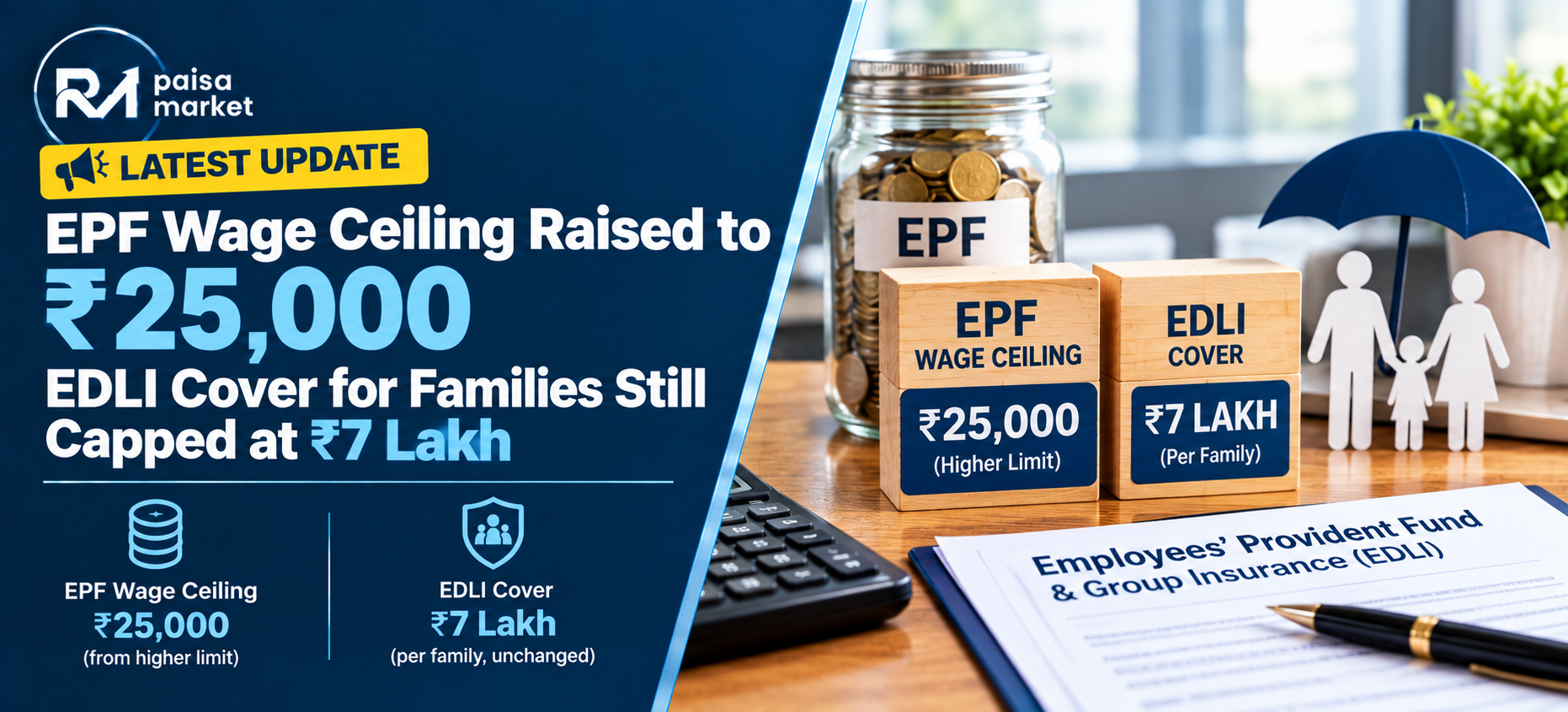
The recent increase in the EPF wage ceiling from ₹15,000 to ₹25,000 has created a lot of confusion around the Employees’ Deposit Linked Insurance (EDLI) benefit. Many people saw the new ceiling and assumed the life insurance cover for families had automatically jumped to around ₹10.5 lakh.
The reality is more nuanced. The formula used to calculate the benefit can now produce a higher number. But the maximum amount that the scheme will actually pay to a nominee remains ₹7 lakh. Understanding this distinction is important if you are relying on EDLI as part of your family’s financial protection.
Table of Contents
EPF Wage Ceiling is Now ₹25,000 – But EDLI Cover for Families is Still Capped at ₹7 Lakh
From 17 September 2026, the statutory wage ceiling under EPFO was raised to ₹25,000 per month. This change brings more employees under mandatory coverage and increases the wage figure that goes into several calculations, including EDLI. However, as clarified in recent reporting, the maximum assurance benefit under the EDLI Scheme remains capped at ₹7 lakh.
On paper, the EDLI formula can now generate a benefit of up to ₹10.5 lakh for someone whose average wages are at the new ceiling. However, the EDLI Scheme itself continues to prescribe a maximum assurance benefit of ₹7 lakh. Until that scheme-level cap is separately amended, the higher calculated figure cannot be paid out.
In simple terms: the input number has increased, but the final ceiling on what can be paid has not.
What is EDLI and Why It Matters for Your Family
EDLI is a life insurance benefit that comes automatically with EPF membership. The employee does not pay any premium for it. The employer contributes 0.5% of wages (subject to the wage ceiling) towards the scheme.
If an EPF member dies while still in service, the nominee or eligible family members can claim a lump-sum amount under EDLI. For many middle-income families, this is often one of the few formal sources of immediate financial support available after a sudden death. It is not a large amount by modern standards, but it is a guaranteed statutory benefit that does not require the employee to have bought a separate policy.
How EDLI Benefit is Calculated
The current formula has two components:
- 35 times the average monthly wages drawn during the 12 months preceding the month of death (subject to the applicable wage ceiling).
- 50% of the average Provident Fund balance during the same 12-month period, subject to a maximum of ₹1.75 lakh.
Under the old ₹15,000 ceiling, the calculation typically worked out as:
- 35 × ₹15,000 = ₹5.25 lakh
- Plus up to ₹1.75 lakh from the PF balance component
- Total = ₹7 lakh
With the new ₹25,000 ceiling, the same formula can produce:
- 35 × ₹25,000 = ₹8.75 lakh
- Plus up to ₹1.75 lakh
- Total = ₹10.5 lakh
This is why many people expected the cover to rise automatically. The mathematics supports a higher number.
Why the Maximum Payout is Still Only ₹7 Lakh
This is the most important point to understand.
The ₹7 lakh figure is not merely the result of the old calculation. It is a separate maximum assurance benefit written into the EDLI Scheme. Even when the formula produces ₹10.5 lakh, the scheme currently does not permit payment of more than ₹7 lakh.
Raising the EPF wage ceiling changes the wage input used in the formula. It does not, by itself, rewrite the maximum payable amount under the scheme. A separate government notification is required to increase the scheme’s maximum assurance benefit. As of early October 2026, no such notification has been issued.
This distinction between “what the formula can calculate” and “what the scheme will actually pay” is the reason the cover has not yet increased for families.
What Has Actually Changed After the Wage Ceiling Hike
What has increased:
- The wage figure that enters the EDLI calculation
- The employer’s monthly contribution towards EDLI (now up to ₹125 per employee instead of ₹75)
What has not increased:
- The maximum amount that can be paid to the nominee (still ₹7 lakh)
- The minimum assurance benefit (still ₹2.5 lakh, subject to eligibility)
So while the calculation base has improved, the actual protection available to families remains at the previous level for now.
The wage ceiling increase itself has broader implications for contributions, take-home pay and coverage. For the full picture of how the change affects employees in the ₹15,000–₹25,000 band, see our earlier detailed guide: EPF Wage Ceiling Raised to ₹25,000 – What Changes for Employees.
What This Means for Your Nominee / Family Cover
In practical terms, if an eligible member dies while in service today, the nominee can still receive a maximum of ₹7 lakh under EDLI. In cases where the calculation works out lower, the amount paid will be lower, subject to the minimum of ₹2.5 lakh where the conditions are met.
The higher wage ceiling improves the underlying calculation for members whose wages are above the old limit, but it does not yet translate into a higher payout ceiling. Families that were counting on an automatic increase to ₹10.5 lakh will need to wait for a further amendment to the scheme.
Will the ₹7 Lakh Cap Be Increased Later?
EPFO has indicated that an actuarial valuation of the EDLI fund will be carried out. Any decision to revise benefits would normally follow such a review. However, as of now, there is no notification that raises the maximum assurance benefit above ₹7 lakh.
Until that happens, the current ceiling continues to apply. It would be incorrect to assume that the cover has already increased or that it will automatically rise just because the wage ceiling has moved.
Who Should Pay Attention to This Update
This clarification is particularly relevant for:
- Employees in the ₹15,000–₹25,000 wage band who have newly come under mandatory EPF coverage
- Existing members who saw the ₹10.5 lakh figure being discussed and assumed their family cover had already risen
- Families that currently treat EDLI as their main or only formal life cover
If your financial planning assumed a higher EDLI payout after the wage ceiling change, it is worth revisiting that assumption.
EDLI as Family Protection – Important Perspective
EDLI remains a useful statutory benefit. It requires no premium from the employee and provides a defined lump sum to the family in the event of death while in service. For many workers, it is better than having no formal cover at all.
At the same time, ₹7 lakh is a limited amount in the current cost of living, especially for someone with children, a spouse who is not earning, or outstanding home and education loans. Most people will still need a personal term insurance policy if the goal is meaningful long-term protection for the family.
EDLI should be seen as a base layer that comes with your EPF membership, not as a complete solution for family financial security.
Key Takeaways
- The EPF wage ceiling is now ₹25,000.
- The EDLI formula can mathematically reach up to ₹10.5 lakh.
- The actual maximum amount payable under the scheme remains ₹7 lakh.
- A separate notification is required to raise the scheme’s maximum assurance benefit.
- Until that notification comes, families continue to receive a maximum of ₹7 lakh (or less, based on the calculation).
- The minimum assurance benefit remains ₹2.5 lakh, subject to eligibility.
Frequently Asked Questions
Has EDLI cover increased to ₹10.5 lakh after the wage ceiling hike?
No. The formula can now produce a higher number, but the maximum amount the scheme currently pays is still ₹7 lakh.
Why is the maximum still ₹7 lakh when the calculation shows more?
Because the EDLI Scheme itself contains a separate maximum assurance benefit of ₹7 lakh. Changing the wage ceiling does not automatically change this scheme-level cap.
What is the minimum benefit under EDLI?
The minimum assurance benefit is ₹2.5 lakh, provided the member meets the eligibility conditions under the scheme.
Does a higher wage ceiling automatically mean higher insurance for the family?
It improves the wage figure used in the calculation, but it does not automatically increase the maximum amount that can be paid. That requires a further amendment to the EDLI Scheme.
Has the government issued any notification raising the EDLI maximum?
As of early October 2026, no such notification has been issued. The ₹7 lakh maximum continues to apply.
Final Summary
The increase in the EPF wage ceiling to ₹25,000 allows the EDLI calculation to produce a higher notional figure of up to ₹10.5 lakh. However, the actual maximum amount that can be paid to a nominee under the current EDLI Scheme remains capped at ₹7 lakh. Until the government issues a separate notification raising this scheme-level ceiling, the insurance protection available to families through EDLI has not increased.