contact.paisamarket@gmail.com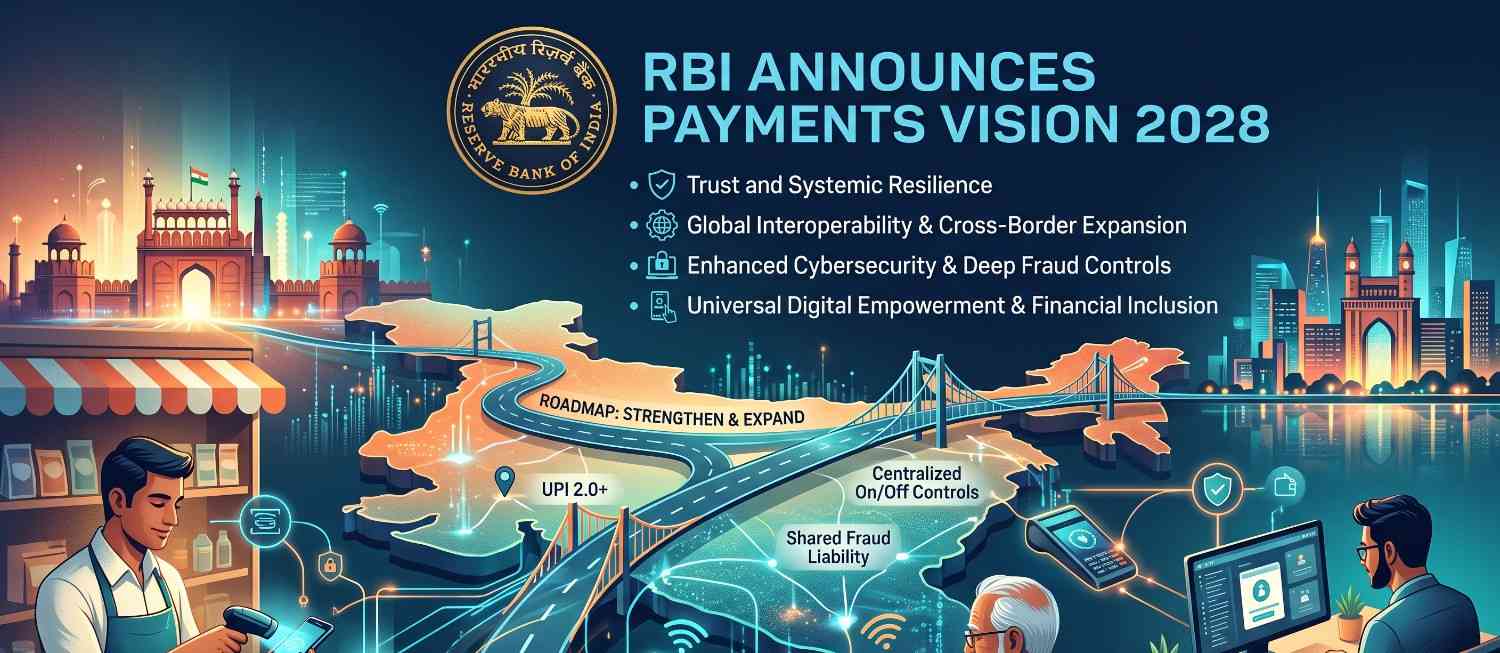
The Reserve Bank of India (RBI) has officially announced its Payments Vision 2028. While previous roadmaps focused heavily on getting citizens to adopt digital payments, the maturity of the Indian ecosystem has prompted a strategic pivot. The new roadmap zeroes in on user empowerment, enhanced cybersecurity, and making digital transactions completely fraud-resilient.
For everyday consumers, retail traders, and small business owners navigating the financial landscape, the RBI’s plan introduces massive structural modifications to your daily banking. Here are the key initiatives that will change how you manage your money by 2028.
1. Universal “Switch On/Off” Control for All Digital Modes
Currently, banks allow users to toggle transaction limits or completely switch on/off their debit and credit cards via mobile apps. The RBI is expanding this granular power across the board.
- The Upgrade: You will soon be able to instantly enable or disable transactions on any digital payment mode—including UPI, IMPS, and net banking—directly through your bank account channels.
- The Impact: This serves as a powerful shield against sudden phishing and cyber frauds. If you aren’t actively using a payment method, you can keep it switched off entirely.
2. Shared Responsibility Framework for Fraud Claims
One of the most radical, pro-consumer changes under discussion is the redistribution of liability for unauthorized digital transactions.
- The Upgrade: Moving away from the current system where liability often traps the customer or only the sender’s bank, the RBI is introducing a Shared Responsibility Framework. Both the remitter’s bank (sending) and the beneficiary’s bank (receiving) will share the liability for unauthorized cyber-fraud transactions.
- The Impact: This forces receiving banks to strictly vet new accounts, stopping fraudsters from easily opening shell accounts to park stolen money.
3. Payments Switching Service (PaSS)
Switching bank accounts or dealing with bank mergers can be an administrative nightmare, especially when migrating all your automated mandates, salary credits, and bill payments.
- The Upgrade: The introduction of PaSS will create a centralized mechanism allowing bank customers to seamlessly transfer all active payment instructions from one financial institution to another.
- The Impact: It fundamentally eliminates account switching friction, boosting competitive service quality across public and private sector banks.
At a Glance: Key Highlights of RBI Payments Vision 2028
| Initiative Feature | What New Guidelines Say | Direct Benefit to Indians |
| Transaction On/Off Switch | Extended from cards to all digital payment modes (UPI, IMPS, etc.). | Instant prevention against remote hacking and financial scams. |
| Fraud Accountability | Implementation of a Shared Responsibility Framework between banks. | Faster resolution of fraud disputes and safer beneficiary account vetting. |
| Account Portability (PaSS) | Centralized switching service to migrate active payment mandates. | Zero friction when changing primary bank accounts. |
| MSME Liquidity Boost | Full interoperability across Trade Receivables Discounting (TReDS) platforms. | Small businesses can upload invoices once and access competitive funding. |
| Cheque Modernisation | Exploration and introduction of high-security “Electronic Cheques”. | Combines the legal weight of paper instruments with modern digital speed. |
| Cross-Border Payments | Single-window authorization mechanism under the PSS Act and FEMA. | Cheaper, faster, and more transparent international fund transfers. |
What This Means for PaisaMarket Readers (Fintech & MSME View)
For retail investors and self-employed professionals, the focus on B2B payments and cross-border simplification is a major victory. By allowing exporters and MSMEs to skip layered bureaucratic operational checks through a single-window foreign currency clearance system, doing business internationally will cost less and move faster.
Furthermore, integrating AI-led queryable data systems across the backend means the RBI can monitor systemic liquidity and track merchant fees with absolute precision, protecting retail consumers from hidden pricing models.