contact.paisamarket@gmail.com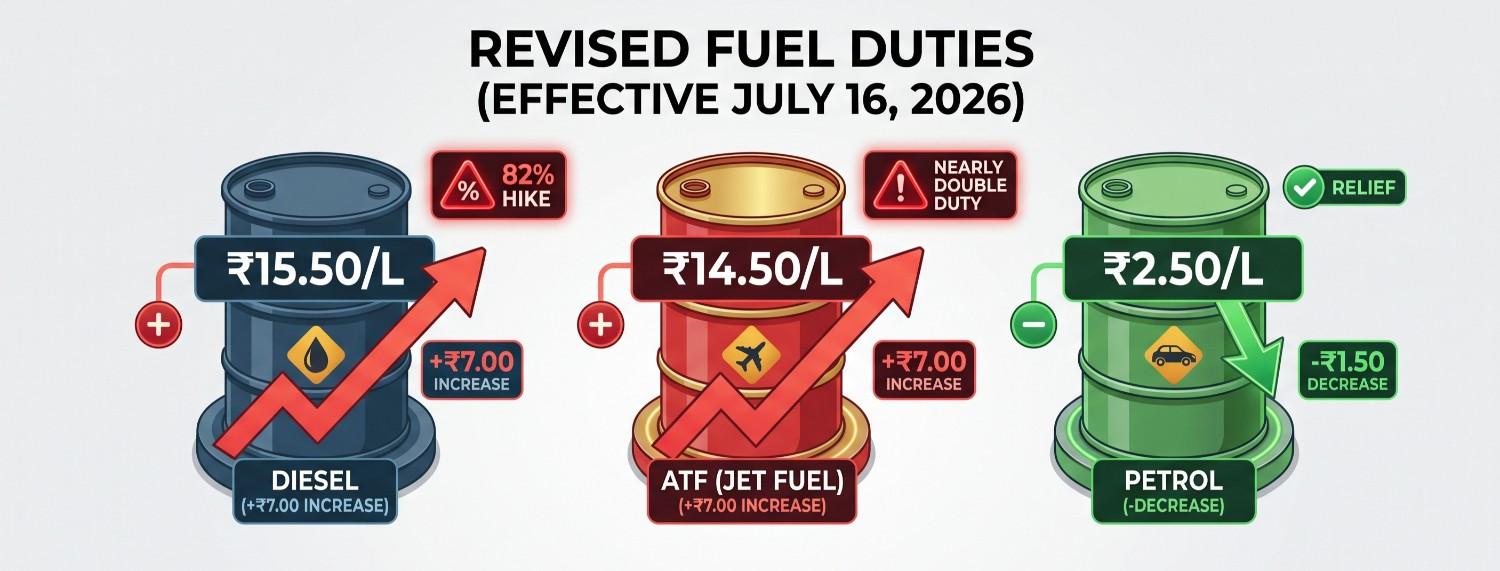
New Delhi: The Indian government has sharply increased the windfall gains tax on the export of diesel and aviation turbine fuel (ATF), while offering relief to petrol exporters in its latest fortnightly review. The revised rates, issued via a Ministry of Finance notification, came into effect on July 16, 2026.
The government clarified that there will be no change to the existing duty rates on petrol and diesel cleared for domestic consumption, shielding domestic motorists and local airlines from the hike.
The New Tax Rates
Under the revised Special Additional Excise Duty (SAED) framework, the duties have been calibrated as follows:
| Petroleum Product | Previous Export Duty | New Export Duty (Effective July 16) | Change |
| Diesel | ₹8.50 per litre | ₹15.50 per litre | Increased by ₹7.00 |
| ATF (Jet Fuel) | ₹7.50 per litre | ₹14.50 per litre | Increased by ₹7.00 |
| Petrol | ₹4.00 per litre | ₹2.50 per litre | Decreased by ₹1.50 |
The adjustments mark an approximate 82% hike for diesel export duties and nearly a doubling of the levy on jet fuel.
Driven by Escalate West Asia Tensions
The decision to steepen export taxes comes amid heightened volatility in global energy markets. Global crude oil prices surged earlier in the week following an escalation of hostilities between the United States and Iran, which included the reinstatement of a naval blockade on all Iranian ports and retaliatory strikes on infrastructure.
Fears of supply disruptions through the critical Strait of Hormuz—a vital passage that handles roughly 20% of global oil flows—pushed international benchmarks higher. Brent crude futures hovered above $85 a barrel, while US West Texas Intermediate (WTI) crude traded around $80 a barrel. Alongside rising crude prices, global diesel refining margins have remained highly elevated due to supply shortages, including reduced Russian exports.
Protecting Domestic Interests
The primary objective behind India’s windfall tax mechanism is two-fold:
- Guarding Domestic Supply: By making fuel exports substantially less lucrative, the government heavily incentivizes private and public refiners to prioritize and secure fuel availability for the domestic Indian market.
- Capping Windfall Gains: The levy prevents oil marketing companies and private refiners from pocketing extraordinary, disproportionate profits arising purely out of geopolitical crises and massive gaps between domestic and international fuel prices.
What is a Windfall Tax?
It is an additional levy imposed by governments when specific industries experience unexpectedly high profits due to external economic factors—such as commodity price spikes—rather than changes to their baseline business operations.
While the sudden ₹7 per litre hike will squeeze international refining margins for major domestic fuel exporters, market analysts note that refiners may still maintain healthy profitability if global product margins stay elevated enough to absorb the new duties. The government will continue to recalibrate these duties every two weeks in line with shifting international prices and refining spreads.