Physical Address
304 North Cardinal St.
Dorchester Center, MA 02124
Physical Address
304 North Cardinal St.
Dorchester Center, MA 02124

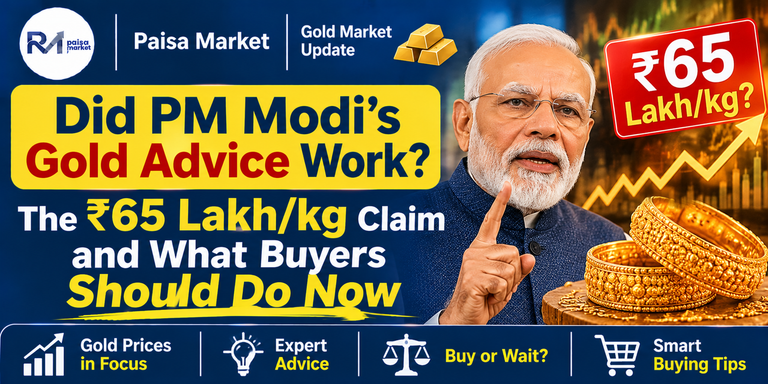
On 22 November 2026 the Chamber of Trade and Industry wrote a formal letter to Prime Minister Narendra Modi thanking him for the appeal he made in May asking citizens to avoid unnecessary gold purchases for a year. The letter claims that the advice helped protect jewellers, traders and ordinary investors from heavy losses after gold prices fell sharply from around ₹1.90 crore per kilogram to roughly ₹1.25 crore per kilogram — a difference of ₹65 lakh per kg. The full text of the letter and CTI’s framing of the ‘saving’ are reported in LiveMint’s coverage of the CTI open letter thanking PM Modi for the gold-purchase advice and the claimed ₹65-lakh-per-kg price drop.
The letter is carefully worded. It does not claim that the Prime Minister single-handedly crashed the international gold market. Instead it focuses on the practical impact on Indian traders who maintain large inventories and on households that postponed purchases.
CTI uses wholesale per-kilogram figures that are commonly tracked by the trade. When the May appeal was made, gold was trading near ₹1.90 crore per kg. By mid-to-late November the same measure had moved down to around ₹1.25 crore per kg. The arithmetic difference is ₹65 lakh per kilogram. Retail buyers usually see prices quoted per 10 grams or per gram, so the numbers look different on a jewellery shop board, but the percentage decline is in the same ballpark. The letter uses the larger unit deliberately because jewellers and wholesale traders think and stock in kilograms.
The calculation itself is simple subtraction. What matters is the implication CTI draws from it. Most jewellery businesses keep inventory covering several months of expected sales. If a trader had bought heavily at the higher May levels and the price then fell, the stock would show a large mark-to-market loss. CTI argues that by restraining fresh purchases after the appeal, many traders avoided locking in that higher cost base. The same logic is extended to small online and offline dealers and to retail investors who stayed away from fresh physical or digital gold buys. The “saving” is therefore framed as avoided loss rather than actual cash profit booked by selling high.
The original May appeal came at a time when crude prices were elevated because of West Asia tensions and when India’s foreign-exchange reserves were under watch. The government also raised the import duty on gold from 6% to 15% around the same period. The combination of higher duty and the public call for restraint was intended to reduce the import bill. CTI notes that the advice was criticised by some at the time as interference in personal financial decisions. The November letter is essentially the trade body saying the criticism looks misplaced in hindsight because prices did fall and inventory losses were avoided by those who held back.
Gold prices did decline substantially between May and November. Establishing how much of that decline can be attributed to one Indian statement is more complicated.
Domestic 24-carat prices that were near ₹15,250 per gram in early May later traded closer to ₹12,500 per gram in several major centres by late November. On a per-kilogram basis this tracks the order of magnitude cited by CTI. The decline was not a straight line; there were periods of volatility, but the overall direction from the May peak was clearly downward. International prices also corrected from the elevated levels seen earlier in the year, confirming that the move was not purely an Indian phenomenon.
Gold is priced in a global market. A firmer US dollar, shifts in expectations about real interest rates, profit-taking after a strong multi-year rally, and changes in central-bank buying and ETF flows all exert powerful influence. These forces were active during the same months. When global prices soften, Indian landed prices and local premiums usually follow, even if domestic demand stays steady. The concurrent rise in India’s import duty added an extra layer of cost that further discouraged imports and local buying.
Reduced Indian demand almost certainly contributed to softer local premiums and to the sharp drop in gold imports (official data showed a decline of nearly 40% in the April–October period). At the same time, the size of the international correction shows that global macro factors were doing heavy lifting. A balanced reading is that the May appeal, the duty increase, and the resulting drop in Indian purchases reinforced a global downtrend rather than creating it in isolation. The statement mattered for domestic behaviour; it did not override the larger market.
Import figures, industry reports of weaker jewellery demand, and the visible price decline are all consistent with softer Indian buying after May. Traders who delayed restocking avoided paying the higher prices that prevailed earlier. In that limited sense the advice aligned with a period of price weakness and protected some balance sheets from inventory losses. The letter’s core observation — that holding back purchases proved beneficial for those who listened — holds up against the price data.
Correlation is not the same as sole causation. Gold had already been volatile, and the international market moved significantly for its own reasons. No public study has isolated the precise contribution of the May appeal versus the duty hike, global dollar strength, or simple mean-reversion after a strong rally. Statements that present the ₹65-lakh-per-kg drop as the direct and exclusive result of one speech overstate what can be cleanly measured. The more accurate description is that the appeal was one of several factors that reduced Indian demand at a time when global prices were already under pressure.
Indian gold demand has always been seasonal and highly sensitive to both price levels and public sentiment. Earlier cycles have shown that tax changes, import restrictions, and high-profile appeals can shift the timing of purchases. They rarely reverse a global trend on their own. The recurring lesson is that concentrated buying at elevated prices creates inventory risk for traders and opportunity-cost risk for households. Spreading purchases across time usually reduces that risk more reliably than trying to time the exact turning point.
Prices are meaningfully lower than the levels seen in May. That fact is useful for anyone planning jewellery purchases in the current wedding window. Families weighing whether to buy now or wait can also refer to the practical framework we laid out earlier in Should You Buy Gold Before Dhanteras 2026 – the smart checklist covering price outlook, jewellery vs digital gold/ETF choices and total-cost considerations.
Families who postponed buying are now looking at rates that are substantially softer than the May peaks. For the same budget they can either buy more weight or spend less for the same weight. The absolute level still feels high by longer-term historical standards, but relative to the recent peak the correction is real and material.
There is no single correct answer because every family’s situation is different. If the gold is required for a wedding that is only weeks away, current prices are more favourable than May prices and waiting for a further sharp drop is a gamble that may not pay off. If the purchase is more flexible or is intended purely as an investment, spreading the buys over several weeks or months still makes sense. Trying to catch the absolute bottom is rarely successful and often leads to either missing the purchase window or buying in a rush later at higher prices.
Compare making charges and wastage percentages across jewellers; these costs often matter more than small daily movements in the pure gold rate. Insist on hallmarked gold and a clear, detailed invoice. Decide the purpose first — jewellery for wearing and gifting has different economics from pure investment exposure. For the investment portion, digital gold, gold ETFs or Sovereign Gold Bonds may be cleaner vehicles than high-making-charge jewellery. Finally, avoid stretching the household budget simply because prices have corrected. The goal is to meet a genuine need at a reasonable total cost, not to “catch the bottom.”
Gold in India is rarely just a commodity. It functions as savings, status marker, wedding essential and cultural symbol at the same time. That emotional weight makes households unusually sensitive to both sharp price rises and high-profile public messaging. It also makes the market prone to herd behaviour on the way up and on the way down.
Public appeals can influence behaviour, and in a market as large as India’s they can affect local demand, premiums and import volumes. They do not, however, override global supply-demand balances, currency moves or interest-rate expectations. Treating any single statement as a complete market-timing tool is risky. The more useful approach is to treat such advice as one input among several and to anchor decisions in personal need and total cost.
The practical framework is straightforward. Separate the genuine need (an upcoming wedding, a planned gift, long-term holding) from the surrounding noise. Buy when the need is clear and the all-in price looks reasonable relative to recent history. Avoid both panic buying at peaks and endless waiting for a perfect bottom that may never arrive in the exact form expected.
According to the figures used by CTI, the per-kilogram price moved from around ₹1.90 crore to around ₹1.25 crore, a difference of ₹65 lakh per kg. Retail quotes expressed per gram or per 10 grams show a substantial decline over the same period, though the exact percentage varies slightly by centre and purity.
It almost certainly contributed to weaker domestic demand and lower imports. Global factors, the simultaneous increase in import duty, and profit-taking after a strong earlier rally were also major drivers. The statement was one important influence among several; it was not the sole cause of the decline.
Yes. Both the trade-body per-kilogram figures and retail per-gram quotes are meaningfully lower than the levels seen around the time of the May appeal.
A rush is unnecessary, but current prices are more favourable than the May peaks. Families with fixed wedding dates can take advantage of the correction while still comparing making charges carefully and avoiding any temptation to over-buy simply because the price has come down.
It demonstrates that delaying purchases during a period of elevated prices protected some traders from inventory losses. For ordinary households the practical lesson is similar: timing and genuine need matter. The letter does not prove that one statement can permanently control a global market, but it does show that restraining purchases at high levels can limit downside when prices later correct.
The CTI letter correctly records a large decline in gold prices since the May appeal and credits the Prime Minister’s advice with helping traders avoid losses on inventory. The price drop itself is not in dispute. The stronger claim that the statement alone produced a ₹65-lakh-per-kg fall overstates what can be isolated from global market forces and the concurrent duty increase. For ordinary buyers the useful takeaway is simpler and more practical. Prices are lower than they were at the peak. Wedding-season demand is still present. The best decisions continue to rest on personal need, total cost including making charges, and a refusal to chase either the fear of missing out or the hope of catching an exact bottom. Buy what you need at a price you can justify, treat public advice as one input among many, and keep the focus on the household balance sheet rather than on trying to prove or disprove any single narrative about what moved the market.