 contact.paisamarket@gmail.com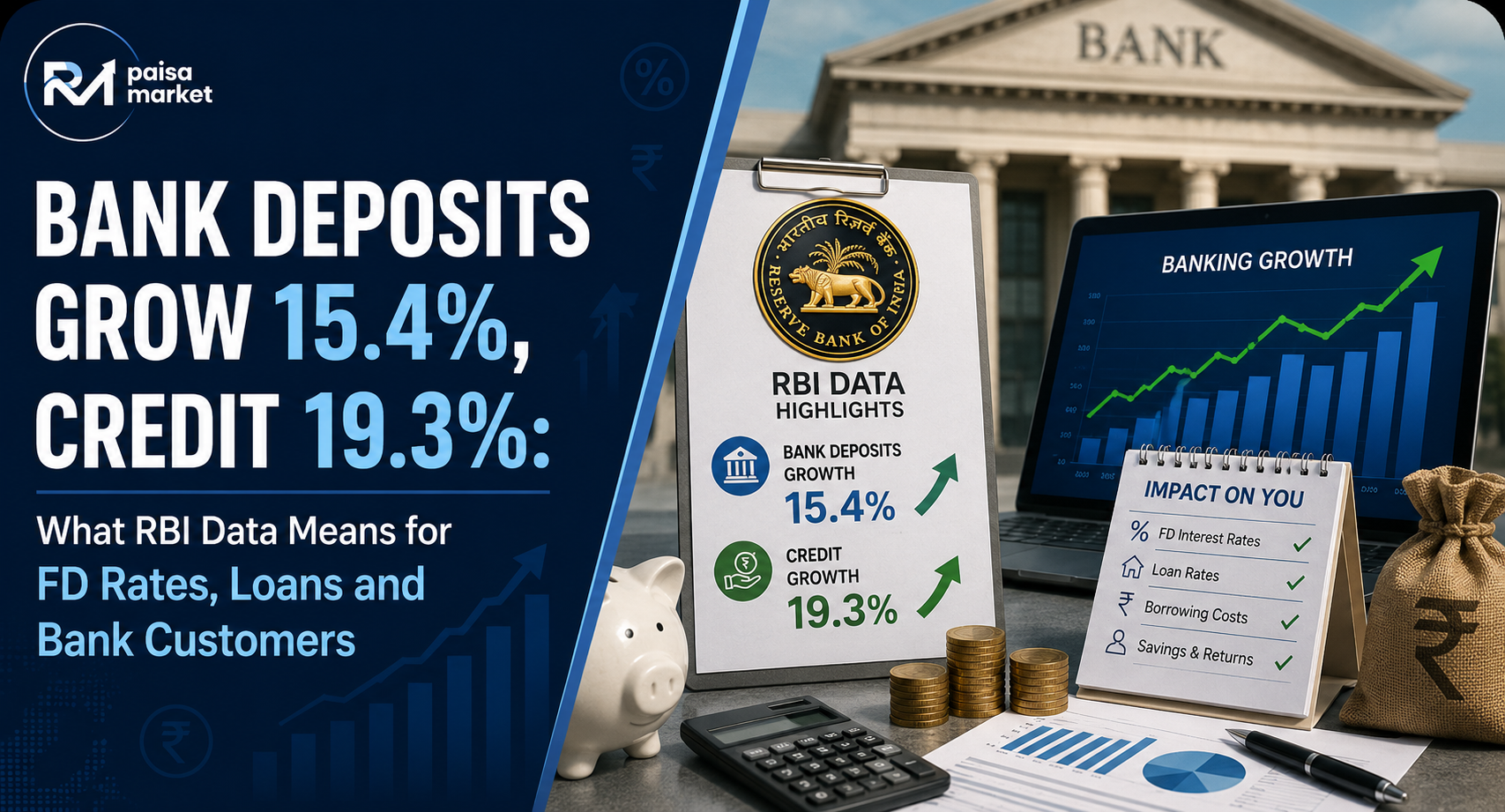
India’s banking system is seeing strong growth on both sides of its balance sheet. Bank deposits grew 15.4% year-on-year to ₹269.41 lakh crore as of July 31, 2026, while bank credit grew 19.3% to ₹220.78 lakh crore, according to the latest RBI data.
Confirmed RBI data: As of July 31, 2026, bank deposits stood at ₹269.41 lakh crore and grew 15.4% year-on-year. Bank credit stood at ₹220.78 lakh crore and grew 19.3% year-on-year. Credit growth therefore remained 3.9 percentage points higher than deposit growth.
What this means: Faster credit growth could keep banks competing for deposits, but the latest data does not by itself determine whether FD rates or loan rates will rise or fall.
The deposit growth is particularly notable because it was the highest since December 2016. At the same time, credit growth accelerated sharply from 17.7% two weeks earlier.
For ordinary bank customers, these numbers matter because they can influence FD rates, loan pricing, deposit competition and banks’ willingness to lend.
RBI Bank Deposit and Credit Data: Key Numbers
| Indicator | July 31, 2026 | Previous fortnight |
|---|---|---|
| Bank deposits | ₹269.41 lakh crore | ₹262.81 lakh crore |
| Deposit growth | 15.4% YoY | 12.7% YoY |
| Bank credit | ₹220.78 lakh crore | ₹217.33 lakh crore |
| Credit growth | 19.3% YoY | 17.7% YoY |
| Deposit increase during fortnight | ₹6.61 lakh crore | — |
| Credit increase during fortnight | ₹3.43 lakh crore | — |
The figures show that both deposits and loans picked up considerably during the fortnight ended July 31.
But there is an important difference: credit is still growing faster than deposits.
Why 15.4% Deposit Growth Matters
Bank deposits grew 15.4% from a year earlier, compared with 12.7% as of July 15.
That is a significant acceleration.
In fact, the latest growth rate was the highest since December 2016. Deposits increased by about ₹6.61 lakh crore in just one fortnight, taking the overall deposit base to ₹269.41 lakh crore.
A large part of the fortnightly increase came from time deposits.
Time deposits increased by around ₹4.21 lakh crore, while demand deposits rose by about ₹2.40 lakh crore.
Why did deposits rise so sharply?
One important factor was the RBI’s special facility for attracting foreign-currency deposits through FCNR(B) deposits.
Banks had mobilised substantial foreign-currency deposits under the facility by July 31. This provided an additional boost to the banking system’s deposit base.
That means the 15.4% number should not automatically be interpreted as a sudden permanent change in household savings behaviour.
The bigger question is whether deposit growth remains strong after this special inflow-related boost fades.
Bank Credit Growth Accelerates to 19.3%
While deposits were rising, bank lending was growing even faster.
Bank credit increased 19.3% year-on-year as of July 31, compared with 17.7% two weeks earlier.
Credit outstanding reached approximately ₹220.78 lakh crore, up around ₹3.43 lakh crore during the fortnight.
This was the strongest credit growth reported since May 2024.
For banks, strong credit demand is generally positive because lending is a major source of interest income.
But rapid loan growth also creates a funding question:
Are banks getting deposits quickly enough to support that lending?
The Deposit-Credit Gap Is Narrowing
Credit growth was still ahead of deposit growth, but the gap became smaller.
As of July 31:
- Deposit growth: 15.4%
- Credit growth: 19.3%
- Difference: 3.9 percentage points
Two weeks earlier, the gap was around 5 percentage points.
That narrowing is important.
If loans grow much faster than deposits for a prolonged period, banks may need to compete harder for deposits or rely more on other sources of funding.
The latest numbers suggest that the funding situation has improved, although credit demand remains very strong.
What Does This Mean for FD Rates?
This is one of the biggest questions for savers.
At first glance, strong deposit growth could reduce the pressure on banks to raise FD rates because banks are attracting more funds.
But the picture is not that simple.
Banks still need deposits to fund their growing loan books. If credit continues to expand faster than deposits, competition for stable deposits can remain strong.
That can support attractive FD rates at some banks.
Should FD investors expect rates to rise?
Not necessarily.
A rise in bank deposits does not automatically mean FD rates will increase or decrease.
Banks consider several factors, including:
- Loan demand
- Deposit growth
- Liquidity conditions
- Competition from other banks
- Funding costs
- Credit-deposit ratios
- RBI monetary policy
- Their own need for stable deposits
So, if you are considering an FD, it is better to compare the rates offered by individual banks rather than assume that RBI data will produce an immediate change in FD rates.
What about existing FDs?
If you already have a fixed-rate FD, the contracted interest rate generally remains unchanged until maturity.
The bigger issue for existing FD investors is what rate will be available when the deposit matures.
If banks reduce rates later, reinvestment could happen at a lower rate. If competition for deposits remains strong, attractive rates could continue to be available.
What Does This Mean for Home Loans?
The latest deposit and credit data does not automatically change your home-loan EMI.
Your EMI depends on your loan’s interest rate, benchmark, reset mechanism and remaining tenure.
For floating-rate borrowers, the bigger factors are RBI policy decisions and how lenders subsequently adjust their lending rates.
The latest credit-growth numbers do, however, show that demand for borrowing remains strong.
That is relevant for banks because strong loan demand can support lending income.
Could loan rates rise?
The RBI data alone does not mean that home-loan rates will rise.
Loan rates can be influenced by:
- RBI repo-rate decisions
- Bank funding costs
- External benchmark rates
- Lending competition
- Liquidity conditions
- Individual lender pricing
So borrowers should not assume that a change in deposit or credit growth automatically means their EMI will change.
Loan rates are also influenced by the RBI’s monetary policy decisions, so borrowers should keep an eye on the RBI repo rate alongside bank-level interest-rate changes.
What About Personal Loans?
The same basic principle applies to personal loans.
If your loan is floating-rate, the applicable interest rate can change when the lender revises its rate according to the loan’s terms.
If it is fixed-rate, the rate generally remains unchanged according to the contractual arrangement.
However, strong credit demand can be relevant for new borrowers because banks may adjust pricing depending on risk, funding costs and competition.
Personal-loan rates are also generally higher than home-loan rates, so even a small change in borrowing costs can matter more for the total interest paid.
Why Strong Credit Growth Is Important for Banks
For banks, loan growth is an important part of the earnings story.
If credit grows 19.3%, banks are extending substantially more loans than they were a year earlier.
That can support interest income.
But banks also need to watch the cost of funding those loans.
This is where deposits become important.
A simplified way to look at it is:
Deposits provide funding → banks use that funding to lend → loans generate interest income.
If loan growth consistently runs ahead of deposit growth, banks may need to work harder to attract deposits.
That could mean greater competition for savings and term deposits.
Is Strong Deposit Growth Good for Bank Customers?
It can be positive, but the impact depends on whether you are a borrower or a saver.
For depositors
Strong competition for deposits can help customers if banks offer attractive FD or savings rates to attract funds.
However, the latest jump in deposits was partly influenced by foreign-currency deposit mobilisation, so it would be premature to assume that all of the increase represents stronger domestic household deposits.
For borrowers
Strong credit growth indicates that loan demand remains healthy.
But it does not automatically mean cheaper loans.
Borrowers should continue to track the interest rate offered by their lender, the benchmark used and the reset mechanism.
For banks
The combination of stronger deposits and strong credit growth can improve funding conditions while supporting loan growth.
The key question is whether deposit growth can remain strong enough as credit demand continues.
Why the FCNR(B) Factor Matters
One unusual feature of the latest deposit data is the contribution from foreign-currency deposits.
The RBI had introduced a special FCNR(B) deposit facility to encourage fresh foreign-currency deposits with eligible maturities.
Banks attracted significant funds through the facility.
This helped increase the deposit base.
That is important when interpreting the headline 15.4% growth figure.
It does not necessarily mean Indian households suddenly moved a huge amount of money into traditional bank deposits.
Some of the increase came from a specific policy-driven source.
That is why the next few rounds of deposit data will be useful.
If deposit growth remains strong even after the special foreign-currency inflows fade, it would provide a stronger indication that banks’ underlying deposit mobilisation has improved.
What the Numbers Mean for the Banking Sector
The latest data gives banks a mixed but broadly positive picture.
Positive signals
- Deposit growth has accelerated sharply.
- Credit growth is at a multi-year high.
- The deposit-credit growth gap has narrowed.
- Banks have more funding available to support lending.
- Strong credit demand can support interest income.
Things to watch
- Whether deposit growth remains strong.
- Whether credit continues growing near 19%.
- Competition for retail deposits.
- Banks’ funding costs.
- Loan demand in the coming months.
- Asset quality as credit expands.
- The effect of the end of the special FCNR(B) mobilisation period.
Does This Mean FD Rates Will Fall?
Not necessarily.
This is an easy conclusion to make from the deposit-growth number, but the data does not support such a direct link.
If banks receive more deposits than they need, they may have less reason to offer very high deposit rates.
But if loan demand remains strong and banks need additional funding, they may continue competing for deposits.
Therefore, deposit growth alone cannot predict the direction of FD rates.
For customers, the practical approach is simple: compare current rates across banks and check the maturity period, premature-withdrawal rules and applicable tax treatment before investing.
Does This Mean Loan Rates Will Rise?
Again, not automatically.
The latest RBI data shows strong credit demand, but a bank does not change your loan rate simply because credit growth reaches 19.3%.
For existing borrowers, the important questions are:
- Is your loan fixed or floating?
- What benchmark is it linked to?
- When is the next reset date?
- What spread does the lender charge?
- How would a future rate change affect your EMI or tenure?
Those details matter more to your actual EMI than the headline credit-growth number.
What Should Bank Customers Do Now?
You do not need to make a financial decision simply because the latest RBI data looks strong.
But it is a good time to review your banking arrangements.
If you have an FD
Compare your current maturity rate with what other banks are offering.
If your FD is maturing soon, check the latest rates rather than automatically renewing it with the same bank.
If you have a home loan
Check your latest interest rate and upcoming reset date.
If your loan is floating-rate, understand which benchmark determines the rate.
If you are planning a new loan
Compare the total borrowing cost, not just the advertised interest rate.
Look at processing fees, reset terms, prepayment conditions and other charges.
If you are keeping large savings in a bank
Check whether your money is spread appropriately across accounts and maturities.
Do not choose a bank solely because it offers the highest FD rate. Consider the bank’s terms, penalties and overall suitability as well.
RBI Bank Data: What to Watch Next
The next few data points will tell us whether the latest jump is sustainable.
1. Deposit growth
Will deposits continue growing at double-digit rates after the special foreign-currency inflows fade?
2. Credit growth
Will bank lending remain close to 19%, or will demand moderate?
3. Deposit-credit gap
A further narrowing would suggest that banks are improving their funding position relative to loan growth.
4. FD rates
Watch whether banks change their term-deposit rates as funding conditions evolve.
5. Loan rates
Borrowers should track lender-level changes rather than reacting to every RBI data release.
6. Bank profitability
The combination of credit growth, deposit costs and asset quality will ultimately matter for bank earnings.
RBI Bank Deposits and Credit: The Bigger Picture
The latest numbers tell a simple story.
People and institutions are putting more money into banks, while borrowers are demanding even more credit.
Deposits reached ₹269.41 lakh crore and grew 15.4% year-on-year. Credit reached ₹220.78 lakh crore and grew 19.3%.
That is a strong combination for the banking sector, but it also creates a funding challenge because loans are still growing faster than deposits.
The deposit growth acceleration is encouraging, but part of the recent jump was linked to foreign-currency deposit mobilisation. The coming months will show whether the improvement is broad-based and sustainable.
Frequently Asked Questions
What is India’s bank deposit growth rate as of July 31, 2026?
Bank deposits grew 15.4% year-on-year as of July 31, 2026, according to RBI data.
How much were bank deposits worth on July 31, 2026?
The deposit base stood at approximately ₹269.41 lakh crore.
What is India’s bank credit growth rate?
Bank credit grew 19.3% year-on-year as of July 31, 2026.
How much bank credit was outstanding?
Bank credit stood at approximately ₹220.78 lakh crore on July 31, 2026.
Will FD rates rise because deposits grew 15.4%?
Not automatically. FD rates depend on banks’ funding needs, loan demand, liquidity and competition. Individual banks can change deposit rates independently.
Will home-loan EMIs increase because credit growth reached 19.3%?
No. Credit growth does not automatically change an existing EMI. Any change depends on the loan’s interest-rate structure and lender revision.
Is strong deposit growth good for banks?
Generally, stronger deposits can improve banks’ funding position. However, banks also need to manage deposit costs, credit quality and the pace of loan growth.
Why did bank deposits increase sharply?
The latest increase was partly supported by mobilisation of foreign-currency deposits through the RBI’s special FCNR(B) facility, alongside growth in other deposits.
Bottom Line
India’s banks are seeing strong growth in both deposits and lending.
Deposits grew 15.4% to ₹269.41 lakh crore, while credit grew 19.3% to ₹220.78 lakh crore as of July 31, 2026.
For savers, the data means banks continue to have a strong reason to attract deposits, but it does not guarantee higher FD rates.
For borrowers, strong credit growth does not automatically mean higher EMIs. Your actual borrowing cost depends on your lender, loan benchmark, interest rate and reset terms.
The most important number to watch now may be whether deposit growth stays strong after the temporary boost from foreign-currency deposit mobilisation fades.
Sources
- Reserve Bank of India — scheduled commercial bank deposit and credit data for the fortnight ended July 31, 2026.
- Business Standard — RBI data analysis on bank deposit and credit growth.
- Informist — RBI banking data and fortnightly comparison.
- SBI Research — analysis of deposit mobilisation and credit growth.